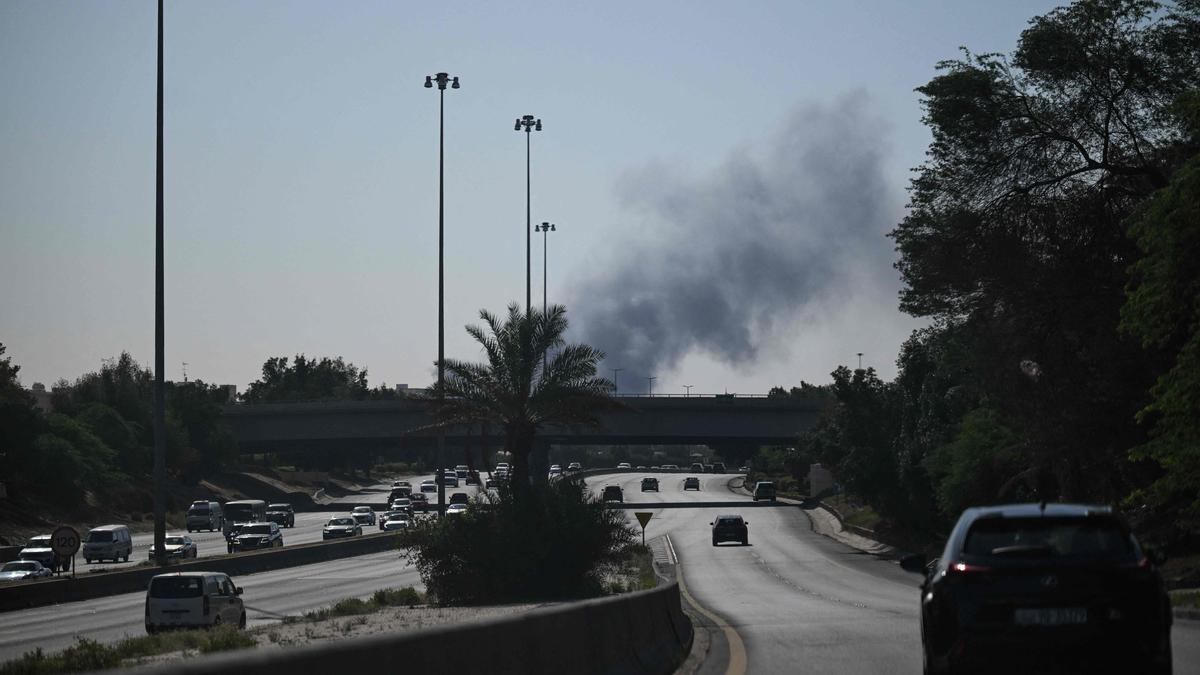
An American F-15SA Eagle just went down in the sands of Kuwait. It wasn't shot down by an enemy. It didn't clip a mountain in a storm. It crashed during a routine training mission near Ahmad al-Jaber Air Base. While both pilots luckily managed to eject and survived, the loss of a $100 million-plus airframe isn't just a line item on a budget report. It's a flashing red light about the sheer physical toll we're putting on these machines and the crews that fly them in the Middle East.
If you’ve been following military aviation lately, you know these headlines are becoming a bit too common. We're seeing a trend where the hardware is being pushed to its absolute limit in environments that are basically giant sandpaper grinders. When an F-15 crashes over Kuwait, it forces us to look at the reality of maintaining a presence in a region that's as politically volatile as it is environmentally harsh.
The Mechanics of a High-Stakes Failure
We don't have the final accident investigation board results yet. Those usually take months of sifting through black boxes and charred titanium. However, anyone who has spent time on a flight line in the Persian Gulf knows the primary suspect is almost always the environment or the intense operational tempo.
The F-15SA is a beast. It’s the "Saudi Advanced" variant, one of the most capable versions of the Eagle ever built, featuring digital fly-by-wire systems and powerful APG-63(V)3 Active Electronically Scanned Array (AESA) radar. But even the best tech struggles against fine silicate dust. This stuff doesn't just sit on the wings. It gets into the engine turbines, coats the cooling vents of the avionics suites, and acts as an abrasive on every moving part.
When a jet goes down during a "routine" flight, it’s usually because something small failed in a big way. Maybe a sensor gave a false reading because of heat soak. Maybe a hydraulic line developed a microscopic leak that the ground crew couldn't see in the 120-degree heat of a Kuwaiti afternoon. These aren't just planes; they're incredibly complex ecosystems of math and metal. When one part of that ecosystem fails at 500 knots, the window to fix it is measured in heartbeats.
Training for a War That Never Pauses
People often ask why we’re even flying these missions in Kuwait. It’s simple. We aren't just there for show. Ahmad al-Jaber Air Base is a critical hub for U.S. Air Forces Central (AFCENT). The training missions flown there are designed to keep pilots sharp for everything from intercepting drones to conducting precision strikes against insurgent groups.
The problem is that training for a "hot" war means flying the jets like you’re already in one. High-G maneuvers, low-altitude sprints, and constant takeoffs and landings. This isn't a Sunday drive. Every hour an F-15 spends in the air requires dozens of hours of maintenance on the ground. When the tempo stays high for years on end, the "maintenance debt" starts to come due. We saw it with the F-18 fleet a few years back, and we're seeing the strain on the Eagle fleet now.
The pilots in this specific incident survived because the ejection seats worked perfectly. That’s the silver lining. But a pilot who has to punch out of a jet is a pilot who is out of the cockpit for a significant amount of time while they undergo medical and psychological evaluations. You don't just lose a plane; you temporarily lose the human capital that makes the plane dangerous.
The Regional Domino Effect
Kuwait is a cornerstone of American strategy in the Gulf. It's stable, it's pro-West, and it provides a geographic middle ground between Iraq, Iran, and Saudi Arabia. An F-15 crash here is a PR headache, but it’s also a logistical nightmare.
- Security Cordons: Whenever a jet carrying sensitive tech crashes, the first priority is a "cordon and recover" operation. We can't let AESA radar components or encrypted radio hardware sit in the desert for anyone to find.
- Safety Stands: Usually, after a crash like this, the local wing might call a "safety stand-down." This means every jet stays on the ground until they can prove the crash wasn't caused by a systemic mechanical flaw that might affect the rest of the fleet.
- Partner Confidence: We sell these jets to our allies. When one of our own goes down, it raises questions in Riyadh and Doha about the long-term reliability of the platforms they just spent billions on.
What This Means for the Future of the Eagle
The F-15 has been the king of the skies since the 1970s. It has an unmatched air-to-air combat record. But the airframes are getting tired. Even with the newer "SA" and "EX" models coming off the line, the older "C" and "D" models are literally structural fatigue nightmares.
This crash in Kuwait should be a signal to the Pentagon that we can't keep patching up 40-year-old designs and expecting them to handle the rigors of 21st-century warfare in a desert. We need to accelerate the transition to the F-15EX Eagle II or start moving more fifth-generation assets into the theater.
The F-15SA is supposed to be the bridge to the future, but if the bridge is crumbling under the weight of daily operations, we’re in trouble. The pilots did their job—they kept the plane away from populated areas and got out alive. Now the bureaucrats and engineers need to do theirs.
Immediate Realities on the Ground
If you're looking for the "why" behind this incident, don't wait for a single smoking gun. It’s almost always a chain of events. A tired mechanic, a dusty sensor, a split-second delay in a computer's response.
The U.S. military isn't going to leave Kuwait because of one crash. If anything, they'll double down on training to prove the mishap was an outlier. But for the crews on the ground at Ahmad al-Jaber, the next few weeks are going to be miserable. They’ll be tearing down engines, checking every bolt, and trying to find a needle in a haystack of scorched metal.
If you want to understand the true cost of American power in the Middle East, don't look at the gas prices. Look at the wreckage in the Kuwaiti scrubland. That’s the real price of maintaining the "edge."
Check the official AFCENT press releases over the next 48 hours for updates on the pilots' conditions. Follow the safety investigation board's preliminary findings if they're made public, as these often hint at whether the entire fleet needs a software patch or a structural overhaul. Keep an eye on the flight sorties out of Kuwait; if they don't resume within 72 hours, the problem is likely much bigger than a single engine flameout. Use this as a moment to realize that air superiority isn't a permanent state—it's a fragile, expensive, and dangerous daily effort.