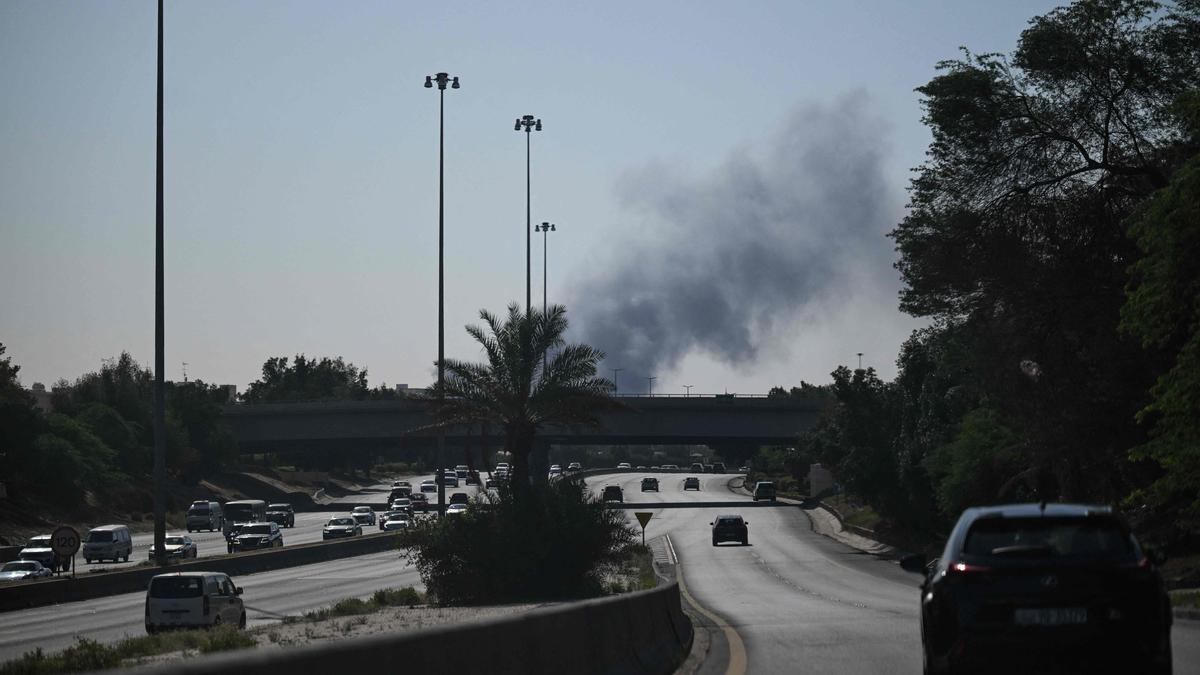
The desert is not silent. It hums with a low, vibrating heat that tricks the eyes and rattles the teeth. In the cockpit of an F-15E Strike Eagle, that heat is a distant memory, replaced by the sterile, pressurized hum of a machine worth more than the lives of everyone in a small Midwestern town.
When the news broke that three of these apex predators had crumpled into the sands of Kuwait, the initial reports were as cold as the titanium frames. Mechanical failure, perhaps. A freak weather event. Pilot error. The official Pentagon briefings used words like "attrition" and "mishap." They spoke of hardware and trajectory.
But they missed the soul of the tragedy.
To understand why forty-five tons of American air power fell out of the sky, you have to look past the wreckage. You have to look at the terrifying fragility of human communication when it is filtered through miles of wire and the fog of war. These weren't accidents born of gravity. They were accidents born of a misunderstanding.
The Invisible Tether
A fighter pilot is never truly alone. They are the tip of a spear, yes, but that spear is held by a thousand hands back on the ground. There is the AWACS controller watching a glowing green sweep, the ground-based radar operator, and the radio chatter that serves as the only umbilical cord to reality.
In the high-stress environment of a combat zone, that umbilical cord can fray. Imagine being strapped into a seat that can move at twice the speed of sound. Your world is a series of green glowing symbols and a HUD that tells you where to kill and where to die. You trust the voice in your ear. You have to. If that voice tells you that the path is clear, or that a target is hostile, you don't have the luxury of a second opinion.
The U.S. military eventually admitted the truth: "Friendly fire."
It is a phrase that tastes like ash. In this specific catastrophe, it wasn't a missile from a wingman or a stray anti-aircraft round from a confused ally. It was a digital ghost. The systems meant to keep these pilots safe—the very technology designed to distinguish friend from foe—betrayed them.
The Physics of a Mistake
Let's look at the mechanics of the F-15E. It is a masterpiece of engineering. It can carry 23,000 pounds of ordnance. It is designed to dominate the sky.
When three of these jets crashed, it wasn't because the engines stopped turning. It was because the pilots were led into a trap of their own making. Think of a driver following a GPS blindly into a lake because the screen said there was a bridge. Now, multiply that speed by ten and add the pressure of a theater of operations where every blink could be your last.
The electronic identifiers—the "Identify Friend or Foe" (IFF) systems—are supposed to be foolproof. They are the secret handshake of the sky. One jet sends a coded pulse; the other sends a coded reply. If the math checks out, you’re brothers. If it doesn't, you’re a target.
In Kuwait, the handshake failed. The data wasn't just wrong; it was catastrophically misleading. The pilots, acting on the information they were given by ground controllers and their own instruments, found themselves in a position where the ground became the enemy. They weren't shot down by a surface-to-air missile. They were shot down by a flaw in the logic of their own mission.
The Weight of the Helmet
We often treat pilots like extensions of the machine. We talk about "assets" and "platforms." We forget that inside that $100 million bird is a person with a heart rate of 160 beats per minute, sweating through a flight suit, trying to process a million bits of data per second.
When a jet goes down due to friendly fire, the trauma ripples. It isn't just a loss of hardware. It’s a crisis of faith. How do you climb back into that cockpit the next day? How do you trust the voice on the radio when you know that same voice just sent three of your friends into the dirt?
The "friendly fire" label is a clinical way of describing a horrific betrayal of the senses. It suggests that the danger came from within the circle of trust. It means the system broke at the most fundamental level.
The Logic of the Unthinkable
The investigation into the Kuwait crashes revealed a terrifying truth about modern warfare: the more complex we make our systems, the more spectacular our failures become. We build layers of redundancy. We add sensors to monitor sensors. We create algorithms to filter out human error.
Yet, human error is a shapeshifter.
It hides in the coding. It lurks in the way a controller interprets a fuzzy signal on a rainy Tuesday. It lives in the gap between what a computer sees and what a human understands.
Consider the sequence of events. A command is given. A coordinate is entered. A pilot, trained to obey and execute with surgical precision, follows the line on the screen. There is no room for a "gut feeling" at Mach 1.5. You follow the data. If the data is poisoned by a system glitch or a misinterpreted signal, the pilot becomes a passenger in their own demise.
The jets didn't just crash. They were steered into the ground by the very hands meant to guide them home.
The Cost of the Silence
The military is an institution built on the idea of the "After Action Report." Everything is quantified. Every fuel burn, every mile logged, every bolt tightened is recorded. But you cannot quantify the silence that follows a friendly fire incident.
When the F-15Es hit the sand, the immediate reaction was to protect the narrative. Information was metered out in tiny, controlled drops. The truth—that our own coordination was the culprit—came out only after the dust had literally settled.
This isn't just about three airplanes. It’s about the terrifying reality that in our quest for total technological dominance, we have created a environment where we can no longer distinguish the signal from the noise. We have automated the most dangerous parts of our lives, and in doing so, we have made the consequences of a simple typo or a misaligned radar dish fatal.
The desert in Kuwait is a graveyard for more than just metal. It is a reminder that the most sophisticated weapon on earth is still tethered to the fallibility of the people operating it.
We want to believe that war is a science. We want to believe that if we just have enough data, enough sensors, and enough "smart" technology, we can eliminate the chaos. But the chaos is built into us. It’s in the way our voices crack under pressure and the way our eyes see things that aren't there when we're tired.
Three F-15Es are gone. They are scrap metal and memories now. The official record will show a series of technical failures and communication breakdowns. It will be filed away in a cabinet in a windowless room in Virginia.
The ghosts of those machines still haunt the frequencies. They serve as a warning to every pilot who hooks their oxygen mask into place and every controller who sits down before a flickering screen. The machine is fast. The machine is powerful. The machine is deadly.
But the machine is also blind, and sometimes, it doesn't know who its friends are.
The sand eventually covers everything. The scorched earth where the engines hit becomes indistinguishable from the rest of the dunes. The only thing that remains is the chilling realization that the greatest threat in the sky wasn't the enemy hiding in the clouds, but the voice coming from home.