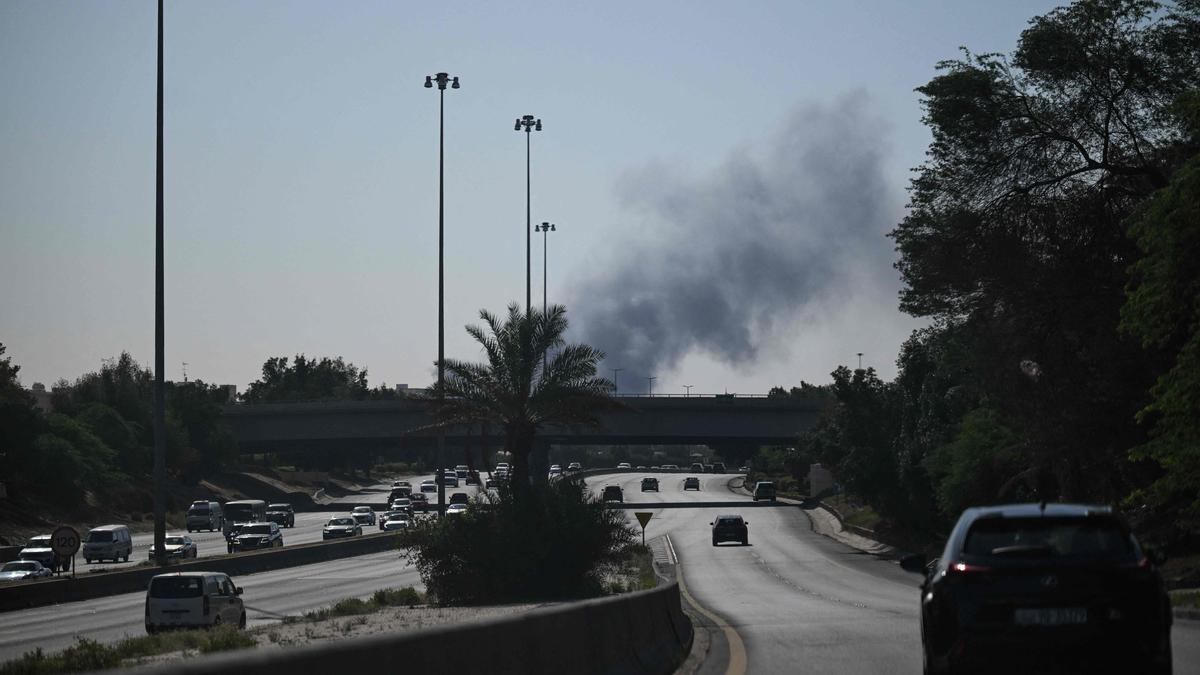
The threshold for regional war in West Asia was not crossed with a single declaration, but through a calculated, high-velocity sequence of kinetic strikes. For decades, the shadow war between the U.S.-Israeli partnership and the Iranian-led "Axis of Resistance" operated under a set of unwritten rules. Both sides understood where the "red lines" lived. Those lines have been erased. The joint operations currently unfolding against Iranian infrastructure represent a fundamental shift from deterrence to active dismantling. This is no longer about sending a message; it is about degrading the physical capacity of a sovereign state to project power beyond its borders.
While early reports focused on the visual spectacle of missile interceptions over Tel Aviv or Tehran, the structural reality is far more grim. We are witnessing the first large-scale application of integrated, multi-domain warfare in a theater crowded with civilian infrastructure and global energy arteries. The primary objective of the current U.S.-Israeli offensive is the neutralization of Iran’s integrated air defense systems (IADS) and its domestic ballistic missile production facilities. By stripping away these layers, the coalition seeks to create a "permissive environment" for sustained long-range operations. Meanwhile, you can explore related stories here: The Cold Truth About Russias Crumbling Power Grid.
The Technical Breakdown of the Offensive
Military analysts often mistake volume for effectiveness. However, the current campaign relies on precision-guided munitions (PGMs) and electronic warfare (EW) suites that have turned Iranian radar arrays into liabilities. The U.S. contribution, largely centering on the deployment of F-22 Raptors and B-2 Spirit bombers, provides the stealth overhead required to bypass the Russian-made S-300 batteries that Tehran once considered its ultimate shield.
The Israeli Air Force (IAF) has taken the lead on the tactical level. Using F-35 "Adir" variants, they have targeted specific "hardened" sites. These are not just bunkers. They are sprawling underground complexes where the Islamic Revolutionary Guard Corps (IRGC) houses the assembly lines for the Fattah-1 and Kheibar Shekan missiles. To reach these depths, the operation utilizes specialized bunker-buster munitions, likely the GBU-57 or updated versions of the GBU-72. To understand the complete picture, we recommend the detailed analysis by USA Today.
The math of this conflict is unforgiving. If Iran loses 40% of its radar coverage in the first 72 hours, its ability to coordinate a retaliatory swarm of "Shahed" drones becomes nearly impossible. Drones require guidance and relay. Without the nodes, they are merely expensive kites.
The Intelligence Failure and the Pivot
We must address why this is happening now. For two years, the prevailing wisdom in Washington was that Iran could be "contained" through regional integration and back-channel diplomacy. That premise collapsed. The failure to predict the scale of proxy activity in the Red Sea and the Levant forced a re-evaluation of the "long game."
Intelligence gathered over the last six months suggests that Iran was significantly closer to a "breakout" capability regarding its nuclear program than previously admitted. The joint strikes are, in many ways, a preemptive strike against a clock that was ticking louder than the public was told. It is an open secret in intelligence circles that the International Atomic Energy Agency (IAEA) had lost visibility on several key centrifuge sites. When diplomacy loses its eyes, the military takes over.
The Energy Fragility Factor
The global economy remains the hostage in this room. The Strait of Hormuz is a narrow throat through which 20% of the world’s petroleum flows. Iran has long threatened to "close the tap" if attacked. This is the ultimate "Samson Option."
However, the U.S. Fifth Fleet has shifted its posture. Instead of mere patrolling, it has moved into an active interdiction phase. By deploying unmanned surface vessels (USVs) equipped with advanced sensors, the U.S. is attempting to map the Iranian mine-laying capabilities in real-time. This is a high-stakes gamble. If even one supertanker is hit, insurance premiums for global shipping will skyrocket, triggering a cascade of inflation that will hit gas stations in Ohio and factories in Guangdong within the week.
The market has not yet fully priced in the potential for a total shutdown of the Abadan refinery or the Kharg Island terminal. If these sites become targets, the "War in West Asia" stops being a regional headline and starts being a global depression.
The Proxy Dilemma and the Third Front
You cannot hit the head of the snake without expecting the tail to thrash. Hezbollah in Lebanon, the Houthis in Yemen, and various militias in Iraq and Syria form a network designed specifically for this moment. They are the "attrition force."
While Israel and the U.S. focus on Iranian soil, these groups are tasked with overstretching the Iron Dome and the Aegis Ashore systems. The goal is simple: exhaustion. By firing low-cost rockets and drones in massive quantities, they force the defenders to spend multi-million dollar interceptors on $20,000 targets. It is a war of economic attrition disguised as a religious crusade.
The "Third Front" is the domestic one. Cyber warfare is currently being deployed against Israeli civilian infrastructure—power grids, water treatment plants, and financial institutions. This is the "invisible war" that accompanies the kinetic one. It creates a psychological toll that a physical bunker cannot protect against.
The Myth of Surgical Precision
Warfare is messy. The term "surgical strike" is a marketing phrase used by defense contractors to sell hardware to nervous politicians. In reality, when you drop a 2,000-pound bomb on a target in a densely populated region like Karaj or Isfahan, the "collateral" is inevitable.
The humanitarian fallout of this widening war will be the primary driver of international condemnation. We are looking at a potential refugee crisis that could dwarf the Syrian exodus of the last decade. If the Iranian state apparatus begins to crumble, the resulting power vacuum will be filled by the most radical elements available, not the democratic reformers that Western think tanks dream about.
The Logistics of a Long Conflict
The U.S. military is currently facing a "munitions gap." Years of supplying the conflict in Ukraine have depleted stockpiles of key missiles and artillery shells. To sustain a joint attack of this magnitude against a peer-level adversary like Iran, the American industrial base must move to a wartime footing. This isn't something that happens overnight.
It takes months to manufacture a single Patriot interceptor. In a high-intensity conflict, you can fire ten of them in ten minutes. The math of the supply chain is the most dangerous variable in this entire equation. If the U.S. cannot replenish its theater stocks faster than Iran and its proxies can expend their cheaper alternatives, the technological advantage evaporates.
The Geopolitical Realignment
Russia and China are not disinterested spectators. For Moscow, a widening war in West Asia is a gift; it distracts Western resources and attention from the Eastern Front. For Beijing, the calculation is more complex. China relies on Iranian oil, but it also relies on global stability for its exports.
We are seeing the emergence of a "Trilateral Block" where Iranian energy, Russian military tech, and Chinese financial backing create a counterweight to the U.S. hegemony. This joint attack might actually accelerate the very alliance it was meant to deter. By pushing Tehran to the wall, the West leaves them with no choice but to fully integrate into the Eurasian security architecture.
The Tactical Reality on the Ground
Ground invasions are currently off the table. No one in Washington or Jerusalem has the appetite for a "boots on the ground" campaign in a country with the geography of Iran. It is a fortress of mountains. Therefore, the strategy is "Vertical Escalation."
This means using air and sea power to destroy the enemy’s ability to function as a modern state. You take out the internet, the power, the fuel, and the command structures. The hope—if you can call it that—is that the internal pressure of a collapsing economy will force the leadership to the negotiating table. History, however, suggests that external attacks usually have the opposite effect: they rally the population around the flag, regardless of how much they might have disliked the government the day before.
The Future of the Conflict
There is no "off-ramp" currently visible. Both sides have invested too much prestige and material to back down without a clear victory. For Israel, this is existential. For the U.S., it is about maintaining the "Rules-Based Order." For Iran, it is about the survival of the Islamic Republic.
When three parties believe they are fighting for their lives, the concept of "proportionality" becomes a relic of the past. The joint attack is the beginning of a period of prolonged instability that will redefine the borders and the power dynamics of the region for the next fifty years.
The hardware is in place. The satellites are locked on. The political will has been hardened. What remains is the brutal, grinding reality of a war that no one could stop, and no one truly knows how to end. Watch the price of crude oil and the frequency of "unexplained" factory fires in central Iran; those are the only honest metrics left in a world of propaganda.