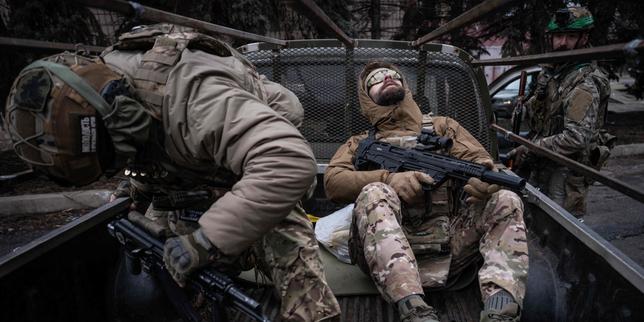
The recent loss of five lives in the Donetsk Oblast following Russian kinetic strikes is not an isolated tactical event but a data point within a broader attrition-based logic governing the current phase of the conflict. Analysis of these strikes reveals a calculated methodology: the systematic degradation of civilian and logistical hubs to force defensive displacement and test the elasticity of the Ukrainian frontline. Understanding the implications of these casualties requires moving beyond the surface-level reporting of the event to analyze the structural mechanics of the "Shatter-Point Strategy" currently being employed in the Donbas.
The Triad of Kinetic Objectives
Military operations in the Donetsk region serve three distinct functions that operate simultaneously. When a strike occurs in a civilian or administrative area, it is rarely a deviation from a plan; rather, it fulfills one of the following criteria:
- Logistical Interdiction through Social Disruption: By targeting population centers near active combat zones, the aggressor forces the local administration to divert resources—fuel, personnel, and transport—away from military support and toward emergency response. This creates a friction coefficient in the rear-guard that slows the movement of reinforcements.
- Acoustic and Electronic Mapping: Every strike triggers a response from localized air defense systems or electronic warfare units. By hitting these targets, Russian forces map the current "signature" of the Ukrainian defense, identifying gaps in the sensor net created by previous depletion.
- The Psychology of Proximity: The five deaths in Donetsk represent a mechanism of "voluntary depopulation." When the cost of residency exceeds the threshold of survival, the resulting exodus clogs arterial roads, creating natural barriers for military maneuvering.
The Attrition Function and Frontline Elasticity
The conflict has moved into a mathematical phase where the primary variable is the Rate of Replacement vs. the Rate of Depletion. The strikes in the Donetsk Oblast are designed to accelerate the latter. In engineering terms, every structure and unit has a "yield strength." Russian tactics currently focus on finding the yield strength of the Ukrainian defensive line by applying pressure at disparate points across the oblast.
This is not a maneuver war of sweeping territorial gains; it is a war of microscopic adjustments. The "Cost of Holding" for Ukraine increases with every strike on the Donetsk periphery. This cost is calculated as:
$$C = (R + L) \times S$$
Where:
- $C$ is the Total Operational Cost.
- $R$ is the Resource replenishment rate.
- $L$ is the Logistic friction (heightened by civilian casualties and infrastructure damage).
- $S$ is the Strategic Importance of the specific geographic coordinate.
When $L$ increases due to strikes on the oblast, the total cost $C$ may eventually exceed the strategic value $S$, necessitating a tactical withdrawal to more defensible, less "expensive" terrain.
The Geography of Vulnerability: Why Donetsk Remains the Center of Gravity
The Donetsk Oblast contains a unique density of urban intersections and industrial infrastructure. This makes it a high-utility target for kinetic operations. Unlike the open fields of the south, the Donbas is a "hardened landscape."
- The Urban Anchor Effect: Cities like those targeted in the recent strikes act as anchors for the trench lines. If the anchor is weakened through consistent bombardment, the entire line loses its tension.
- The Depth of the Rear: The proximity of the Russian border allows for a shorter "kill chain"—the time between identifying a target and delivering a munition. This proximity minimizes the window for Ukrainian interception, explaining the high lethality rates in recent reports.
The five fatalities reported are the human metric of this "Anchor Degradation." As the strikes move from the contact line into the deeper oblast, the intent is to hollow out the support structures that allow the frontline to remain static.
Distinguishing Fact from Calculated Ambiguity
In high-intensity conflict zones, data integrity is often compromised by the "fog of kinetic feedback." To maintain analytical rigor, we must categorize the information coming out of the Donetsk Oblast:
- Verified Fact: The location of impact, the caliber of the munitions used (often determined by crater analysis), and the confirmed casualty count. These provide the "What."
- Operational Hypothesis: The reason behind a specific strike—whether it was targeting a suspected command post or simply acting as a terror-inducing mechanism. These provide the "Why."
- The Probability Gap: There is a consistent delay between a strike and the full understanding of its impact on military readiness. It is a mistake to view these five deaths only as a civilian tragedy; they must also be viewed as a disruption of the local labor and support pool necessary for long-term territorial defense.
The Mechanism of Escalatory Signaling
Strikes in the Donetsk region also function as a form of non-verbal communication between the Kremlin and the West. By increasing the lethality of strikes in populated areas, Russia signals its willingness to accept high collateral damage as a baseline for its operations. This creates a "Risk Premium" for any Western entities involved in reconstruction or logistical support within the region.
This signaling works on three levels:
- To the Ukrainian High Command: A message that no "safe zones" exist within the oblast.
- To the Local Population: An incentive to pressure local leaders for a ceasefire or a shift in defensive posture.
- To International Observers: A demonstration of persistent strike capability despite reported ammunition shortages or technical failures.
Structural Bottlenecks in Defensive Response
The Ukrainian response to these strikes faces a critical bottleneck: the Priority Conflict. When a strike occurs in a residential area of Donetsk, the military must decide whether to deploy localized air defense assets—which are in finite supply—to protect civilian life or to keep them masked to protect high-value military assets.
This creates a tactical dilemma:
- Deployment: Protecting the oblast centers reduces civilian casualties but exposes the air defense batteries to "SEAD" (Suppression of Enemy Air Defenses) missions.
- Conservation: Keeping defenses hidden protects the "teeth" of the military but allows the "tail" (logistics and civilian morale) to be severed.
The recent deaths suggest that Russian forces are exploiting this dilemma, launching strikes that are significant enough to demand a response but dispersed enough to prevent an efficient defensive concentration.
The Kinetic Trajectory
Based on the distribution of strikes in the Donetsk Oblast and the resulting casualty patterns, the operational trajectory indicates an intensifying "Shaping Phase." This phase is characterized by the systematic removal of obstacles—both physical and psychological—prior to a concentrated ground assault.
The immediate strategic play for Ukrainian forces involves a transition from static defense to "Elastic Absorption." This requires:
- Decentralized Logistics: Moving supply nodes away from the targeted oblast centers to minimize the impact of "Anchor Degradation."
- Asymmetric Counter-Battery: Using long-range precision strikes to target the launch platforms responsible for the Donetsk strikes, rather than attempting to intercept every incoming munition.
- Rapid Triage and Extraction: Enhancing the speed of civilian evacuation to remove the "Social Disruption" variable from the Russian tactical equation.
The conflict in Donetsk is no longer about the gain or loss of a single village; it is about the structural integrity of the Ukrainian state's ability to govern and defend its eastern frontier. The metric of success for the aggressor is not the five lives taken, but the resulting degradation of the defensive system those lives were a part of. Strategic planning must now account for a sustained high-lethality environment where civilian infrastructure is viewed by the adversary as a valid military sub-component.