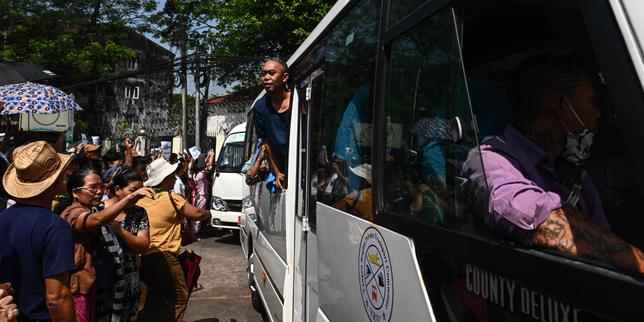
The Myanmar military’s announcement that it will release over 7,000 prisoners is not a gesture of mercy or a pivot toward democratic reconciliation. It is a calculated piece of political theater. Since the February 2021 coup, the State Administration Council (SAC) has used these cyclical amnesties as a pressure valve to deflect international scrutiny and manage overcrowded, inhumane prison facilities. While the headlines suggest a softening of the regime’s iron fist, the reality on the ground remains unchanged. For every political prisoner walked out of the front gates of Insein Prison, dozens more are abducted in night raids or sentenced in closed-door military tribunals.
The junta typically times these releases to coincide with significant national holidays—in this case, Independence Day—to wrap their authoritarian survival tactics in the flag of Buddhist merit-making. However, the data reveals a grimmer pattern. Most of those released are low-level offenders or individuals whose sentences were nearly complete. High-profile democratic leaders, including State Counsellor Aung San Suu Kyi and former President Win Myint, remain in solitary confinement or under house arrest, serving decades-long sentences on fabricated charges ranging from election fraud to the illegal possession of walkie-talkies.
Survival Through Strategic Leniency
The SAC is currently facing its most significant existential threat since the coup. A coordinated offensive by ethnic armed organizations and People’s Defence Forces (PDFs) has stripped the military of key border crossings and dozens of outposts. In this context, an amnesty serves a dual purpose. It attempts to appease regional neighbors, specifically members of ASEAN who have grown increasingly frustrated with the junta’s refusal to implement the Five-Point Consensus. By releasing a few thousand inmates, the military generals can claim they are making "progress" toward stability without actually ceding an inch of political power.
This is a revolving door policy. Human rights monitors have documented numerous instances where activists released in the morning are re-arrested by dinner. The "pardon" often comes with a caveat: if the individual is caught engaging in any further anti-junta activity, they must serve the remainder of their original sentence plus new penalties. It is a leash, not a release. The military uses these individuals as hostages to ensure their families and communities remain compliant.
The Logistics of Desperation
The physical state of Myanmar’s prisons is a scandal in its own right. Overcrowding has reached a breaking point, with facilities holding three to four times their intended capacity. Disease, malnutrition, and systemic torture are the baseline for the incarcerated. By clearing out 7,300 bodies, the junta is simply making room for the next wave of dissidents. It is a logistical necessity disguised as a moral choice.
Intelligence reports suggest the military is also suffering from a severe recruitment crisis. Defections are up, and morale is at an all-time low. There are unconfirmed reports that some of those granted amnesty, particularly those with military backgrounds or minor criminal records, are being pressured into "security roles" or forced labor to support the front lines. The junta is cannibalizing its own population to maintain its grip on the urban centers.
Global Complicity and the Failure of Sanctions
The international community’s response to these amnesties is often disappointingly predictable. A few mid-level diplomats issue statements of "cautious optimism," while the underlying machinery of the coup continues to receive fuel and funding. Sanctions on aviation fuel and military-controlled businesses have been patchy and poorly enforced. Singapore remains a hub for the junta’s financial transactions, and various global entities still provide the dual-use technology required for the military to track and kill its own citizens.
We must look at the math of the resistance. The opposition is no longer just a group of protesters with placards; it is a sophisticated, decentralized military force. The junta knows it cannot win a traditional war of attrition against a population that has reached a point of total rejection. Therefore, it resorts to psychological warfare. The amnesty is a message to the middle class and the international business community: Look, we are the only entity capable of providing a path back to normalcy.
It is a lie. There is no normalcy under a regime that relies on scorched-earth tactics, air strikes on schools, and the systematic burning of villages in the heartland.
The Ethnic Factor
While the world focuses on the Bamar majority areas, the situation in the ethnic states—Kachin, Kayin, Shan, and Rakhine—is far more dire. The amnesty rarely extends to the thousands of ethnic civilians detained during "clearance operations." For these populations, the military's talk of peace and prisoner releases is a cruel joke. The junta’s strategy has always been "divide and rule." By offering crumbs of leniency to the urban population, they hope to isolate the armed ethnic groups who have provided sanctuary and training to the democratic resistance.
The military’s legal framework, specifically Section 505(A) of the Penal Code, remains the primary tool for stifling dissent. This broad law criminalizes any comment that could cause "fear" or "spread false news." As long as these laws remain on the books, any amnesty is a temporary reprieve. The judiciary in Myanmar is not an independent branch of government; it is a specialized department of the Ministry of Defence. Judges take orders from colonels.
The Shadow Economy of the Incarcerated
Behind the high walls of Insein and Obo prisons, a brutal economy thrives. Families of the detained describe a system where every "privilege"—from receiving a letter to getting basic medicine—requires a bribe to prison guards. The amnesty process itself is reportedly riddled with corruption. In some cases, prisoners with the financial means to pay are prioritized for release over those who were actually included on the official lists.
This corruption is not a bug; it is a feature. It ensures that the rank-and-file of the security apparatus remains loyal because they are allowed to supplement their meager salaries through the misery of the populace. When the SAC head, Min Aung Hlaing, signs an amnesty decree, he is also signaling to his subordinates that the "market" is open for another round of negotiations with desperate families.
The Role of China and Russia
One cannot analyze the junta’s survival without looking at its patrons. Russia has become the primary provider of the hardware—fighter jets and attack helicopters—used to terrorize the interior. China, while more circumspect, provides the diplomatic cover and the infrastructure investment that keeps the junta’s coffers from running completely dry. Both nations benefit from a weakened, isolated Myanmar that is dependent on their patronage.
These geopolitical actors view the prisoner releases as a useful "out" for the junta. They use these events at the United Nations to argue against further intervention or tougher sanctions. They claim the military is "moving in the right direction," ignoring the fact that the direction is a circular path leading back to total authoritarianism.
A Strategy of Controlled Chaos
The military has no intention of returning to the barracks. Their proposed "elections," which have been delayed repeatedly, are designed to produce a result where the military-backed parties win by default. Releasing prisoners is a way to clear the deck for a sham democratic process. By letting out a few thousand people, they hope to create a facade of political pluralism that might trick a few gullible foreign observers.
The resistance, however, is not fooled. The National Unity Government (NUG) and the various strike committees have been clear: there is no negotiation without the total removal of the military from politics and the unconditional release of all political prisoners. The amnesty is a tactical retreat, not a strategic shift.
We are witnessing the final stages of a colonial-style occupation where the occupiers are the nation's own army. They treat the country as a resource to be extracted and the people as a threat to be managed. The prisoner release is merely a change in management style, shifting from the bayonet to the carrot for a few brief days before the cycle of violence begins anew.
The true indicator of change in Myanmar will not be found in an official decree from Naypyidaw. It will be found when the people can walk the streets without the fear of a white van pulling alongside them. It will be found when the military’s budget is slashed and redirected to the schools and hospitals they have spent three years destroying. Until then, these amnesties are nothing more than the rattling of chains.
To view this as a sign of progress is to ignore the thousands who remain in the dark, and the thousands more who will inevitably take their place in the coming months. The junta is not opening the doors; it is just resetting the trap.
The international community must stop treating these tactical maneuvers as genuine diplomatic openings and recognize that the only way to end the crisis is the complete dismantling of the military’s economic and political power.