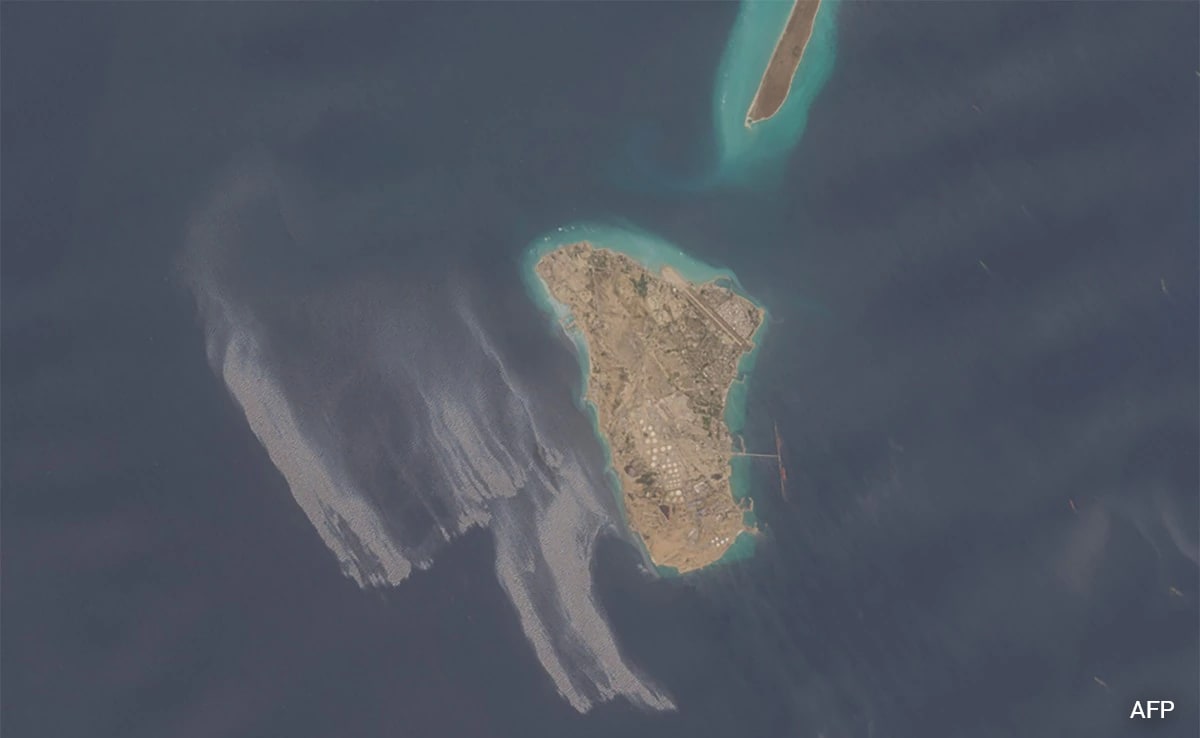
The Persian Gulf is currently the site of a silent, expanding catastrophe that Tehran insists does not exist. While Iranian state media and the Oil Terminals Company flatly deny any leaks near Kharg Island, eyes in the sky tell a far more damning story. Satellite imagery captured between May 6 and May 8, 2026, reveals a massive oil slick spreading across the western waters of Iran’s primary export hub, a 45-to-70-square-kilometer stain that represents more than just an industrial accident. It is the physical manifestation of a nation’s energy infrastructure buckling under the weight of a 70-day naval blockade and a grinding war.
The Physics of a Ghost Slick
Detecting oil from space is no longer a matter of looking at simple photographs. Analysts use Synthetic Aperture Radar (SAR), a technology that measures the "roughness" of the ocean surface. Oil creates a damping effect on capillary waves, making the water appear as a flat, dark void on radar returns. Recent data from the Copernicus Sentinel-1 and Sentinel-2 satellites show a grey-and-white plume emerging from the western side of the 8-kilometer-long island. This is not a minor "ballast water" discharge as some Iranian lawmakers have claimed. The sheer volume—estimated by some maritime intelligence firms at roughly 80,000 barrels—suggests a pressurized release from a pipeline or a significant failure at a loading terminal.
Why the Blockade is the Real Culprit
To understand why Kharg Island is bleeding oil, you have to look at the pressure building behind the valves. Kharg handles 90% of Iran's crude exports. With the U.S. Navy maintaining a tight blockade and several tankers already disabled in recent exchanges, the flow of oil has nowhere to go.
- Storage at the Brink: When tankers cannot dock or depart, the onshore storage tanks at Kharg fill to capacity. Once they hit the "red line," operators must either shut down the inland oil fields—an expensive and technically risky process—or risk overpressurizing the subsea infrastructure.
- Degraded Maintenance: Decades of sanctions had already left Iran’s pipelines brittle. Now, under active combat conditions, the specialized spare parts and international divers needed for underwater repairs are nonexistent.
- The Loading Stress: If a loading arm or a subsea hose fails during a frantic attempt to move crude onto a "dark fleet" vessel at night, the resulting spill is massive and immediate.
The Iranian narrative—that a "European tanker" intentionally dumped waste to spite the environment—falls apart under technical scrutiny. The slick's point of origin appears consistent with the island's own western subsea infrastructure, not a moving vessel's wake.
A Transboundary Disaster in Motion
The Persian Gulf is a semi-closed bathtub. Unlike the open Atlantic, where currents can eventually disperse a spill, the Gulf’s circulation is slow and clockwise. This means a spill at Kharg Island is not just an Iranian problem; it is a ticking time bomb for the entire region.
The slick is currently drifting southward. Current modeling suggests that if the leak is not capped, the oil could reach the coastlines of Saudi Arabia, Qatar, or the UAE within ten to fourteen days. This moves the crisis from a military confrontation to a diplomatic nightmare. These neighboring nations rely heavily on desalination plants for their drinking water. A single oil slick entering a desalination intake can shut down the water supply for millions of people, effectively weaponizing the pollution.
The Truth Behind the Denial
Tehran’s refusal to acknowledge the spill is a calculated move to project "resilience." Admitting to a major leak is an admission that the U.S. blockade is working and that the "impenetrable" Kharg Island is actually falling apart. By the time the oil washes up on the beaches of Dubai or Doha, Iran will likely blame "foreign sabotage" or "maritime terrorism."
Yet, the imagery does not lie. The slick's footprint shrank slightly by May 9, but the residue remains, moving through some of the most sensitive coral and mangrove ecosystems in the world. We are witnessing the beginning of a "kinetic environmental war," where the collateral damage is the very water the region survives on.
The only way to stop the spread is a de-escalation that allows for technical repair crews to reach the island under a neutral flag. Without it, the Persian Gulf faces an ecological scar that will outlast the current administration in any capital.
Satellite Evidence of the Kharg Island Oil Spill
This report provides expert analysis and visual evidence of the spreading oil slick and the potential geopolitical fallout for the region.