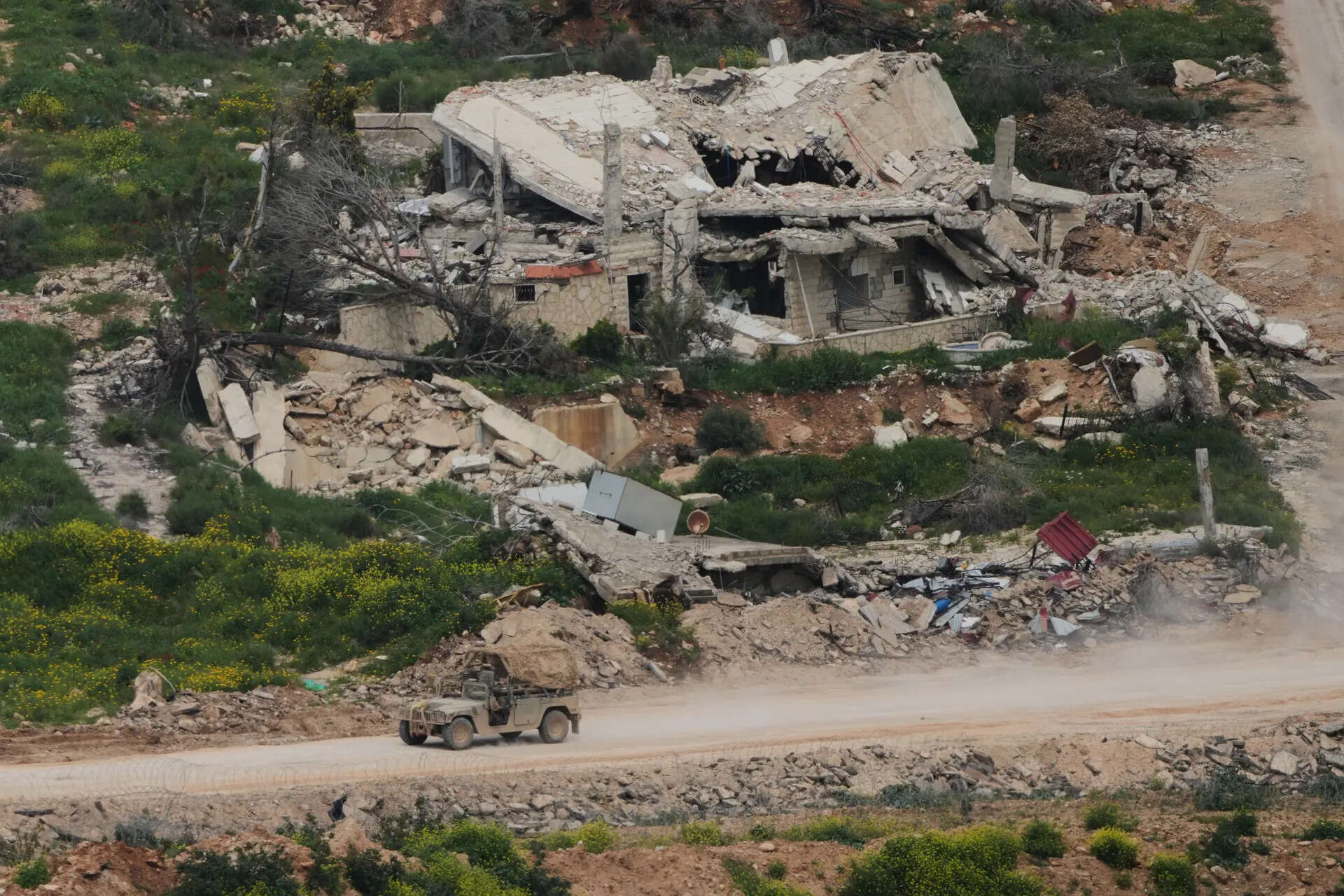
The media is currently hyperventilating over a map. On April 28, 2026, the Israeli government issued a wave of fresh evacuation orders for southern Lebanon, all while Foreign Minister Gideon Saar looked into the cameras and insisted Israel has "no territorial ambitions." The press calls this a contradiction. They see the "Yellow Line"—that 10-kilometer-deep strip of Lebanese territory—as a messy, hypocritical land grab.
They are wrong. You might also find this similar article useful: Diplomatic Signaling and the Metrics of Sovereign Parity.
The analysts are stuck in 1982, obsessed with the "Security Zone" model where holding territory meant boots, bunkers, and static targets. I’ve watched defense ministries blow billions on physical occupation only to realize that in the 2020s, land is a liability, not an asset. When Saar says Israel doesn't want the land, he’s being brutally honest, but not for the reasons you think.
The Ghost Occupation
The "Yellow Line" isn't an expansion of the Israeli state; it’s the implementation of the De-territorialized Kill Zone. In 2026, territorial ambition is a bug, not a feature. If you annex southern Lebanon, you inherit the "failed state" plumbing, the starving population, and the international legal responsibility to provide for them. As discussed in detailed articles by The Washington Post, the results are worth noting.
Instead, Israel is pioneering a model of Control without Sovereignty. By displacing the population and declaring the area between the border and the Litani River a permanent "combat zone," they have created a digital and kinetic moat.
- Algorithmic Warfare: This isn't about sitting in a trench with a rifle. The IDF is utilizing autonomous drone swarms and AI-driven sensor grids—what some call the "smart fence on steroids"—to ensure that nothing larger than a stray cat moves without being painted by a laser.
- The Gaza Template: We saw this in Rafah and Beit Hanoun. The goal isn't to fly a flag; it's to ensure the area is physically incapable of supporting life or military infrastructure.
- The Cost of "Ownership": Real estate in a war zone is a depreciating asset. Why pay the political and economic price of occupation when you can simply turn the land into a high-tech vacuum?
The Ceasefire Paradox
The April 17 ceasefire was never a peace treaty; it was a calibration. Hezbollah violated it by attempting to rebuild, and Israel "violated" it by enforcing the Yellow Line. But here is the counter-intuitive truth: both sides need the friction.
Hezbollah’s entire brand is "resistance." Without an Israeli presence—even a "ghost" presence—their internal political leverage in Beirut evaporates. Conversely, the Israeli government uses the specter of the "gun pointed at our head" to justify a permanent war economy that has become the backbone of their current technological R&D.
I've seen this cycle in corporate boardrooms: you don't solve the problem; you manage the tension to justify the budget.
Why Diplomacy is Asking the Wrong Questions
The international community keeps asking: "When will the troops leave?"
The better question is: "What does 'leaving' even mean in 2026?"
If an Israeli soldier isn't standing on a hill in Bint Jbeil, but an Israeli drone has a 24/7 loitering window over that same hill with an automated engagement protocol, is the occupation over?
The "lazy consensus" of the news cycle focuses on the physical evacuations. They miss the Infrastructural Erasure. By blowing up the bridges on the Litani, Israel isn't just stopping Hezbollah trucks; they are severed the economic umbilical cord of the South. They are creating a "No Man’s Land" that functions as a strategic buffer without the PR nightmare of formal annexation.
The Brutal Reality of the Buffer Zone
Let’s dismantle the premise that this is a temporary security measure. A "temporary" buffer zone in the Middle East is as real as a "temporary" tax hike.
Imagine a scenario where the Lebanese Army (LAF) actually tries to fill the void. Saar already signaled the punchline: he called Lebanon a "failed state." By definition, a failed state cannot provide security guarantees. Therefore, the Yellow Line is designed to be permanent. It is the new border, regardless of what the official maps at the UN say.
The downside to this contrarian reality? It creates a permanent class of displaced people—over a million currently—who have no home to return to because their home is now a sensor-grid coordinate.
Stop Waiting for the Withdrawal
If you are waiting for a "Mission Accomplished" speech and a full withdrawal to the 1923 international border, you aren't paying attention to how modern warfare has evolved.
Israel has figured out that it can achieve 100% of its security objectives by owning the airspace and the data of southern Lebanon while leaving the rubble and the responsibility to the Lebanese government.
It’s not a land grab. It’s an obsolescence of land. In the age of autonomous killing, the map is not the territory—the sensor range is.
Saar is telling the truth. They don't want your land. They just want you off of it so their algorithms can work in peace.



