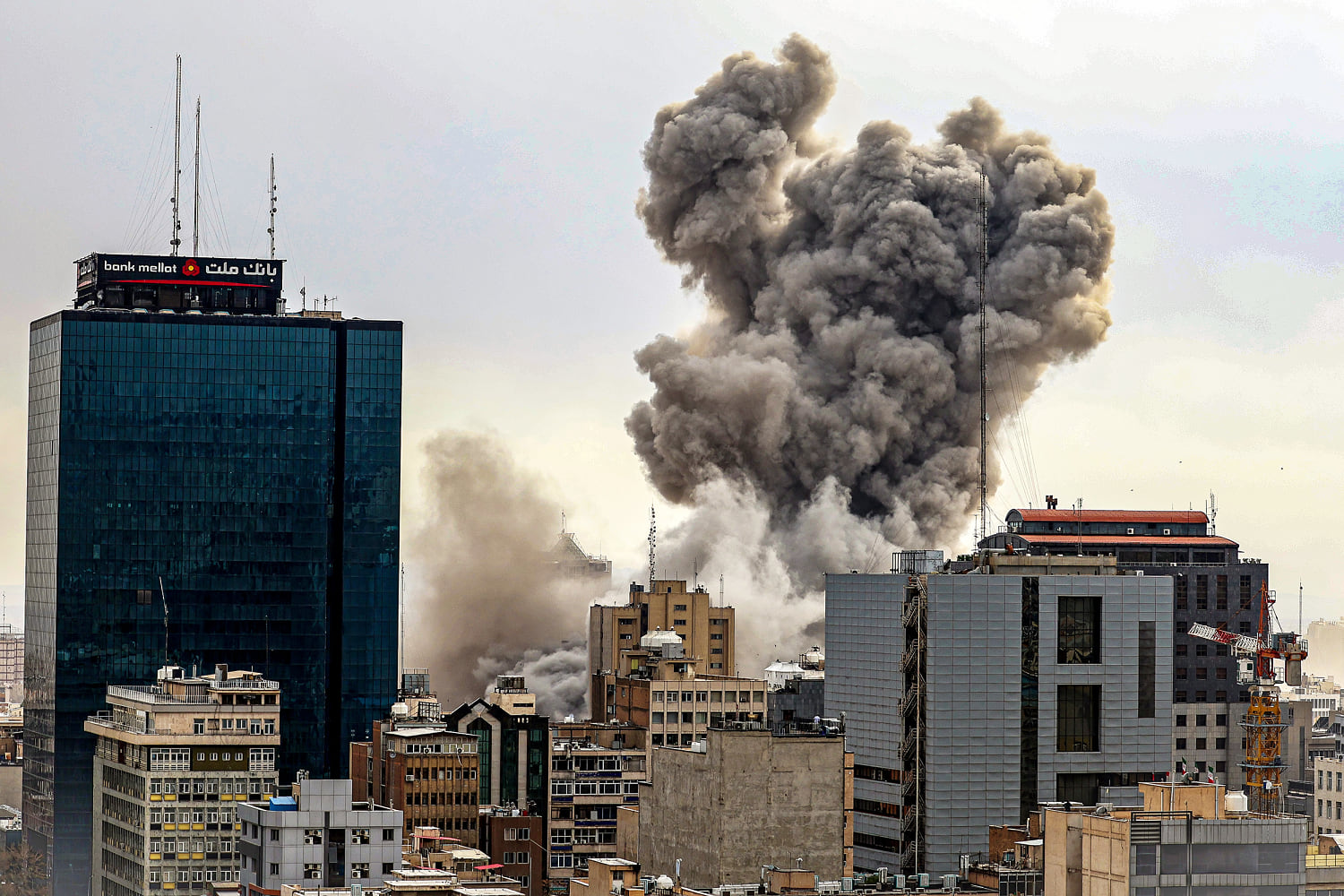
The air in the hearing room usually smells of floor wax and stale coffee. It is a sterile place where men in expensive suits discuss the end of the world in the tone most people use to describe a grocery list. But today, the atmosphere changed. There was a specific, heavy vibration in the wood of the witness table as the officials from the Trump administration leaned into their microphones. They weren't there to offer diplomatic platitudes or vague warnings. They were there to describe a kinetic reality.
Tehran is roughly 6,300 miles from Washington D.C. At that distance, it is easy to view conflict as a series of red icons on a digital map. You see a drone strike here, a cyber-attack there, and a naval maneuver in the Strait of Hormuz. It feels like a game. It feels bloodless. But for the officials testifying before Congress, the distance had vanished. They spoke of "overwhelming firepower" not as a deterrent, but as an imminent event. They were describing a machinery of war that had already been fueled, greased, and pointed. For a closer look into similar topics, we suggest: this related article.
The message delivered to the Capitol was a sharp departure from the shadow boxing of previous decades. For years, the relationship between the United States and Iran has been a dance of "maximum pressure"—sanctions that squeeze the life out of an economy until the currency is worth less than the paper it’s printed on. But sanctions are slow. They are a siege. What was described in those halls was something different: a blitz.
The Anatomy of Overwhelming
When military planners use the word "overwhelming," they aren't talking about winning a fair fight. They are talking about a total collapse of the opponent's ability to respond. Imagine a blackout that doesn't just turn off the lights, but melts the wires inside the walls. For further information on this topic, extensive coverage can also be found at NPR.
The strategy outlined to Congress involves a multi-domain assault. It starts in the silence of the electromagnetic spectrum, where signals are jammed and communications are severed. Then comes the steel. We are talking about carrier strike groups moving into position, B-52 bombers loitering in the thin air of the upper atmosphere, and missile batteries in the desert sands of allied nations clicking into "active" mode.
The officials made it clear: if Iran crosses the invisible line—whether through a proxy attack on American troops or a leap in their nuclear enrichment—the response will not be proportional. Proportionality is for lawyers. This plan is for executioners. The goal is to remove the Iranian regime's ability to see, hear, or strike back within the first hour of a conflict.
But here is the invisible stake: what happens to the person sitting at a desk in Tehran? Or the sailor on a patrol boat in the Gulf? Or the shopkeeper in Mashhad?
Conflict is never just about firepower. It's about the resonance of the first shot. The officials spoke to Congress with a confidence that bordered on the mechanical. They knew the math. They knew the numbers of Tomahawk missiles and the range of our stealth fighters. They were convinced of the outcome. But history has a way of laughing at the math of generals.
The Human Shadow on the Wall
Consider a hypothetical—let's call him Hamid. Hamid is twenty-four, a conscript in the Iranian Revolutionary Guard Corps. He doesn't make policy. He doesn't care about the theology of the Islamic Republic or the political maneuvering in Washington. He cares about his mother’s health and the fact that he hasn’t had a decent cigarette in weeks.
When the "overwhelming firepower" arrives, Hamid isn't a geopolitical pawn. He is a young man in a bunker. He is the person who feels the shockwave in his lungs. He is the one who watches the sky turn a color it shouldn't be.
The officials in the hearing room didn't mention Hamid. They mentioned "targets." They mentioned "assets." They mentioned "capabilities." But when a missile finds its target, it doesn't just destroy an asset. It creates a crater in a family's history. It creates a vacuum that something else will inevitably fill—and that something else is rarely peaceful.
The administration’s stance is a gamble on the psychology of fear. They believe that by showing the full extent of the American arsenal, the Iranian leadership will blink. They believe that the threat of total destruction will force a regime that has survived forty years of isolation to finally come to the table.
But what if the regime doesn't blink? What if they see the overwhelming firepower as an existential signal?
The officials told Congress that the risk of inaction is higher than the risk of escalation. They argued that a nuclear-armed Iran, or an Iran that can strike American interests with impunity, is a future we cannot afford. They spoke of a "deterrence gap" that has been growing for years—a space where Tehran felt it could push without being pushed back.
That gap is now closed. The officials were clear: the finger is on the trigger.
The Silence After the Boom
There is a specific kind of silence that follows a massive explosion. It is a ringing, hollow quiet. It is the sound of a world that has just been irrevocably changed.
The "overwhelming firepower" being described to Congress is a tool of destruction. But it is not a tool of creation. You can use a sledgehammer to break a wall, but you cannot use it to build a house. The officials were focused on the breaking. They were experts in the physics of demolition.
When asked about the "day after," the answers in the hearing room became thinner. The confidence softened. Because while we can predict the trajectory of a missile with mathematical precision, we cannot predict the trajectory of a country’s rage. We cannot calculate the long-term impact of a humiliated nation or the unintended consequences of a power vacuum in the heart of the Middle East.
The administration's plan is a masterpiece of military engineering. It is a display of technological superiority that no other nation on Earth can match. It is, in every sense of the word, overwhelming.
But as the hearing concluded and the officials gathered their papers and straightened their ties, the weight of their words lingered. They had just told the world that a storm was coming. They had promised a display of power that would be impossible to ignore. They had set the stage for a conflict that would define the next decade of human history.
As they walked out of the room, the floor wax still smelled the same. The coffee was still stale. But the world outside those doors was already beginning to tilt. The machinery was in motion. The missiles were in their tubes. The orders were written.
And somewhere, thousands of miles away, a young man like Hamid was looking at the horizon, unaware that his life was now a variable in a calculation he would never see. The overwhelming firepower isn't just a military strategy. It's a choice to let the hammer fall.
Once it does, the only thing left will be the ringing in our ears.