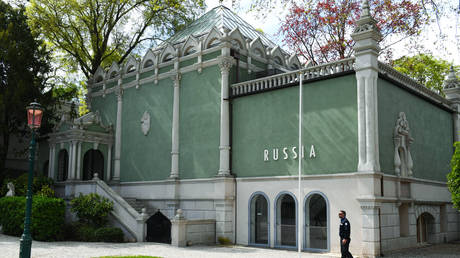
The European Union is currently weighing a drastic financial ultimatum that could fundamentally reshape the world’s most prestigious art gathering. By threatening to withdraw crucial funding if the Venice Biennale permits a Russian return to the Giardini, Brussels is no longer just funding art; it is weaponizing it. This move signals a total collapse of the "neutral ground" philosophy that has governed international cultural exchange for over a century.
At the heart of the dispute is the Russian Pavilion. While the building has remained dark since the 2022 invasion of Ukraine, recent diplomatic back-channeling suggests a push for a "neutral" reopening or a handover to non-aligned curators. The EU’s response has been swift and clinical. If Moscow’s presence is validated in any form, the millions in subsidies and grants that flow from European cultural funds to the Biennale’s various programs are on the chopping block.
The Price of Artistic Sovereignty
The Venice Biennale operates on a complex financial model that relies heavily on a mix of Italian state support, private patronage, and European Union grants. While the Italian Ministry of Culture provides the backbone, EU funding often secures the "Creative Europe" initiatives and specialized educational programs that give the Biennale its global reach.
Taking that money away would leave a crater. We aren't just talking about fewer cocktail parties on the Lido. We are talking about the potential insolvency of specific satellite pavilions and the end of scholarships for artists from developing nations. The EU understands this pressure point. By targeting the wallet, Brussels is forcing the Biennale’s board to choose between its tradition of administrative independence and its fiscal survival.
The Myth of the Neutral Pavilion
For decades, the art world clung to the idea that the Giardini was a diplomatic green zone. It was a place where national tensions were supposedly sublimated into aesthetic discourse. That era is over. The current standoff proves that the physical real estate of the Biennale is now viewed as sovereign territory in a very literal sense.
When Russia’s hand-picked artists and curators withdrew in 2022, it was seen as a moral victory for the creative community. However, the empty pavilion now stands as a haunting reminder of a frozen conflict. Some board members argue that keeping the building empty indefinitely is a logistical nightmare; others see any attempt to fill it as a betrayal of the Ukrainian cause. The EU’s position is that there is no middle ground. You either exclude the aggressor or you lose the patronage of the bloc.
Why the EU is Breaking Protocol
The European Commission’s sudden aggression in the cultural sector isn't happening in a vacuum. It is a reaction to a perceived "soft power" gap. For years, European officials watched as cultural institutions accepted funding from authoritarian regimes under the guise of "cultural diplomacy."
The shift we are seeing now is a hard-line correction. The EU is effectively implementing a "Culture First" sanctions policy. They believe that allowing a Russian presence in Venice—even under a neutral flag—would provide the Kremlin with a massive propaganda win. It would signal that "business as usual" is returning to the European high-society circuit.
The Legal Quagmire of the Giardini
The Biennale is unique because many of the national pavilions are actually owned by the respective foreign governments. This creates a legal headache that the EU’s funding threats are designed to bypass.
- Ownership Rights: Italy cannot simply seize the Russian Pavilion without sparking a massive international legal battle over diplomatic property.
- Administrative Loophole: The Biennale board can, however, refuse to "activate" the pavilion for a specific edition.
- Funding Hooks: This is where the EU comes in. Since they cannot legally force Italy to seize the building, they use the threat of financial abandonment to ensure the board makes the "correct" administrative decision.
It is a classic squeeze play.
The Collateral Damage of Cultural Sanctions
If the EU follows through on cutting funds, the primary victims won't be the Russian oligarchs or the Brussels bureaucrats. The damage will hit the smaller, fringe participants who rely on the Biennale’s infrastructure to be seen.
The Biennale is an ecosystem. When the central funding for the overarching event is slashed, the "Collateral Events"—exhibitions hosted by smaller nations and NGOs across Venice—see their costs skyrocket. Insurance premiums go up. Transport subsidies vanish. Security costs, already high due to the potential for protests, become unbearable for smaller budgets.
A Precedent for Future Conflicts
This isn't just about Russia. By establishing this precedent, the EU is setting the stage for a future where every geopolitical flare-up results in a funding review for international events.
What happens during the next conflict in the Middle East? Or a territorial dispute in the South China Sea? If the EU uses its purse strings to dictate the guest list in Venice today, it loses the ability to claim that art exists above the fray tomorrow. We are moving toward a fractured cultural world where events are divided into ideological blocs, much like the Cold War, but with the added complication of modern financial interdependence.
The Italian Government’s High Stakes Gamble
Rome finds itself in an impossible position. On one hand, the Italian government wants to remain a loyal pillar of the EU and NATO. On the other, the Venice Biennale is a crown jewel of Italian prestige and a massive driver of high-end tourism.
The Italian Ministry of Culture has traditionally pushed for the Biennale to remain autonomous. They view any outside interference—even from Brussels—as an infringement on their national heritage management. However, with Italy’s own economy under constant scrutiny, the prospect of filling a multi-million-euro hole left by a departing EU is not an attractive option.
Tracking the Money
To understand the scale, one must look at the "Creative Europe" budget allocations. In recent cycles, the Biennale and its associated entities have accessed funds totaling nearly 5% of their operational budget through various EU-linked schemes. While 5% might sound small, it represents the "risk capital" of the event—the money used for innovation, digital archiving, and supporting artists who don't have billionaire backers.
Losing this money doesn't just make the Biennale smaller. It makes it more conservative. Without that EU safety net, the Biennale will be forced to rely even more heavily on blue-chip galleries and ultra-wealthy private donors. This will inevitably shift the focus away from challenging, political art and toward "safe," market-friendly pieces that please the donor class.
The Curator's Dilemma
How do you organize "The Olympics of Art" when the referees are threatening to take away the stadium? Future curators of the Biennale now face a terrifying vetting process. They aren't just looking for the best art; they are looking for a lineup that won't trigger a financial collapse.
This leads to a chilling effect. Self-censorship starts long before the first crate arrives in Venice. Curators will begin to avoid any theme or any nationality that might be deemed "problematic" by the funding bodies in Brussels. The result is a curated blandness, a sanitized version of culture that meets the requirements of a grant application but fails the test of artistic truth.
The Shadow of the 1930s
Historians are already drawing parallels to the mid-20th century, when the Biennale was used as a tool for fascist and Nazi propaganda. The post-war era was supposed to be a rejection of that—a move toward a universal humanism.
The EU argues that by excluding Russia, they are protecting that humanism. They claim that you cannot have a dialogue with a state that is actively trying to erase the culture of its neighbor. It is a powerful argument. But it is also an admission that the post-war dream of a "universal" art world is dead.
The Impending Deadline
The clock is ticking toward the next major cycle. The Biennale board is expected to meet in the coming months to finalize the participation list. This meeting will be the true test of their resolve.
Will they stand behind the principle of a global forum, open to all, regardless of the actions of their governments? Or will they bow to the fiscal reality of the 21st century, where the price of admission is total alignment with the donor's foreign policy?
The EU has made its move. The checkbook is open, but the pen is poised to strike through the Biennale’s name. If the funding is cut, the Biennale will survive, but it will be a different animal—leaner, more beholden to private wealth, and stripped of its claim to be the world's moral compass for the arts.
The real tragedy is that once an institution becomes a pawn in a larger game, it rarely regains its independence. Venice is a city built on water and fragile foundations; its most famous cultural export is now discovering just how quickly those foundations can wash away when the political tide turns. The Biennale is no longer an escape from the world’s problems. It is the front line.