The efficacy of a geopolitical blockade is measured by the delta between a target's standard operating costs and the cost of its primary alternative. On April 13, 2026, the United States initiated a kinetic and selective naval blockade targeting Iranian-linked vessels in the Persian Gulf. Tehran’s pivot to the China-Iran rail corridor represents a structural attempt to replace maritime volume with overland velocity. However, this transition is governed by rigid logistical constraints: the rail link functions not as a replacement for sea trade, but as a high-cost, low-volume survival buffer designed to prevent total economic asphyxiation.
The Infrastructure Framework: Velocity vs. Volume
The China-Iran rail link, primarily operating from Xi’an to Tehran via Kazakhstan and Turkmenistan, offers a distinct advantage in Time-to-Market. While traditional maritime routes from Shanghai to Bandar Abbas require approximately 30 days, the rail corridor reduces this to roughly 15 days. For an alternative view, see: this related article.
This 50% reduction in lead time is the "Velocity Premium." Yet, the Volume Deficit creates a hard ceiling on its strategic utility.
- Vessel Capacity: A standard Neopanamax container ship carries 12,000 to 14,000 Twenty-foot Equivalent Units (TEUs).
- Train Capacity: A single freight train on the Xi'an-Tehran route typically transports 50 containers (approx. 50-100 TEUs).
- Scale Ratio: It requires at least 120 full freight trains to equal the cargo capacity of one medium-sized container vessel.
As of May 2026, train frequency has increased from one per week to one every three to four days. While this represents a 100% to 133% increase in frequency, the total throughput remains less than 2% of pre-blockade maritime container capacity. Similar insight on this trend has been published by Forbes.
The Cost Function of Sanction Circumvention
Logistics in a blockade environment are subject to a Sanction Risk Premium. Shipping a 40-foot container on the China-Iran rail route now costs up to $7,000, a 40% increase over pre-blockade rates. This cost escalation is driven by three primary variables:
- Capacity Scarcity: Demand for overland transit has surged, with May 2026 slots fully booked.
- Insurance Friction: Overland routes bypass Western-controlled maritime insurance mechanisms, but they require sovereign guarantees or specialized regional insurers who price for geopolitical volatility.
- Transshipment Complexity: Differing track gauges in Central Asia (1,520 mm) versus China and Iran (1,435 mm) necessitate physical cargo transfer at borders like Dostyk (Kazakhstan/China) and Incheh-Borun (Iran/Turkmenistan). Each transfer point adds labor costs and dwell-time risk.
Strategic Asymmetry: The Non-Crude Buffer
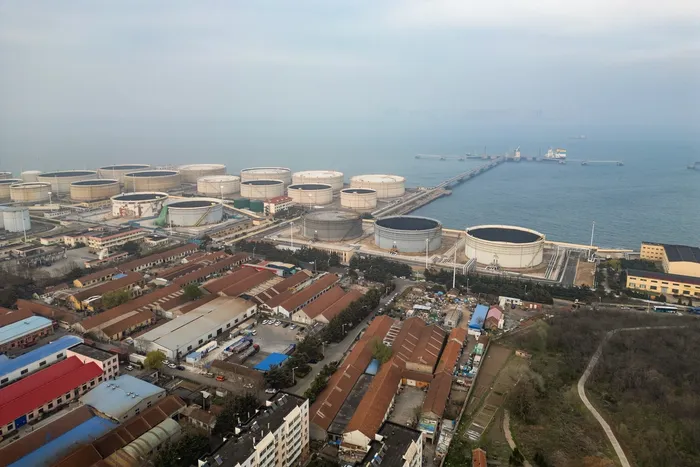
The blockade’s primary objective is the suppression of Iranian crude oil exports. Rail infrastructure is fundamentally ill-suited for large-scale liquid bulk transport. In 2025, Chinese buyers took over 80% of Iran’s exported crude.
The rail corridor cannot move the 1.5 million barrels per day (bpd) required to maintain Iran’s fiscal stability. Instead, the corridor is utilized for Strategic Imports and High-Value Exports:
- Imports: Automotive components, generators, industrial machinery, and electronics.
- Exports: Petrochemicals, sulfur, and minerals that can be containerized.
By shifting high-value non-oil trade to rail, Tehran preserves its remaining domestic industrial base while the "Dark Fleet" attempts to bypass the naval blockade with crude.
Geopolitical Resilience and the Southern Corridor
The revitalization of the China-Iran rail line is a pillar of the 25-year, $400 billion Strategic Cooperation Agreement. This "Southern Corridor" is gaining traction because of the degradation of the Northern Corridor (via Russia/Ukraine) and the multimodal inefficiencies of the Middle Corridor (Caspian Sea crossings).
Tehran's strategy involves the Integrated Transit Diplomacy framework, connecting several key nodes:
- Khaf-Herat Link: Connecting Iran to Afghanistan, with plans to extend toward China.
- Chabahar-Zahedan Rail: Aiming for completion by late 2026 to link the Indian Ocean to the internal rail network, bypassing the Strait of Hormuz entirely.
- Rasht-Astara Segment: The final link in the International North-South Transport Corridor (INSTC) to connect Iran to Russian markets.
Strategic Recommendation
The China-Iran rail link is a tactical success but a strategic bottleneck. For Tehran to achieve its goal of handling 40% of maritime volume via land, it must move beyond containerized freight into dedicated pipeline-on-wheels operations or specialized mineral transit.
Western strategy should focus not on the total closure of the rail link—which is physically impossible to police without infringing on Central Asian sovereignty—but on the Financial Chokepoints. Monitoring the settlement systems used by the Kazakhstan-Turkmenistan-Iran rail operators will reveal the true volume of trade more accurately than satellite imagery of locomotives. The rail corridor is a pressure valve; it prevents a total explosion of the Iranian economy but lacks the diameter to fuel a recovery.