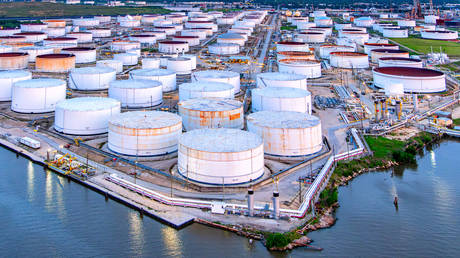
The headlines are panicking. "Iran has nowhere to put its oil!" "Is Tehran dumping crude into the Persian Gulf?" It makes for a great thriller plot, but it is a total failure of logic. If you believe a nation state would literally pour billions of dollars of a finite resource into the ocean because they ran out of tanks, you aren't paying attention to how the energy shadow market actually functions.
Panic-baiting articles suggest that because onshore storage in places like Kharg Island is hitting capacity and the global tanker fleet is squeezed, the only option left is environmental sabotage. This is lazy journalism. It assumes that if the oil isn't in a visible, tracked tank or a registered VLCC (Very Large Crude Carrier), it must be gone. If you liked this article, you might want to look at: this related article.
Here is the reality: Oil is never "lost." It is just moved into the dark.
The Myth of the "Full" Tank
The premise that Iran is "out of room" assumes they are playing by the same transparent storage rules as an OECD nation. They aren't. When the mainstream media looks at satellite imagery of storage farms and sees floating roofs at their peak, they scream "overflow." For another angle on this story, refer to the recent coverage from The Motley Fool.
I have spent years watching how sanctioned regimes manage oversupply. They don't dump. They innovate. Iran has perfected the art of the "ghost fleet." They utilize aging tankers that have been scrubbed from official registries—vessels that effectively do not exist on paper—to act as floating warehouses.
If you see a storage crisis, you’re looking at the wrong map. You’re looking at the official one. The unofficial map includes millions of barrels tucked away in "bonded" storage in Asian ports, waiting for a bureaucratic sleight of hand to turn Iranian heavy into a "Malaysian blend" or "Middle Eastern mix."
[Image of an oil tanker ship]
The Economics of Dumping is Nonsense
Let’s talk about the math. Even at a steep sanctions discount, a single VLCC carries roughly 2 million barrels of oil. At $70 a barrel, that is $140 million.
A country under crippling economic pressure does not throw $140 million into the water. They would rather burn it for electricity, pump it back into aging wells for Enhanced Oil Recovery (EOR), or literally give it away to domestic industries to stimulate local manufacturing.
Dumping oil into the sea is not just an environmental crime; it is an accounting impossibility for a regime that counts every cent of hard currency. Pumping oil back into a reservoir—reinjection—is a standard industry practice. It maintains pressure and saves the product for a day when the political winds shift. It costs money to pump, sure, but it preserves the asset. Throwing it away destroys the asset.
The "Leaking Ship" Narrative as a Smokescreen
When people see oil slicks near Iranian terminals, they immediately jump to "intentional dumping." This ignores the decaying state of the infrastructure.
Sanctions don't just stop sales; they stop maintenance. The "leaks" people see aren't a policy of disposal; they are the physical manifestation of a crumbling midstream sector. Pipelines that haven't been serviced in a decade leak. Loading arms on 40-year-old jetties drip.
The media confuses incompetence and decay with intent. Calling it "dumping" gives the Iranian Ministry of Petroleum too much credit for a decisive action they aren't actually taking. They are struggling to keep the pipes from bursting, not opening the valves on purpose.
The Invisible Pipeline to China
The "excess oil" isn't sitting in a puddle in the Gulf. It is moving through a sophisticated network of Ship-to-Ship (STS) transfers.
If you track the AIS (Automatic Identification System) transponders of tankers in the region, you'll see "dark" periods where ships disappear. They aren't sinking, and they aren't dumping. They are huddling together in the middle of the night, equalizing pressure, and moving cargo from an Iranian-flagged vessel to a "clean" vessel.
This is the "Tehran Shuffle."
- The oil is produced because shutting down a well is technically difficult and can permanently damage the geological formation.
- The oil is moved to the coast.
- If the tanks are full, it goes to the Ghost Fleet.
- The Ghost Fleet meets a third-party buyer in international waters.
- The oil is relabeled.
This process is so efficient that the concept of "running out of room" is almost a joke. The world is the storage tank.
Why the "Experts" Get This Wrong
Most energy analysts sit in glass offices in London or Singapore looking at Bloomberg terminals. They rely on "transparent" data. But Iranian oil is the most opaque commodity on earth.
When an analyst says Iran has 100 million barrels in floating storage, they are guessing based on the ships they can see. They aren't counting the ships that have changed their IMO numbers, the ones that have been "scrapped" but are still floating, or the underground strategic reserves that Iran doesn't report to any international agency.
The "People Also Ask" sections of search engines are filled with questions like: "Is Iran's oil supply a threat to the environment?"
The honest answer: The threat isn't dumping; it's the fact that we've forced a major producer to use a "shadow" logistics chain that uses the oldest, most dangerous ships on the ocean. If you want to worry about an oil spill, don't worry about a captain opening a valve to make room. Worry about a 30-year-old rust bucket breaking in half because it hasn't had a safety inspection since 2015.
Stop Looking for a Puddle, Start Looking for a Discount
If Iran truly had "too much" oil, the price wouldn't be reflected in a slick in the Persian Gulf. It would be reflected in the massive, under-the-table discounts being offered to independent "teapot" refineries in China.
When storage gets tight, the price drops until the oil moves. That is the fundamental law of commodities. There is always a buyer if the price is low enough to offset the risk of secondary sanctions. Iran isn't dumping oil; they are dumping the price.
By framing this as an environmental or storage crisis, we miss the actual story: a massive, global-scale laundering operation that keeps the Iranian economy on life support despite every effort to decouple them from the global grid.
The next time you see a headline wondering if Iran is "throwing oil away," ask yourself who benefits from you believing that Tehran is that desperate and that stupid. It isn't the Iranians. They are too busy counting the yuan they just made from a "dark" transfer.
Stop looking at the water. Watch the tankers with their lights off.