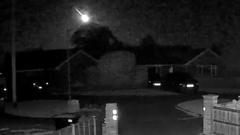
Residents across Suffolk just got a spectacular reminder that we live in a cosmic shooting gallery. A massive meteor streaked across the night sky, turning the darkness into a brief, neon-bright daylight. It wasn't just a faint glimmer. This was a "bolide"—a specific type of fireball that ends with a bright flash as the rock basically gives up and explodes under the intense pressure of our atmosphere.
If you missed it, don’t feel bad. Most people were probably looking at their phones or nursing a cup of tea. But for those with doorbell cameras or a lucky vantage point in Ipswich, Bury St Edmunds, or the rural stretches of the Suffolk coast, it was a once-in-a-decade show.
The Suffolk meteor wasn't a random event without context. We're currently moving through several minor debris fields in our orbit. This specific fireball is a wake-up call for amateur stargazers. You don't need a multi-million-pound telescope to see the coolest things in the universe. You just need to be in the right place at the right time.
What Really Happened Over Suffolk
Let's talk about the physics without getting bogged down in a textbook. That streak of light wasn't "burning" in the way a campfire burns. It’s actually a process called ablation. When a rock from space—usually a fragment of an asteroid or an old comet—hits our atmosphere at roughly 11 to 72 kilometers per second, it compresses the air in front of it.
That air gets insanely hot. We’re talking thousands of degrees Celsius. This heat strips away the outer layers of the rock, creating that glowing trail of ionized gas we call a meteor. The Suffolk event stood out because of its vivid green and blue hues. Those colors aren't just for show. They tell us exactly what that rock was made of. Green typically indicates the presence of nickel or magnesium. If you saw a hint of orange, you were looking at sodium.
I’ve tracked these events for years. Most "shooting stars" are the size of a grain of sand. They vanish in a blink. To get a light show that triggers security lights and gets caught on grainy Ring doorbells across the county, you need something bigger. We’re likely looking at an object the size of a grapefruit or a bowling ball. It sounds small, but when it moves that fast, it carries the energy of a small explosive.
Why Suffolk is a Hotspot for Meteor Sightings
Suffolk has an unfair advantage when it comes to the night sky. While Londoners struggle to see the moon through the orange haze of light pollution, large swaths of the Suffolk countryside remain remarkably dark. The Suffolk Coast & Heaths Area of Outstanding Natural Beauty (AONB) is one of the few places in the UK where you can actually see the Milky Way with the naked eye on a clear night.
Lower light pollution means the contrast between the dark sky and a fireball is much higher. It makes a meteor appear ten times more dramatic than it would over a city center. If you were standing in a dark spot near Aldeburgh or Dunwich, the flash would have been enough to cast actual shadows on the ground.
Identifying a Meteor Versus Space Junk
I see people get this wrong all the time on social media. Someone posts a video of a slow-moving light and claims it’s a meteor. It’s usually not. Here is how you tell the difference.
- Meteors are fast. They cross the sky in a few seconds at most. If it takes thirty seconds to move across your field of vision, it’s likely a satellite or a piece of a rocket re-entering the atmosphere.
- Meteors crumble. Look for fragmentation. A true fireball often looks like it’s shedding sparks or smaller glowing pieces as it dies.
- The "Sonic Boom" factor. Very large meteors can create a delayed thud or a sonic boom. This happens because the object is traveling faster than the speed of sound. If you heard a rumble a few minutes after the flash, you witnessed something truly rare.
The UK Meteor Network (UKMON) is the group you want to check with after an event like this. They use a network of specialized cameras to triangulate exactly where these rocks come from. For the Suffolk meteor, the data suggests it may have originated from the asteroid belt between Mars and Jupiter, wandering through space for millions of years only to end its journey over a quiet English county.
How to Catch the Next One
You don't need luck. You need a plan. People think these events are unpredictable, and while a random "sporadic" meteor like the recent Suffolk fireball is hard to time, we have dozens of scheduled meteor showers every year.
If you want to see a show that rivals what just happened, you need to mark your calendar for the big ones. The Perseids in August and the Geminids in December are the heavy hitters. During these peaks, you can see up to 100 meteors per hour. The trick is to stop looking at the "radiant" (the point where they seem to come from) and instead lie flat on your back to take in as much of the sky as possible.
The biggest mistake I see beginners make? They check their phone. It takes about 20 minutes for your eyes to fully adjust to the dark. One glance at a bright screen to check Twitter for "did anyone else see that?" and your night vision is ruined. You'll miss the fainter streaks that follow the big one.
The Science of Finding Space Rocks
There is a non-zero chance that pieces of the Suffolk meteor actually hit the ground. When a meteor survives its trip through the atmosphere and lands, we call it a meteorite. These things are scientifically priceless. They are essentially time capsules from the birth of our solar system, 4.5 billion years ago.
If you happen to be walking the Suffolk fields and spot a rock that looks out of place, look for a "fusion crust." It will look like a thin, black, burnt orange-peel texture. It will also likely be magnetic. But don't go trampling over private farmland. Most of these fragments are tiny and end up in the North Sea or buried deep in soft soil.
The 2021 Winchcombe meteorite in Gloucestershire changed how we look at these events in the UK. Because people found fragments quickly, scientists were able to analyze minerals that hadn't been touched by Earth's rain or oxygen. The Suffolk fireball might not have left such a big footprint, but it contributes to the same pool of data.
Setting Up Your Own Meteor Watch
Honestly, you can contribute to this science yourself. You don't need to be an astrophysicist. Many people in Suffolk are now installing "All-Sky" cameras. These are small, weather-proof cameras that point straight up and record 24/7. They use software to ignore clouds and planes but save any frames that contain a high-speed streak.
When multiple cameras across East Anglia catch the same meteor, we can use math—specifically the Law of Sines—to calculate the exact trajectory.
$$\frac{a}{\sin A} = \frac{b}{\sin B} = \frac{c}{\sin C}$$
By comparing the angles of the meteor from Ipswich versus Norwich, we can pinpoint its height and speed. It turns a "cool moment" into hard data that helps us track "Near Earth Objects" that could pose a threat later.
Your Next Steps
Stop waiting for the news to tell you about a meteor. Get outside tonight. Even if there isn't a major shower, the "sporadic" rate of meteors is about five per hour. If you spend sixty minutes in a dark Suffolk garden without looking at your phone, you are almost guaranteed to see a piece of the cosmos burning up.
Download an app like Stellarium to identify what you’re looking at, but then put the phone in your pocket. Find a reclining lawn chair, grab a blanket because Suffolk nights get damp, and just watch. The universe is putting on a show every single night. You just have to be willing to look up and wait for the light.
If you think you saw something, report it immediately to the International Meteor Organization (IMO). Your observation, even if it’s just "I saw it in the East and it was green," helps scientists piece together the path of these celestial visitors. Don't worry about being "accurate"—human eyewitness accounts are a staple of meteoritics. Go do it. Your couch isn't going anywhere, but that meteor is moving at 40,000 miles per hour and it won't wait for you.