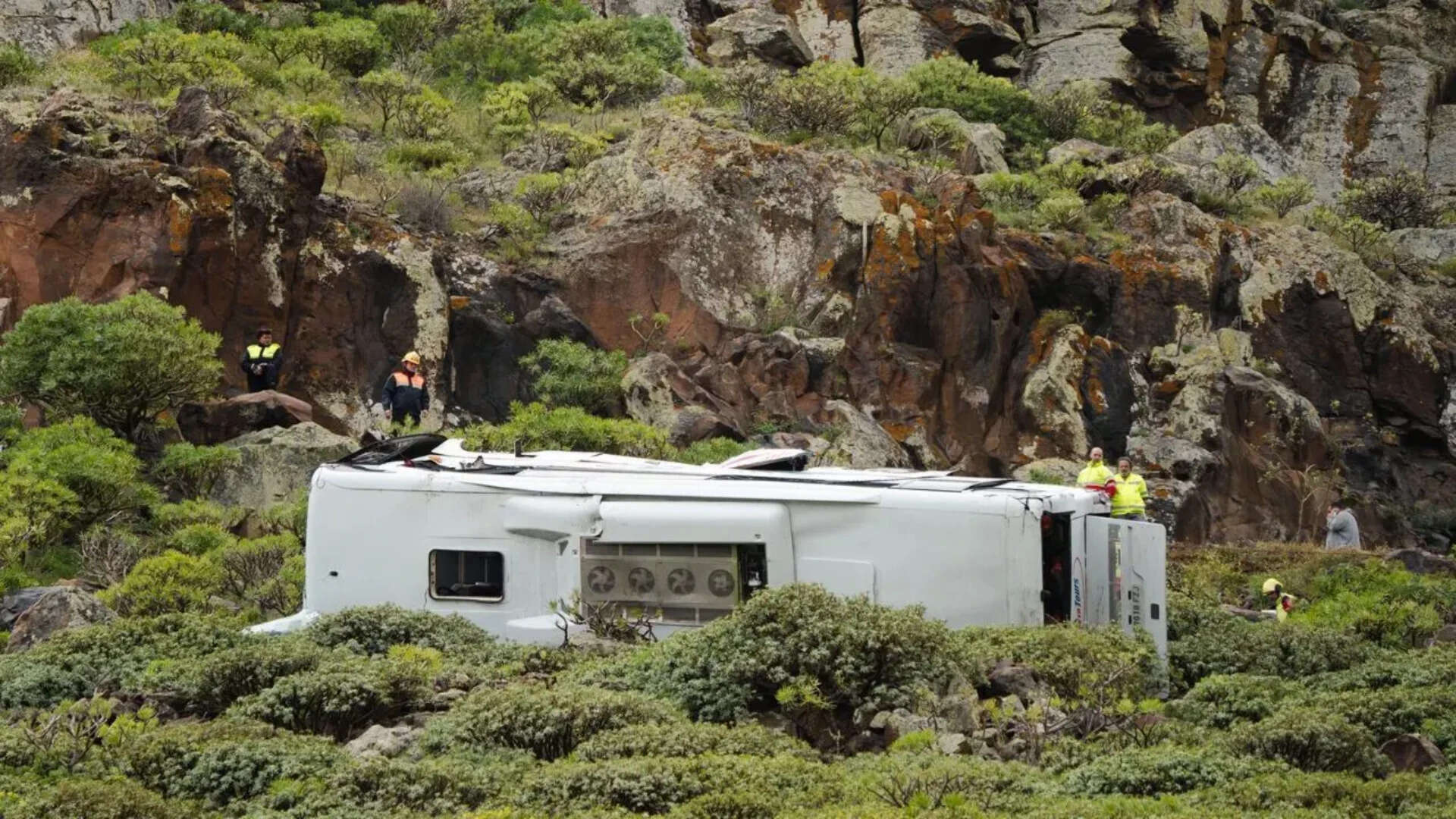
The fatal plunge of a tourist transport vehicle into a ravine in the Canary Islands represents more than a localized traffic accident; it is a systemic failure of the safety-redundancy triad required for high-gradient transit. When a coach carrying 28 passengers exits the roadway in Gran Canaria or Tenerife, the outcome is dictated by the kinetic energy of the vehicle and the topographical severity of the catchment area. This incident, resulting in one fatality and 27 injuries, serves as a case study in the precarious balance between tourism logistics and geographical risk management.
The Physics of Ravine Ingress
In the context of the Canary Islands' volcanic geography, a roadway "exit" frequently transitions into a vertical descent. The severity of such an event is a function of the Gravitational Potential Energy ($GPE = mgh$) being converted into kinetic energy, where $m$ is the mass of the coach (typically 12,000 to 18,000 kg), $g$ is the acceleration due to gravity, and $h$ is the depth of the ravine. Don't forget to check out our previous post on this related article.
The primary mechanism of trauma in these scenarios is the failure of the vehicle’s structural cage. While modern coaches are designed with rollover protection (ECE R66 standards), these certifications often assume a single roll on a flat or slightly inclined surface. A ravine plunge introduces multi-axial forces and repetitive impacts that exceed the energy absorption capacity of the pillars. The resulting "pancaking" effect on the roof is what typically leads to fatal crush injuries or ejection of passengers if seatbelt compliance is low—a common variable in tourist transit.
The Three Pillars of Alpine Transit Risk
Understanding why these accidents persist requires a deconstruction of the operational environment into three distinct risk vectors. If you want more about the context here, The Guardian provides an informative breakdown.
1. The Orographic Constraint
The Canary Islands feature some of the highest road-gradient profiles in Europe. These roads are often characterized by "hairpin" turns (tornantes) and narrow carriageways carved into basaltic rock. The margin for error is non-existent. A momentary steering overcorrection or a brake-fade event—where kinetic energy converts to heat faster than the drum or disc can dissipate it—leads to immediate catastrophic failure.
2. The Mechanical Duty Cycle
Tourist coaches in high-altitude environments undergo accelerated wear. Constant gear-hunting and heavy reliance on retarders (electromagnetic or hydraulic braking systems) put immense strain on the drivetrain. If the retarder fails, the friction brakes overheat within minutes, leading to a state of "brake fade" where the coefficient of friction drops to near zero.
3. The Human Factor in Low-Familiarity Environments
While local drivers are accustomed to the terrain, the psychological load of navigating 28 passengers through high-consequence zones is significant. Fatigue, coupled with the pressure to maintain tight tour schedules, often leads to "heuristic shortcuts" in speed management.
Decoupling Logic: Cause vs. Catalyst
To analyze this event with rigor, one must distinguish between the triggering event and the severity catalyst.
- Triggering Events: These are the initial deviations from the norm. Examples include a mechanical burst of a front-offside tire, an animal crossing, or an oil slick on a sharp bend.
- Severity Catalysts: These are the environmental factors that turn a minor lane departure into a mass casualty event. In the Canary Islands, the lack of high-containment level (H4b) steel or concrete barriers is a primary catalyst. Standard W-beam guardrails are often insufficient to redirect a 15-ton vehicle traveling at even moderate speeds.
The intersection of these two categories determines the "Survivability Quotient." In this specific accident, the fact that 27 individuals survived suggests the descent was either interrupted by vegetation or the vehicle maintained some level of structural integrity during the initial roll.
The Cost Function of Emergency Response in Isolated Terrain
The logistics of a 27-injury event on a ravine-side road present a "bottleneck of care." The Canary Islands' emergency services (SUC - Servicio de Urgencias Canario) must operate within the constraints of the Golden Hour—the period where medical intervention is most likely to prevent death.
- Extraction Complexity: Every victim must be stabilized and hoisted from the ravine floor. This requires technical rope teams and vertical rescue units.
- Triage Ratios: With 28 total victims, a standard ambulance crew is overwhelmed within seconds. This necessitates a "Reverse Triage" logic, where resources are initially allocated to those with the highest probability of survival rather than those with the most critical injuries, until more units arrive.
- Air-Bridge Limitations: While the Canary Islands utilize Bell 412 or Eurocopter search and rescue (SAR) aircraft, high winds and narrow canyons often make aerial extraction impossible, forcing a reliance on slower ground-based transport.
Quantitative Safety Metrics: The Failure of Standard Inspections
Current safety protocols for tourist transport rely heavily on the ITV (Inspección Técnica de Vehículos) and driver tachograph logs. However, these metrics are "lagging indicators"—they tell us the vehicle was safe two months ago or that the driver took a break four hours ago. They do not account for the "Leading Indicators" of disaster:
- Brake Temperature Monitoring: Most coaches lack real-time heat sensors on individual wheel ends.
- Inertial Load Sensors: Standard telematics often fail to track the lateral G-forces experienced in mountain hairpins, which contribute to tire-bead stress.
- Terrain-Specific Training: There is no universal requirement for "High-Altitude Certification" for drivers operating in these specific micro-climates.
The disconnect between European-wide road standards and the specific demands of volcanic island topography creates a "Safety Gap." A road that meets EU regulatory minimums for width and banking can still be fundamentally unsafe for a long-wheelbase coach.
Structural Recommendation for Transport Risk Mitigation
To move beyond the reactive cycle of accident reporting, tourism authorities and transport providers must shift toward a predictive safety model. This involves the mandatory installation of Active Brake Monitoring Systems and the implementation of Geo-Fencing Speed Governors that automatically limit vehicle velocity based on GPS-mapped slope gradients.
Furthermore, the "Civil Engineering Redundancy" on high-risk routes must be upgraded. Replacing standard guardrails with high-absorption energy attenuators at identified "Hot Zones" (curves with a radius of less than 30 meters) would effectively decouple a driver error from a fatal descent.
The primary strategic move for operators is the transition from high-capacity 50-seater coaches to smaller, more agile "midibus" platforms for interior island routes. The lower center of gravity and reduced mass significantly improve the Static Stability Factor (SSF), lowering the probability of a rollover during a lane departure. Smaller vehicles also reduce the "Triage Load" on local emergency services, ensuring that in the event of a failure, the scale of the crisis remains within the immediate response capacity of the local infrastructure.
Operators should immediately audit their fleet's retarder efficiency and mandate seatbelt interlocks that prevent the vehicle from exceeding 20 km/h unless all passengers are secured. This shifts the safety burden from the driver’s verbal commands to the vehicle’s operating system.