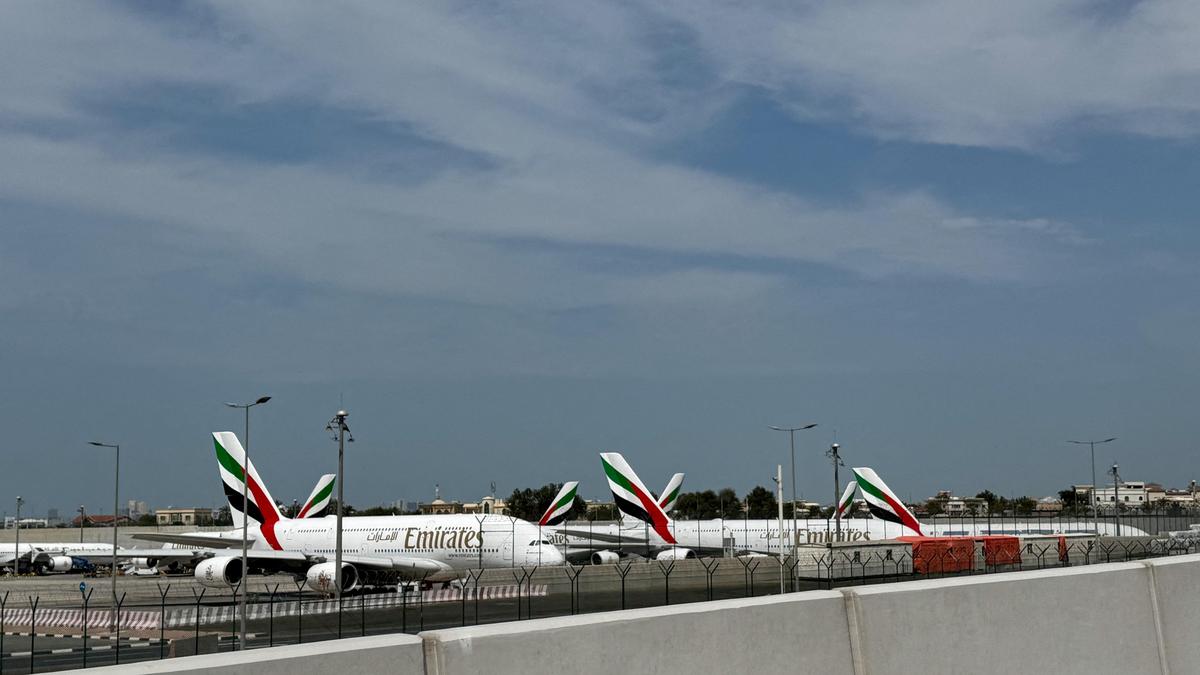
Dubai International Airport (DXB) operates not as a traditional transport node but as a high-velocity liquidity engine for global human capital. The 66% drop in passenger volume triggered by regional instability exposes a fundamental vulnerability in the "Hub and Spoke" model: the total reliance on geopolitical equilibrium. When the geography of the hub becomes a theatre of risk, the efficiency of the network collapses. This contraction is not a temporary dip in demand but a systemic failure of the transit-dependent economic architecture that defines the modern aviation industry.
The Mechanics of Network Disruption
The viability of a global transit hub depends on three critical variables: geographic neutrality, operational continuity, and perceived airspace safety. Regional conflict degrades all three simultaneously.
- Airspace Geometry Degradation: As conflict zones expand, flight paths must be rerouted. This increases fuel burn, extends crew duty cycles, and reduces the number of viable rotations an aircraft can complete in a 24-hour period. For a carrier like Emirates, which relies on synchronized "banks" of arrivals and departures, a 30-minute delay in a single spoke can derail the entire hub’s efficiency.
- The Insurance Risk Multiplier: War risk insurance premiums are not static. They scale with the proximity of the infrastructure to active kinetic zones. As these costs are passed to the consumer or absorbed by the carrier, the price-elasticity of demand for "discretionary transit" (travelers who could choose Istanbul, Doha, or Singapore instead) triggers a sharp volume decline.
- Bilateral Agreement Volatility: Conflict often leads to the suspension of overflight rights or direct route cancellations. When 66% of traffic vanishes, it signifies a breakdown in the connectivity between the Middle East, Europe, and the Asian corridors—the very arteries DXB was built to serve.
The Cost Function of Idle Infrastructure
A 66% reduction in throughput creates a massive divergence between fixed operational costs and variable revenue streams. Large-scale airports have high "break-even" load factors due to the immense capital expenditure required for runway maintenance, security protocols, and terminal cooling.
Operational Deleveraging
In a standard business model, costs scale with volume. In aviation infrastructure, the baseline cost to keep the lights on and the runways certified remains largely fixed. When volume drops by two-thirds, the "per-passenger" cost of operation triples. This creates a liquidity trap. If the airport raises landing fees to cover the gap, it drives away the remaining airlines. If it keeps fees low, it bleeds cash.
The Concessions Death Spiral
Approximately 40% to 50% of a major hub's revenue often comes from non-aeronautical sources—duty-free, food and beverage, and luxury retail. These businesses rely on high "dwell time" and foot traffic density. A 66% drop in passengers does not result in a 66% drop in retail revenue; it often results in an 80% or 90% drop, as the remaining passengers are often distressed travelers or essential personnel who lack the "leisure mindset" required for high-margin retail consumption.
The Geometric Failure of the Middle East Corridor
To understand why a regional war hits Dubai harder than a domestic-heavy market like the United States or China, we must analyze the Transit-to-Domestic Ratio.
- Dubai (DXB): Transit-to-Domestic ratio is approximately 85:15.
- London (LHR): Transit-to-Domestic ratio is approximately 35:65.
- Atlanta (ATL): Transit-to-Domestic ratio is approximately 25:75.
Dubai lacks a "hinterland"—a domestic population large enough to sustain flight operations when international borders or airspaces become unstable. This makes the airport a derivative of global geopolitical stability. When the region becomes a "no-fly" zone for risk-averse travelers, there is no domestic floor to catch the fall. The 66% drop is the mathematical expression of this lack of a domestic buffer.
Strategic Bottlenecks in Air Traffic Management
The immediate bottleneck during regional conflict is Air Traffic Control (ATC) Capacity. When specific sectors of airspace are closed (e.g., over Iraq, Syria, or Yemen), traffic is compressed into narrower corridors.
This compression leads to:
- Flow Management Constraints: Aircraft must be spaced further apart for safety, reducing the hourly arrival rate (AAR) of the airport.
- Fuel Hedging Inefficiency: Unpredictable rerouting makes fuel planning impossible. Carrying "contingency fuel" adds weight, which increases fuel burn—a circular economic penalty.
- Secondary Hub Cannibalization: As DXB becomes a high-risk node, traffic shifts to competitors with more "geographic insulation." This creates a permanent shift in passenger habits; once a corporate travel department reroutes its employees through a safer hub, returning to the original node requires a significant price or convenience incentive.
The Psychological Threshold of the Premium Traveler
Dubai’s aviation strategy is built on the "Premium Leisure" and "Global Corporate" segments. These demographics are highly sensitive to perceived risk. Unlike budget travelers who may tolerate minor delays or risks for a lower fare, the premium segment—which provides the majority of the profit margin for carriers like Emirates—pivots rapidly to alternative routes.
The decline in traffic reflects a breach of the "safety halo." In aviation, brand equity is synonymous with predictability. If a hub cannot guarantee a seamless, safe transit, its value proposition as a "global crossroad" evaporates. The 66% drop suggests that the majority of global travelers no longer view the Gulf corridor as a predictable path.
Operational Pivot: The Logistics Hedge
The only mechanism to mitigate a 66% drop in passenger traffic is a rapid pivot toward dedicated freighter operations (Air Cargo). While passenger decks (belly cargo) usually carry 50% of global air freight, the grounding of two-thirds of the fleet creates a massive supply-side crunch for logistics.
- Conversion of Passenger Capacity: Utilizing empty passenger aircraft as "preighters" to move high-value electronics, pharmaceuticals, and perishables.
- Sea-to-Air Integration: Leveraging the Jebel Ali Port to move goods by sea to Dubai and then by air to Europe, bypassing blocked land routes.
- Humanitarian Logistics: Positioning the hub as a distribution point for aid, though this rarely offsets the loss of high-margin commercial passenger fees.
The Structural Realignment of Gulf Aviation
The era of "infinite growth" for Gulf hubs is facing its first major structural limit. The assumption that global traffic would always flow through the path of least resistance (the Middle East) is being tested by the reality of kinetic conflict.
Future strategy must involve Diversified Hub-Spoke Architectures. Relying on a single massive airport (DXB) is a "single point of failure" risk. The transition of operations to Dubai World Central (DWC) or the development of more point-to-point long-haul routes that bypass the region entirely are the only logical responses to a 66% traffic collapse.
Airlines must now price in "Geopolitical Risk Premiums" into their long-term fleet planning. This likely means a shift away from massive aircraft like the A380—which require high-density hub volumes to be profitable—toward smaller, long-range twin-engine jets (A350, 787) that can fly "around" conflict zones and serve smaller cities directly.
The 66% decline in Dubai's traffic is the market's way of signaling that the "Megahub" model is over-leveraged against peace. To survive, the aviation industry must de-risk its geography by decoupling growth from any single volatile region. The immediate strategic play for stakeholders is to divest from high-density hub infrastructure and reallocate capital toward flexible, long-range point-to-point assets that can navigate a fragmented global landscape.