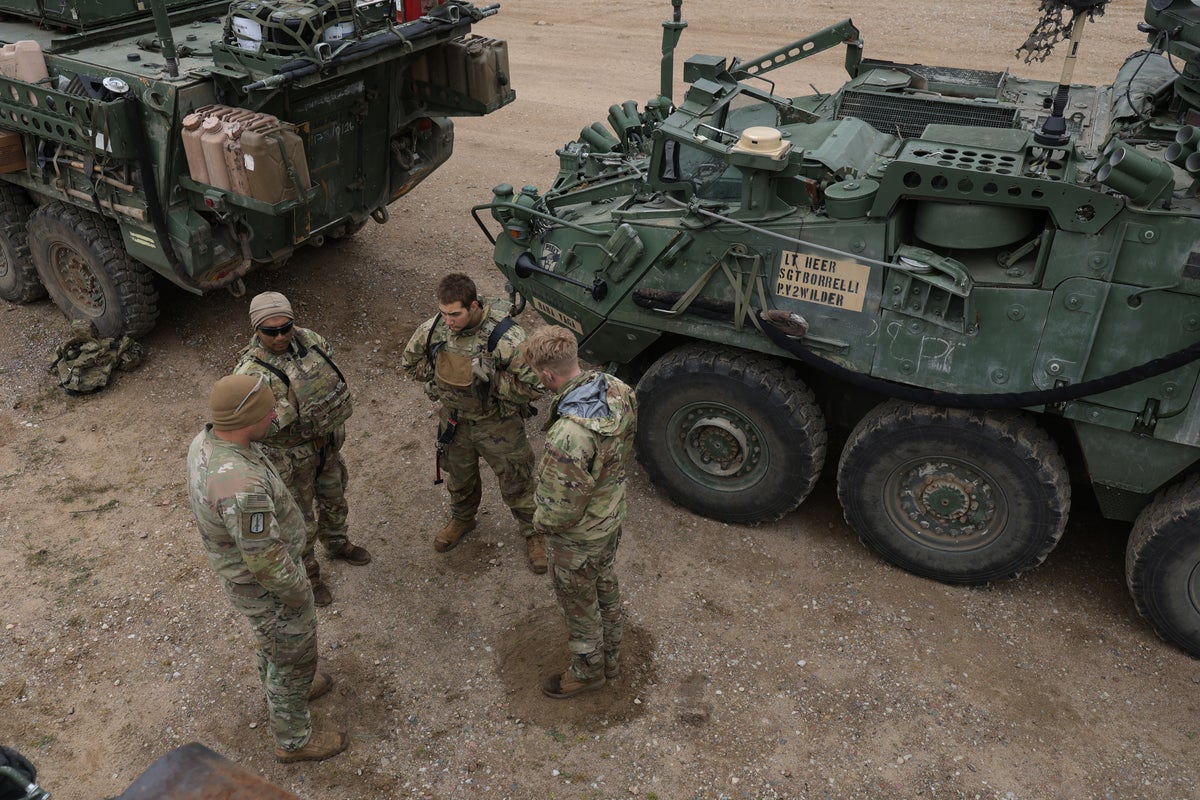
The cancellation of the 4,000-troop deployment to Poland by Secretary of Defense Pete Hegseth represents a fundamental shift from permanent forward-presence orthodoxy to a doctrine of strategic unpredictability and cost-efficiency. While initial reporting characterized the move as a "blindsiding" of the Pentagon, a rigorous analysis suggests it is a deliberate stress test of the North Atlantic Treaty Organization (NATO) burden-sharing model. This decision serves as a functional pivot away from the European Deterrence Initiative (EDI) baseline, forcing a reassessment of how the United States calculates the return on investment (ROI) for overseas garrisoning.
The Triad of Deterrence Efficiency
To evaluate the impact of this cancellation, one must look past the immediate logistical friction and examine the three variables that dictate modern force posture: Response Velocity, Host Nation Reciprocity, and Opportunity Cost of Capital. You might also find this related article useful: The Triangulation of Tehran Structural Mechanics of US China Alignment on Iranian Nuclear Containment.
- Response Velocity: The assumption that physical presence is the only viable deterrent is being challenged by the concept of "Dynamic Force Employment." By canceling the 4,000-troop rotation, the Department of Defense (DoD) is signaling that it prioritizes the ability to surge forces from the Continental United States (CONUS) over maintaining static targets in Eastern Europe.
- Host Nation Reciprocity: Poland has historically been one of the most aggressive spenders on defense within NATO, frequently exceeding the 2% GDP threshold. However, from a transactional strategic lens, a permanent or long-term rotational U.S. presence acts as a subsidy that can inadvertently de-incentivize further independent regional defense integration.
- Opportunity Cost of Capital: Every dollar spent on the logistics of a Polish deployment—housing, transport, and sustainment of the 1st Armored Division elements or similar units—is a dollar not spent on the Pacific Deterrence Initiative or the procurement of long-range precision fires.
Breaking the Logic of the European Deterrence Initiative
The European Deterrence Initiative, established in 2014, was designed to reassure allies through visible, persistent presence. Hegseth’s cancellation of the 4,000-troop increment breaks the "Reassurance Cycle" in favor of a "Readiness Cycle."
The Reassurance Cycle creates a feedback loop where allies demand U.S. boots on the ground to feel secure, which in turn leads to the U.S. military becoming a permanent fixture of European internal security. This creates a bottleneck in global force management. By abruptly halting the deployment, the new leadership is forcing the Pentagon to justify these movements through a rigorous cost-benefit analysis rather than historical momentum. As highlighted in latest articles by Reuters, the effects are significant.
The mechanism of "blindsiding" described by internal sources is actually the failure of the interagency process to adapt to a top-down directive style. Historically, the Joint Staff and Combatant Commands (like EUCOM) operate on a two-to-three-year planning horizon. A sudden cancellation disrupts the "Flow of Force" (the sequenced movement of units through ports of debarkation), but it also exposes the lack of flexibility within the current bureaucratic framework.
Quantifying the Institutional Friction
The friction generated by this decision is not merely political; it is deeply mathematical. A brigade-sized element (roughly 4,000 troops) involves a massive logistical tail.
- Logistical Throughput: The movement involves thousands of pieces of rolling stock, tracked vehicles, and containers. Canceling this mid-stream creates a "Logistical Whiplash" effect where units already in the pre-deployment training cycle (at the National Training Center or similar hubs) must be retrofitted for stay-behind missions.
- Budgetary Reallocation: The funds earmarked for this rotation—often drawn from Overseas Contingency Operations (OCO) style accounts or specific EDI line items—now sit in a state of flux. The strategic question is whether these funds can be legally and effectively re-vectored into high-end capability development, such as hypersonic testing or drone swarm integration, which Hegseth has signaled as a priority.
This disruption serves as a "forcing function." It forces the military bureaucracy to prove that the 4,000 troops were essential to preventing a Russian incursion, rather than just being a symbolic gesture. If the security situation in Poland remains stable without the 4,000 additional troops, the argument for future large-scale rotational deployments is fundamentally undermined.
The Burden Sharing Calculus and Polish Autonomy
Poland’s role in this equation is unique. Unlike Western European nations that have historically underspent on defense, Warsaw has been on a procurement binge, purchasing Abrams tanks, HIMARS, and K2 Black Panther tanks from South Korea.
The cancellation of the U.S. deployment creates a power vacuum that Poland is uniquely positioned to fill. This aligns with a "burden-shifting" strategy rather than a "burden-sharing" one. In a burden-shifting model, the U.S. provides the high-end "enablers" (intelligence, surveillance, reconnaissance, and nuclear umbrella), while the host nation provides the "bulk" (infantry and armor).
The risk here is a perceived decoupling. If the Kremlin views the cancellation as a wavering of U.S. commitment, the threshold for hybrid warfare or "gray zone" provocations may lower. However, if the Polish military successfully fills the gap, it validates a new model where U.S. involvement is the exception, not the rule.
Operational Risks of the Strategic Pivot
The primary risk of this decision is not a Russian tank offensive, but the degradation of "Interoperability." Interoperability is the ability of different nations' forces to work together effectively. It is built through repetitive, small-scale engagements and large-scale exercises.
When a 4,000-troop deployment is scrapped, the following "Soft Power" assets are lost:
- Human Interoperability: Lower-level commanders lose the experience of working with Polish counterparts.
- Technical Interoperability: The testing of secure communications and data links (Link 16, etc.) in a field environment is bypassed.
- Procedural Interoperability: The "muscle memory" of moving large formations across European rail networks atrophies.
These losses are difficult to quantify on a spreadsheet but are vital during a hot conflict. The Hegseth strategy assumes that these risks are outweighed by the benefits of a more agile, less predictable U.S. military.
The "America First" Doctrine Applied to Force Posture
The cancellation must be viewed through the lens of a "Transactional Defense." This doctrine views security as a commodity. If the U.S. is the sole provider of security, it holds the leverage to dictate terms. By withdrawing the 4,000 troops, the administration is effectively "resetting the price" of U.S. protection.
This creates a new baseline for negotiations with NATO. It signals that no deployment is permanent and no commitment is immune to revision based on the current administration’s assessment of national interest. This is a departure from the "Liberal International Order" framework which prioritizes stability and long-standing alliances as ends in themselves.
Regional Implications Beyond Warsaw
The ripples of the Poland decision extend to the Baltic States (Estonia, Latvia, Lithuania). These nations rely on the "tripwire" effect—the idea that even a small number of U.S. troops would ensure full U.S. involvement in any conflict.
By pulling back 4,000 troops from Poland—the strategic depth for the Baltics—the tripwire becomes thinner. This necessitates a rapid evolution of the "Porcupine Defense" strategy for these smaller nations, focusing on anti-tank guided missiles (ATGMs), man-portable air-defense systems (MANPADS), and decentralized insurgency tactics rather than relying on a U.S. armored counter-attack.
Strategic Recommendation for Regional Stakeholders
The cancellation of the 4,000-troop deployment is not an isolated incident but a template for future U.S. force management. Alliances are moving from a "Subscription Model" (fixed presence for a fixed expectation) to an "On-Demand Model" (surge capacity based on immediate crisis).
European defense ministries must immediately accelerate the development of the "European Pillar" of NATO. This involves:
- Standardizing ammunition and parts across EU nations to reduce reliance on the U.S. logistical tail.
- Investing in sovereign heavy-lift capabilities to move their own troops without U.S. Air Force assistance.
- Establishing a permanent European operational headquarters that can function independently of U.S. European Command (EUCOM) for regional contingencies.
The U.S. military is currently undergoing a "Strategic Contraction" to prepare for a "Potential Expansion" in the Indo-Pacific. The Poland decision is the first major data point in this realignment. Observers should expect similar audits of troop levels in Germany, South Korea, and Japan. The era of the "Permanently Forward" U.S. military is ending; the era of the "Rapidly Projectable" U.S. military has begun.
Ultimately, the measure of success for this policy will not be found in the reaction of the Pentagon’s senior leadership, but in the speed at which European allies increase their own readiness. If the gap is filled by European armor, Hegseth’s "blindside" will be remembered as the catalyst for a more sustainable, balanced Atlantic alliance. If the gap remains empty, the risk of a miscalculated escalation by regional adversaries increases significantly.
The final move for the DoD is to codify this "Unpredictability Doctrine" into the next National Defense Strategy, ensuring that the movement of every battalion is tied to a specific, measurable strategic outcome rather than an indefinite commitment to a 20th-century geography.

,webp/025/394/392/1280x720.17302063.jpg)