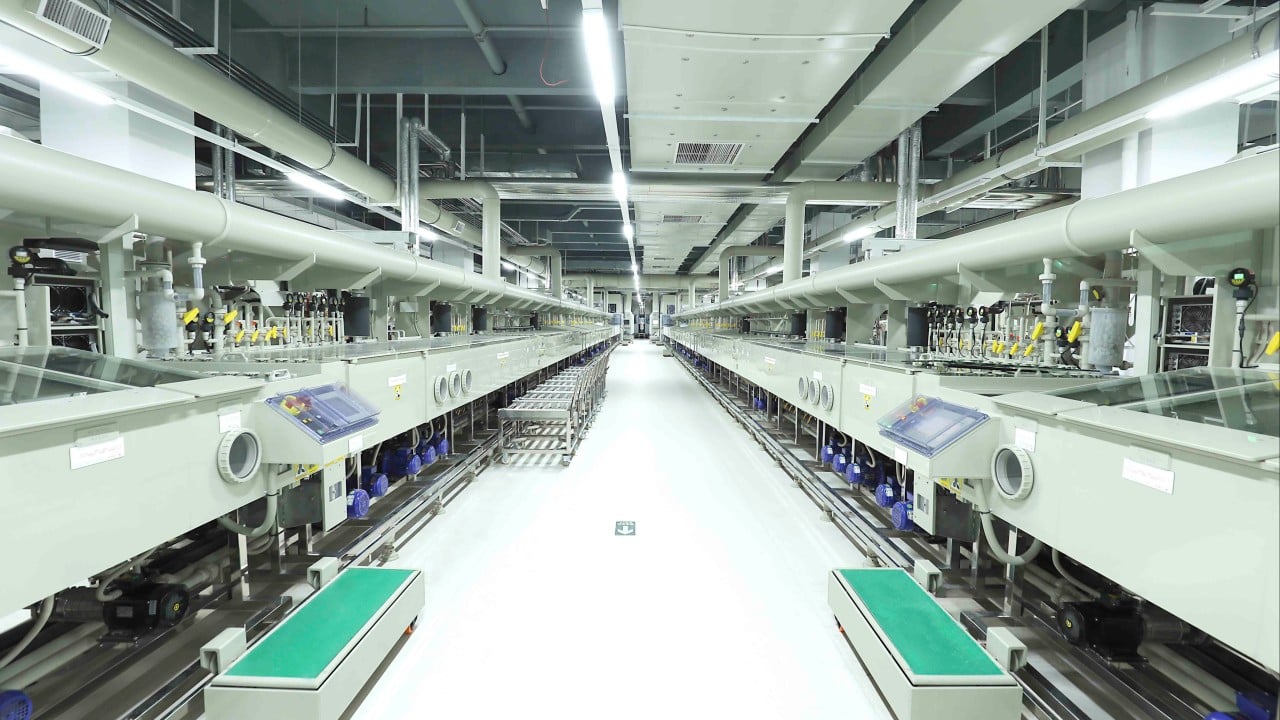
Victory Giant Technology’s (VGT) 57% appreciation during its Hong Kong debut serves as a clinical case study in how capital markets price the intersection of geopolitical supply chain de-risking and the physical infrastructure requirements of Generative AI. This valuation surge is not a byproduct of retail sentiment; it is a quantitative acknowledgment of VGT’s position within the high-density interconnect (HDI) and multi-layer printed circuit board (PCB) vertical. As hyperscalers accelerate the deployment of GPU clusters, the PCB transitions from a passive substrate to a critical thermal and signal integrity bottleneck. VGT’s secondary listing provides the liquidity necessary to scale production for a specific class of high-layer-count boards that currently face a global supply deficit.
The Physical Constraints of AI Compute Power
The primary driver of VGT’s valuation is the radical shift in PCB complexity necessitated by the transition from General Purpose Servers to AI-optimized nodes. Standard server motherboards typically utilize 10 to 14 layers. In contrast, boards designed to support high-performance accelerators—specifically those housing NVIDIA Blackwell or AMD Instinct architectures—require 20 to 30+ layers with specialized low-loss materials.
This shift alters the unit economics of PCB manufacturing through three distinct levers:
- Layer Count and Aspect Ratio Complexity: Increasing layer counts exponentially raises the risk of registration errors during lamination. A single misalignment in a 28-layer board renders the entire unit scrap, creating a steep yield curve that favors established high-volume players like VGT.
- Signal Integrity and Dielectric Materials: High-speed data transmission (PCIe 6.0 and beyond) requires ultra-low-loss copper-clad laminates (CCL). VGT’s ability to manage the chemical bonding of these advanced materials while maintaining impedance control is a proprietary operational moat.
- Drilling Precision: The move toward "Any-layer" HDI requires advanced laser drilling for microvias. The capital expenditure required for these machines creates a high barrier to entry, insulating incumbents from lower-tier competitors who lack the balance sheet to modernize their toolsets.
Mapping the Global Dual-Listing Strategy
Victory Giant’s decision to list in Hong Kong while maintaining its Shenzhen presence is a tactical move to resolve a specific capital bottleneck. Domestic A-share markets offer high valuations but present significant friction for international capital allocation and M&A activity.
By securing Hong Kong-denominated capital, VGT achieves two strategic objectives. First, it creates a "currency bridge" for international expansion. To serve global Tier-1 CSPs (Cloud Service Providers), PCB manufacturers must diversify their manufacturing footprint outside of mainland China to satisfy "China + 1" procurement mandates. The Hong Kong proceeds likely fund capacity expansion in regions like Southeast Asia, allowing VGT to bypass geopolitical trade barriers while retaining its core R&D and engineering talent in Huizhou.
Second, the dual-listing narrows the "valuation gap" between domestic hardware providers and global electronics manufacturing services (EMS). The 57% jump indicates that international institutional investors were under-allocated to the Chinese PCB sector relative to its role in the global AI hardware stack.
The Unit Economics of Yield and Capacity Utilization
The profitability of a PCB supplier is a direct function of the relationship between Throughput (T), Yield Rate (Y), and Material Cost (M). For high-spec AI boards, the cost of raw materials—specifically high-end CCL from suppliers like Shengyi Technology or Rogers Corp—accounts for a disproportionate percentage of the Total Cost of Goods Sold (COGS).
$$Total Cost = \frac{M + Labor + Overhead}{Y}$$
When Y (yield) falls below 90% for a 20-layer board, the margin collapses because the material cost (M) is sunk. VGT’s historical data suggests an operational efficiency that maintains high yields even as board complexity increases. This is achieved through automated optical inspection (AOI) integrated at every lamination stage, a capital-intensive process that smaller competitors cannot afford to implement at scale.
The market is pricing in an expansion of VGT’s EBITDA margin as the product mix shifts from consumer electronics (low margin, 4-6 layers) to AI-driven data center infrastructure (high margin, 20+ layers). This "mix-shift" is the most potent driver of earnings per share (EPS) growth in the electronics component sector.
Supply Chain Interdependencies and Risk Factors
While the 57% debut reflects optimism, the structural risks inherent in the PCB industry are non-linear. The most significant threat to VGT’s growth trajectory is the upstream concentration of CCL (Copper Clad Laminate) suppliers. If the supply of ultra-low-loss resin or specialized glass cloth is disrupted, VGT’s production lines—no matter how advanced—become idle.
Furthermore, the "commoditization trap" remains a persistent threat. Historically, PCB innovations follow a rapid decay curve. What is "high-layer count" today becomes the industry standard in 24 months. VGT must maintain a continuous R&D cycle to transition from 800G optical module boards to the next generation of 1.6T networking hardware. Failure to lead the transition to "Glass Substrates"—an emerging technology for chiplet packaging—could render traditional organic PCB manufacturing obsolete for the highest-end AI applications by 2027.
Structural Competitive Positioning
VGT’s competitive advantage is best understood through the lens of Operational Velocity. In the electronics sector, the "Design-to-Mass Production" cycle is shrinking. Automotive OEMs and AI hardware startups require rapid prototyping and immediate scaling. VGT’s highly integrated manufacturing campus allows for a compressed feedback loop between engineering design and assembly.
Key differentiators include:
- Vertical Integration in Thermal Management: As heat dissipation becomes the limiting factor for AI clusters, VGT’s expertise in metal-core PCBs and embedded heat sinks provides a unique value proposition to server integrators.
- Customer Concentration Diversification: Unlike smaller peers who may rely on a single smartphone OEM, VGT has successfully penetrated the automotive (EV) and server markets, insulating it from the cyclicality of the handset market.
- Compliance and ESG for Global Tenders: International listings demand higher transparency. By meeting HKEX standards, VGT improves its "Investability" for ESG-mandated sovereign wealth funds and pension funds, lowering its long-term weighted average cost of capital (WACC).
Strategic Allocation and Market Forecast
Investors should view the Victory Giant debut as the opening of a new cycle in hardware infrastructure. The "easy" gains in the AI trade—buying GPU designers—have largely been realized. The second-order trade involves identifying the specialized component manufacturers who enable those GPUs to function at 100% duty cycles in a data center environment.
The fundamental thesis for the PCB sector in 2026 revolves around the "Silicon-to-System" integration. As chips become more powerful, the physical board must evolve to handle higher current densities and more aggressive cooling requirements. Victory Giant is currently one of the few entities with the scale to meet the volume requirements of the world's three largest cloud regions simultaneously.
The successful Hong Kong debut provides the "war chest" needed for VGT to aggressively pursue market share in the automotive AI space—specifically in Domain Control Units (DCUs) for autonomous driving, which require the same high-reliability HDI boards used in data centers.
The strategic play for VGT is to utilize its new capital to acquire smaller, specialized European or Japanese materials firms. This would allow them to move upstream, capturing the high-margin CCL manufacturing process and securing their supply chain against future geopolitical shocks. The 57% jump is not an peak; it is a re-baselining of the company's valuation to reflect its status as a foundational utility for the global compute economy. Companies that fail to secure long-term capacity agreements with Tier-1 PCB suppliers like VGT will find themselves unable to ship AI hardware regardless of their access to silicon.