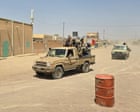
The deployment of the Russia-linked Africa Corps—the successor entity to the Wagner Group’s decentralized operations—to Mali represents a shift from purely mercenary activity to a formalized state-adjunct security architecture. Recent operational claims that the group neutralized a coup attempt following rebel territorial gains in Northern Mali suggest a specific interventionist logic: the preservation of the ruling junta’s "sovereignty" in exchange for deep-tier access to extractive resources and strategic basing. This model functions through the synchronization of tactical kinetic support, information warfare, and the systematic replacement of Western institutional influence with a bilateral dependency loop.
The Security-Dependency Architecture
The Russian presence in Mali operates via a three-layered structural framework designed to insulate the transition government from both internal dissent and external pressure.
- Kinetic Insulation: Africa Corps provides the tactical backbone for the Malian Armed Forces (FAMa). Unlike traditional UN or French missions (Barkhane), this force operates without the constraints of human rights oversight or complex rules of engagement. This "unrestricted warfare" capability allows the junta to project force into the restive northern regions, even if the actual territorial holding capacity remains low.
- Regime Survivability: The primary product being sold is not "national security" in the abstract, but "regime security" in the specific. By claiming to thwart a coup, Russia signals to other regional leaders that alignment with Moscow provides a personal safety net that Western democratic partnerships—which often demand adherence to constitutional order—cannot match.
- The Resource-Security Swap: The operational costs of the Africa Corps are rarely paid in transparent liquid currency. Instead, the model utilizes a cost-transfer mechanism where mining concessions (gold, lithium, and magnesium) are granted to entities linked to the Russian Ministry of Defense. This creates a self-funding expeditionary force that bypasses international sanctions.
Quantifying the Rebel Incursion and the Counter-Coup Narrative
The escalation in Northern Mali, specifically around the seizure of towns by the CSP-PSD (Permanent Strategic Framework for Peace, Security, and Development) and the Al-Qaeda-linked JNIM, serves as the catalyst for the Africa Corps’ utility. To understand the effectiveness of the Russian intervention, one must distinguish between tactical victory and narrative dominance.
The "coup prevention" claim functions as a high-value signal. If the Malian military experiences significant battlefield losses, the legitimacy of the junta is threatened. By framing a military setback or a localized mutiny as an "foiled international coup," the Africa Corps preserves the junta's authority while positioning itself as the indispensable shield. This creates a feedback loop: the more unstable the country becomes, the more necessary the Russian presence appears, regardless of whether that presence actually reduces the total volume of insurgent violence.
Logistics of the Africa Corps Model
The transition from the Wagner Group to the Africa Corps involved a centralization of command under the Russian Ministry of Defense (MoD). This shift changed the logistical calculus of Sahelian operations.
- Command Integration: Direct oversight by the GRU (Russian Military Intelligence) ensures that paramilitary actions align with broader Kremlin foreign policy. This reduces the risk of rogue elements but increases the "sovereign risk" for the host nation; Mali is no longer dealing with a private company, but an extension of the Russian state.
- Aviation and Sustainment: The use of Il-76 transport aircraft to move personnel and equipment into Bamako provides a heavy-lift capability that local forces lack. This allows for rapid reaction to rebel advances, such as the recent skirmishes in the Kidal region.
- Information Operations (IO): The kinetic actions are always preceded and followed by digital campaigns. These campaigns utilize localized Telegram channels and radio stations to amplify the "liberator" narrative while painting rebel groups and Western actors as a unified enemy.
The Instability Paradox
A critical failure in standard analysis of this region is the assumption that Russia seeks a "peaceful Mali." From a strategic standpoint, a fully stabilized Mali would decrease the demand for Africa Corps services. The optimal state for Russian influence is managed instability.
This state is characterized by a conflict level high enough to justify a permanent foreign security presence, but low enough to prevent the total collapse of the capital. In this environment, the Africa Corps can protect the "center of gravity" (the junta and the mines) while allowing the periphery to remain contested. This ensures a perpetual market for their security exports.
Risk Factors and Structural Bottlenecks
While the Africa Corps model appears effective in the short term, it faces significant long-term structural constraints.
- Attrition Rates: The loss of experienced Wagner veterans in the 2024 Battle of Tinzaouaten demonstrated that Russian forces are not invincible against seasoned desert guerrillas. High casualty rates among elite contractors are difficult to replace given the ongoing demands of the Ukrainian front.
- Fiscal Exhaustion: While gold mines provide revenue, the overhead of maintaining a foreign expeditionary force in a landlocked country with crumbling infrastructure is massive. If the cost of security exceeds the value of the extracted resources, the Russian MoD may be forced to scale back, leaving the Malian junta vulnerable.
- The Extremist Vacuum: By focusing on regime protection rather than counter-insurgency at the village level, the Africa Corps leaves a vacuum in rural areas. Groups like JNIM exploit this by positioning themselves as the "alternative" to the predatory state and its foreign mercenaries, leading to a long-term increase in extremist recruitment.
Strategic Forecast for the Sahelian Corridor
The claim of preventing a coup in Mali is a template for Russian expansion into Burkina Faso and Niger (the Alliance of Sahel States). We are witnessing the assembly of a "Security Belt" across the Sahel that functions as a strategic counter-weight to Mediterranean and European influence.
The most likely trajectory involves the expansion of the Africa Corps into a permanent regional hub. This will move beyond tactical infantry to include Integrated Air Defense Systems (IADS) and more sophisticated drone warfare capabilities. For the Malian state, the price of this protection is a total loss of strategic autonomy. The junta has effectively traded the risk of a domestic coup for the certainty of becoming a peripheral actor in a Great Power competition.
The strategic play for regional observers is to monitor the ratio of resource export to security expenditure. If the Africa Corps begins seizing civilian-operated mines or demanding direct control over the central bank's gold reserves, it will indicate that the "managed instability" model has moved into its final, purely extractive phase. At that point, the risk of a genuine, internally-driven military collapse in Bamako becomes a statistical certainty, as the local officer corps realizes they have been sidelined in their own defense architecture.