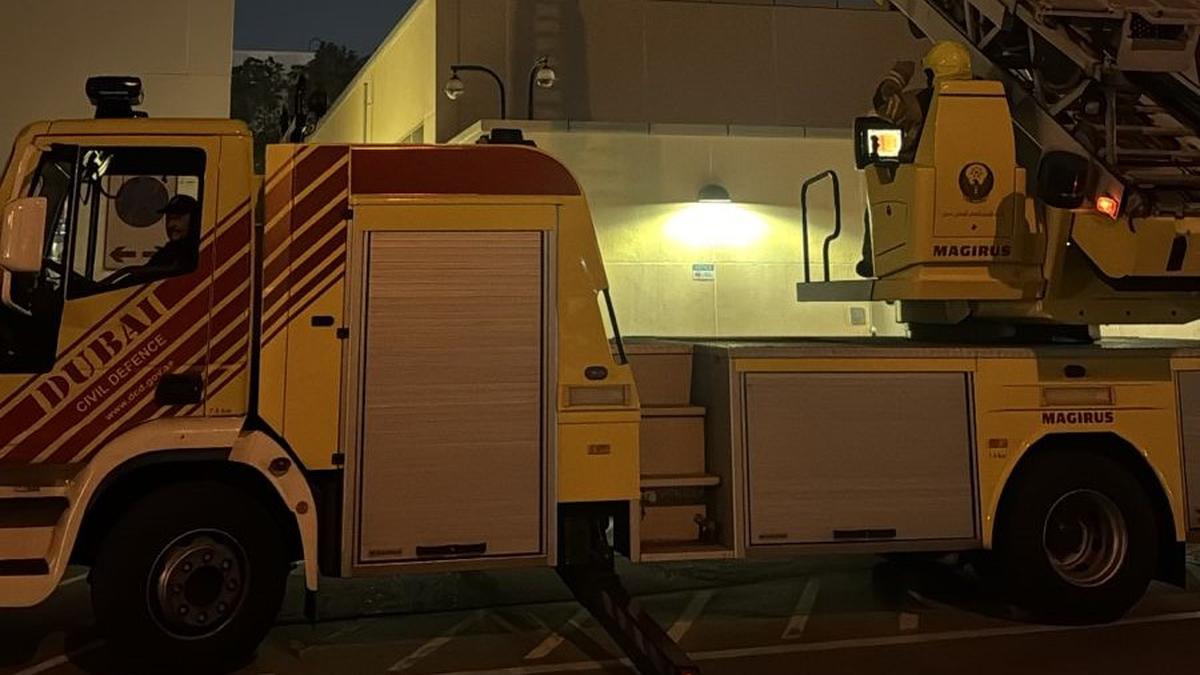
The security architecture of global financial hubs remains perpetually vulnerable to low-cost, high-autonomy aerial threats that bypass traditional kinetic defense perimeters. The recent government-confirmed report of a fire near the United States consulate in Dubai following a drone deployment serves as a definitive case study in Asymmetric Escalation. When a non-state actor or a regional proxy utilizes a sub-$50,000 unmanned aerial vehicle (UAV) to disrupt a multi-billion dollar real estate and diplomatic corridor, the cost-exchange ratio shifts drastically against the defender. This incident is not merely a localized fire; it is a stress test of the United Arab Emirates’ (UAE) integrated air defense systems and the broader regional stability framework.
The Triad of Urban Drone Vulnerability
Analyzing this event requires moving beyond the surface-level reporting of "smoke and sirens" to understand the structural vulnerabilities of a hyper-dense urban environment like Dubai. The risk profile of this attack is defined by three specific vectors:
- Signal Saturation and Clutter: In a metropolis dominated by 5G networks, satellite communications, and localized Wi-Fi mesh systems, detecting a small-RCS (Radar Cross Section) drone is a signal-processing nightmare. Traditional radar systems designed to track fast-moving jets or large ballistic missiles often filter out small, slow-moving objects to prevent "false positives" from birds or weather patterns.
- Collateral Constraints: Unlike a desert intercept, a drone loitering near a diplomatic mission in a high-density area cannot be engaged with high-explosive surface-to-air missiles without risking significant civilian casualties and property damage. This creates a "Defensive Paradox" where the more valuable the target, the harder it is to defend through traditional kinetic means.
- The Proximity-to-Impact Ratio: The distance between the initial detection and the target is often less than three kilometers in urban settings. At standard UAV cruise speeds, this leaves a response window of less than 60 seconds for electronic warfare (EW) jamming or physical interception.
Mechanics of the Incident: Kinetic vs. Non-Kinetic Interaction
Government statements indicate a fire occurred after a drone attack, which suggests one of two mechanical outcomes: a successful impact by an explosive-laden "suicide" drone, or a fire resulting from the interception process itself (falling debris or lithium-polymer battery ignition).
The Energy Transfer Variable
If the drone carried a shaped charge or a fragmentation warhead, the objective was likely symbolic rather than structural destruction. The U.S. consulate and surrounding diplomatic infrastructure are hardened against blast overpressure. However, the secondary effects—specifically the thermal energy released—pose a greater threat to the surrounding commercial glass-and-steel architecture.
Electronic Warfare (EW) Limitations
The UAE utilizes sophisticated jamming arrays. However, the emergence of GNSS-denied navigation (using optical flow or terrain mapping) means that even if the GPS signal is severed, a sophisticated drone can continue its terminal guidance phase. If the drone was jammed and crashed into a secondary structure, the resulting fire is a byproduct of the defense system's success, highlighting the "Second-Order Risk" of urban air defense.
Economic Implications of the Security Premium
Dubai’s value proposition is built on the perception of "Absolute Safety" within a volatile geography. Any disruption to this perception triggers a recalibration of the Security Premium—the additional cost of doing business in a region prone to kinetic spillover.
- Insurance Scoping: Lloyd’s of London and other maritime/property insurers adjust premiums based on "War Risk" designations. An attack within the city limits of Dubai, specifically targeting a high-profile diplomatic site, shifts the actuarial tables for every high-rise within a five-mile radius.
- Foreign Direct Investment (FDI) Stability: Long-term capital expenditure in the UAE relies on the assumption that the state can maintain a "Sanctuary Status" amidst regional proxy conflicts. The persistence of drone threats forces a diversion of national budget from infrastructure development to counter-UAS (C-UAS) procurement.
The Technological Arms Race: C-UAS Frameworks
To mitigate future occurrences, the strategy must shift from reactive interception to a multi-layered Detection-to-Neutralization Pipeline.
- Acoustic and Optical Fusion: Since radar is compromised by urban noise, defenders must deploy high-fidelity microphone arrays and infrared cameras that recognize the unique "chirp" of brushless motors and the heat signature of LiPo batteries.
- Directed Energy Weapons (DEW): The deployment of high-energy lasers or high-power microwaves (HPM) offers a cleaner "kill" than kinetic interceptors. A laser can disable the drone’s optics or melt its control surfaces with millimetric precision, though atmospheric conditions (dust and humidity in the Gulf) can degrade beam coherence.
- Geofencing and Protocol Exploitation: Most commercial drones have built-in "No Fly Zones." State-level actors, however, use custom flight controllers. The defense must therefore involve "Protocol Manipulation"—effectively hijacking the command link of the drone in mid-air to force a safe landing or a return-to-home command.
Structural Geopolitical Consequences
This incident marks a shift in the regional "Rules of Engagement." The choice of target—the U.S. consulate—is a calculated move to draw a global superpower into a localized conflict while maintaining plausible deniability for the perpetrator.
The UAE’s reliance on the "Abraham Accords" and its ties with Western defense contractors make it a primary target for actors seeking to demonstrate the fallibility of Western-integrated defense umbrellas. The bottleneck here is not the lack of technology, but the Information Asymmetry; the attacker only needs to succeed once to shatter the image of invulnerability, while the defender must be perfect 100% of the time across a 360-degree perimeter.
Operational Recommendation for Multi-National Entities
For organizations operating in the vicinity of diplomatic or critical infrastructure in Dubai, the reliance on municipal security is no longer sufficient. The strategic move is the implementation of Autonomous Internal Resilience (AIR).
- Structural Hardening: Retrofitting HVAC intakes with fire-suppressant mesh to prevent smoke ingestion from external fires.
- Independent Communication Redundancy: If a drone attack is coupled with a cyber-offensive or localized jamming, internal fiber-optic loops must remain isolated from public RF-dependent networks.
- Evacuation Modeling: Updating protocols to account for "Top-Down" threats where the roof or upper floors are the primary impact zones, reversing standard "ground-up" fire drill logic.
The escalation from remote border skirmishes to the heart of a global financial center necessitates a total pivot in urban security doctrine. The drone is the ultimate democratic weapon of destruction; defending against it requires a technocratic, data-heavy integration of hardware, software, and psychological resilience.
Establish a private, localized C-UAS monitoring node that operates on passive RF detection. This allows for early warning without interfering with state-run defense systems. Prioritize the installation of low-profile, high-strength window films on all north and west-facing facades of high-value assets to mitigate fragmentation risk from secondary blast effects.