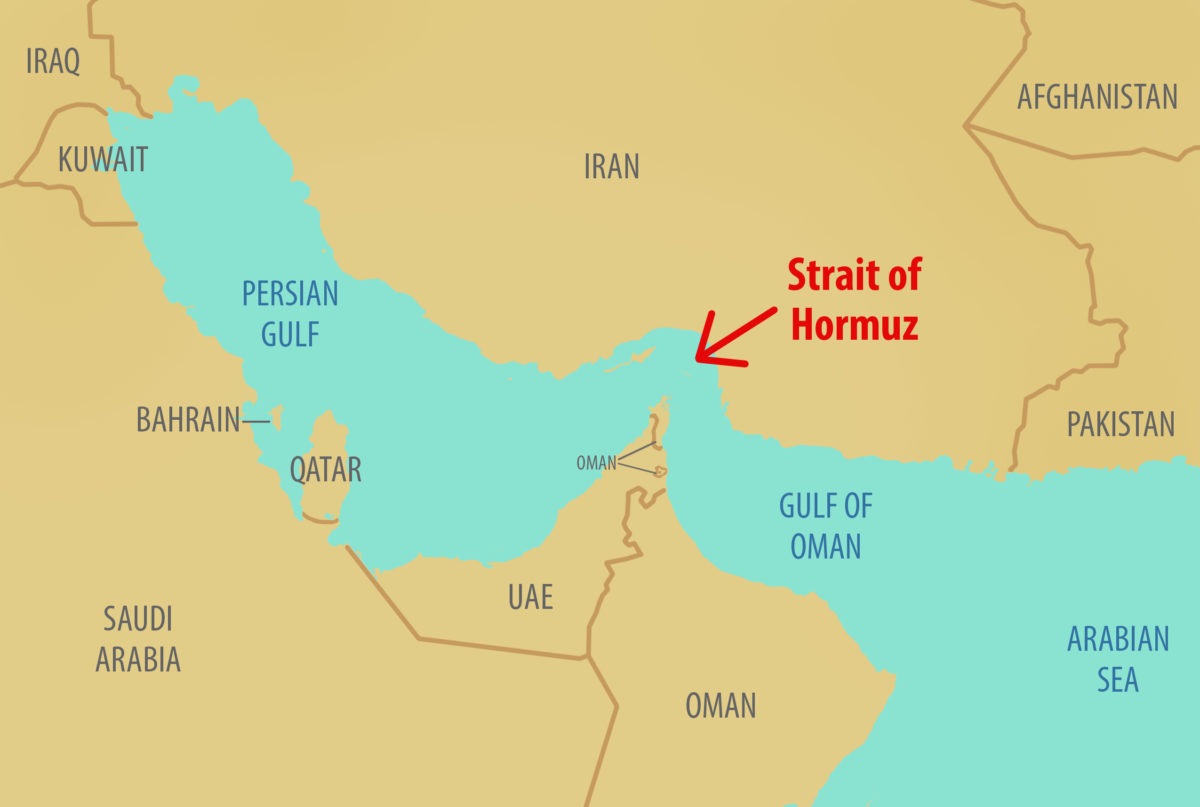
Iranian Foreign Minister Abbas Araghchi’s declaration at the BRICS summit in New Delhi that the Strait of Hormuz remains "open to all except those at war with Iran" is not an open navigation policy; it is the formalization of a conditional transit regime. By shifting the operational definition of the chokepoint from an international waterway to a sovereign security corridor, Tehran is attempting to codify a new maritime baseline. This strategy leverages geographic asymmetry to neutralize external economic and military pressure, specifically targeting the counter-blockade dynamics driven by the United States.
To analyze the strategic realities behind this rhetoric, the situation must be disassembled into its core components: geographic mechanics, legal friction points, and the microeconomics of maritime risk management.
The Asymmetric Transit Equation
The Strait of Hormuz cannot be analyzed under standard open-ocean doctrine. Its physical constraints dictate its geopolitical utility. At its narrowest point, the passage spans approximately 21 nautical miles, but the actual width of the shipping lanes is far more restricted. The Traffic Separation Scheme (TSS) establishes a two-mile-wide inbound lane and a two-mile-wide outbound lane, separated by a two-mile buffer zone.
[Persian Gulf] ---> [Inbound Lane: 2nm] [Buffer: 2nm] [Outbound Lane: 2nm] ---> [Gulf of Oman]
                    └─────── Located within Omani/Iranian Territorial Waters ───────┘
Because these lanes traverse the territorial waters of Iran and Oman rather than international waters, the legal framework governing transit is a primary structural bottleneck. Under the 1982 United Nations Convention on the Law of the Sea (UNCLOS), foreign vessels enjoy the right of transit passage through straits used for international navigation. However, Iran has signed but never ratified UNCLOS. Tehran recognizes only the more restrictive customary international law concept of innocent passage, which allows a coastal state to suspend or condition transit if it deems the cargo or vessel prejudicial to its peace, good order, or security.
Araghchi’s assertion that "there are no international waters" within the passage is the legal foundation for Iran's conditional cooperation model. By asserting that transit requires explicit coordination with the Islamic Revolutionary Guard Corps Navy (IRGCN) or the Islamic Republic of Iran Navy (IRIN), Tehran converts a global maritime highway into a controlled customs checkpoint. This creates a two-tiered operational environment:
- Compliant Neutral Transit: Vessels from aligned or neutral states (such as recent bulk shipments bound for India or Chinese tankers operating under bilateral pricing agreements) are granted pilotage and safe passage vectors to avoid defensive minefields.
- Interdiction Targets: Vessels flying flags of states deemed hostile, or those refusing to transmit manifests and identity data to Iranian coastal stations, face physical detention, as evidenced by recent vessel seizures outside United Arab Emirates ports.
The Cost Function of Maritime Risk
The operational objective of Iran's conditional opening is not the total cessation of maritime commerce, which would devastate its own residual export capabilities and alienate strategic partners like China and India. Instead, the mechanism operates by manipulating the cost function of global shipping companies.
When a coastal state mandates military coordination and warns of active maritime mines within the historical TSS, it triggers specific financial penalties for commercial fleets. The total cost of operating a vessel through a contested chokepoint is defined by three primary variables:
$$\text{Total Transit Cost} = \text{Base Freight Rate} + \text{Hull War Risk Premium} + \text{Demurrage/Delay Cost}$$
By enforcing mandatory naval coordination, Iran directly influences the second and third variables of this equation.
Hull War Risk Premiums
Lloyd’s Joint War Committee maintains the Persian Gulf and Gulf of Oman on its Listed Areas for hull war, piracy, terrorism, and related perils. When Iran imposes a conditional framework, underwriters adjust breach premiums based on the flag state, ownership structure, and compliance level of the vessel. For non-compliant or Western-linked tonnage, these additional premiums can rise to 1% to 1.5% of the total hull value per transit, adding hundreds of thousands of dollars to a single voyage.
Demurrage and Delay Cascades
The requirement to utilize Tehran-approved corridors and wait for naval clearance creates a systematic bottleneck. For a standard Very Large Crude Carrier (VLCC) carrying two million barrels of crude, a five-day delay awaiting coordination or safe routing around minefields costs approximately $50,000 to $100,000 per day in wet demurrage. This cost is ultimately passed down the supply chain, inflating the landed price of energy regardless of actual supply volumes.
This economic mechanism allows Iran to impose a targeted penalty on specific national supply chains while keeping the chokepoint functional for states willing to engage in direct bilateral diplomacy.
The Counter-Blockade Bottleneck
Araghchi’s diplomatic narrative attributes the current closure and disruption entirely to "American aggression and the blockade." This framing masks a complex structural deadlock between US-led maritime coalitions and Iranian defensive deployment.
In April 2026, the United States attempted to enforce a stringent counter-blockade on Iranian ports to halt oil bypass mechanisms. Iran's response was a proportional asymmetric escalation: the deployment of naval mines and the declaration of alternative, controlled routes. This interaction has created a strategic bottleneck characterized by three structural limitations:
- The Mine Clearance Deficit: While the US Navy and multinational partnerships (such as Combined Maritime Forces) possess significant mine countermeasure (MCM) capabilities, including airborne mine neutralizers and autonomous underwater vehicles, clearing a 21-nautical-mile corridor under the umbrella of Iranian shore-based anti-ship cruise missiles (such as the Ghadir and Qader systems) is tactically unfeasible without escalating to full-scale kinetic conflict.
- The Escort Dilemma: Western naval assets can provide close-in security for high-value assets via explicit escort missions. However, the sheer volume of global traffic previously transiting the strait—roughly 20.5 million barrels of oil and petroleum products per day—exceeds the structural capacity of available coalition destroyer and frigate hulls.
- The Bilateral Alternative: By offering safe passage to specific partners, Iran weakens the international consensus required to sustain a counter-blockade. When major consumers like China secure direct exemptions by accommodating limited charging mechanisms and bypassing Western insurance networks, the political will to enforce a hard maritime blockade erodes.
Tactical Realities for Global Logistics
For maritime operators, logistics managers, and sovereign energy planners, navigating the current iteration of the Strait of Hormuz requires a departure from traditional routing assumptions. The operational reality is that the passage is neither completely closed nor reliably open; it is selectively permeable.
Sovereign entities and commercial fleets must evaluate their exposure based on a strict matrix of alignment.
| Vessel Origin / Flag State | Insurance Network | Iranian Naval Coordination Status | Risk Profile |
|---|---|---|---|
| US / UK / Allied Nations | Western P&I Clubs | Refused / Prohibited | Extreme (Subject to immediate interdiction or kinetic targeting) |
| BRICS / Neutral Nations | Non-Western / Sovereign Backed | Maintained via Maritime Ports Org | Moderate (Subject to operational delays and mandatory routing shifts) |
| Aligned / Sanction-Exempt | Proprietary / Self-Insured | Continuous Integration | Low-Moderate (Protected by active bilateral diplomatic guarantees) |
The final strategic play for global energy security under this conditional regime relies on the decoupling of maritime transit from Western institutional verification. As long as Iran maintains its defensive posture and the US maintains its economic restrictions, the traditional Traffic Separation Scheme remains non-functional.
Logistics firms must either accept the structural delays and sovereignty concessions required to utilize Tehran’s approved corridors, or permanently reroute VLCC tonnage around the Cape of Good Hope. The latter option adds roughly 10 to 14 days to transit times and increases bunker fuel consumption by approximately 400 metric tons per voyage, structurally elevating the global baseline for maritime freight costs. Tehran's conditional access policy has successfully converted geographic proximity into an enduring economic tax on international trade.