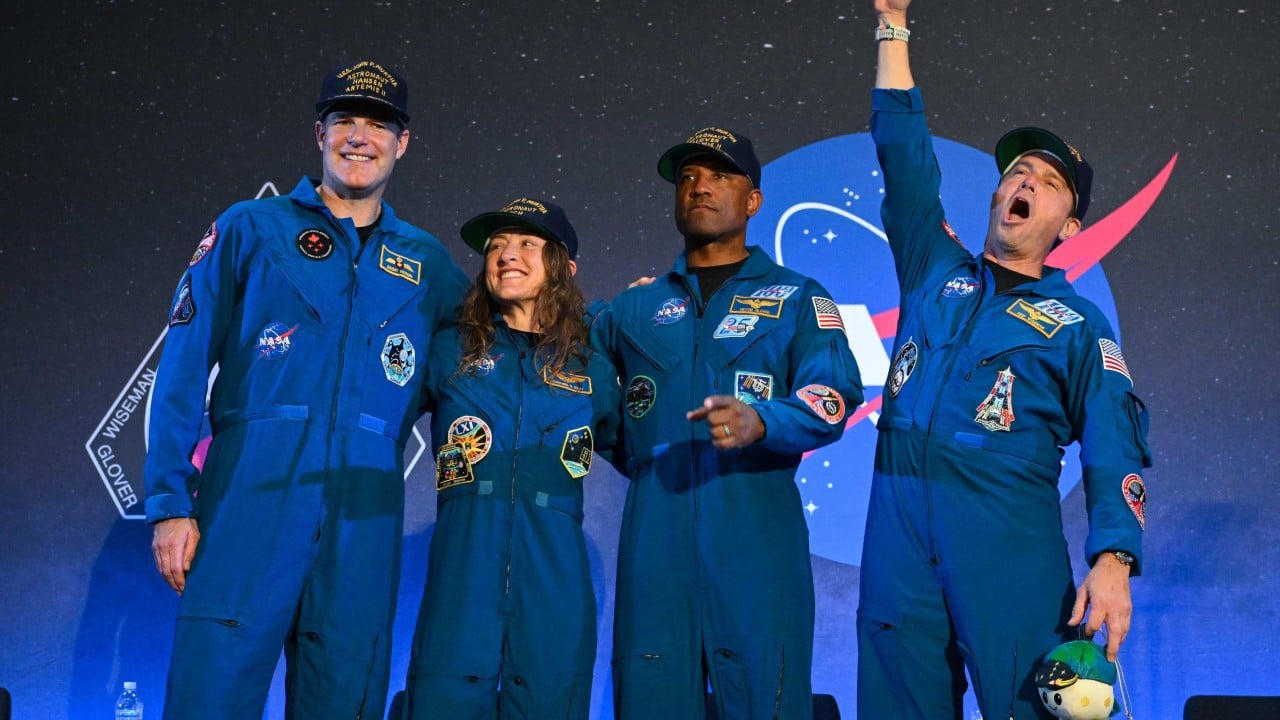
The images from Houston are predictable. Four astronauts in blue flight suits, a waving crowd, and a standing ovation that suggests we are on the verge of a new era. The media narrative is wrapped in a warm blanket of Apollo-era nostalgia, framing Artemis II as a bold leap toward the Moon.
It isn't. It is a high-priced lap of honor for 1970s technology.
While the public celebrates the "return to the Moon," they are missing the uncomfortable reality: we are currently burning billions to refine chemical propulsion systems that reached their physical limits decades ago. If you think Artemis II is about progress, you are looking at the wrong map. We aren't building a bridge to the stars; we are building a very expensive museum exhibit in orbit.
The Tyranny of the Rocket Equation
The applause in Houston masks a fundamental mathematical failure. Space flight today still bows to the Tsiolkovsky rocket equation. To go further, you need more fuel. To carry more fuel, you need more fuel to lift that fuel. We are trapped in a cycle of diminishing returns.
The Space Launch System (SLS) is essentially a Frankenstein’s monster of Space Shuttle components—solid rocket boosters and RS-25 engines—repackaged at a cost that would make a defense contractor blush. Each launch carries a price tag north of $2 billion. For that price, we get a flyby. Not a landing. Not a base. A flyby.
Imagine a scenario where a car company spent twenty years and $20 billion to develop a vehicle that could only drive around the block once before being crushed for scrap. We wouldn't applaud that. We would call for a board-room purge.
The "lazy consensus" suggests that we must move slowly to ensure safety. The reality? We are moving slowly because we are committed to an infrastructure that cannot scale. Chemical rockets will never get us to Mars in a way that is biologically or economically viable. The transit times are too long, the radiation exposure is too high, and the mass fractions are pathetic.
The Hero Myth is a Distraction
We love the astronauts. Reid Wiseman, Victor Glover, Christina Koch, and Jeremy Hansen are exceptional human beings. But the focus on their personal journeys is a classic PR pivot. When the technology is stagnant, you sell the personality.
By focusing on the "first woman" or the "first person of color" to leave low Earth orbit—milestones that are culturally significant but technically irrelevant to the physics of deep space—NASA shifts the conversation away from the fact that we are using a heat shield design that hasn't fundamentally changed since the 1960s.
True innovation doesn't look like a parade. It looks like the NERVA (Nuclear Engine for Rocket Vehicle Application) tests from the 1960s—projects that were scrapped because they were politically "difficult," despite offering double the efficiency of any chemical engine. If we were serious about being a multi-planetary species, the Artemis astronauts wouldn't be training for a lunar slingshot. They would be the test pilots for a nuclear thermal or plasma propulsion ship that could cut Mars transit times from nine months to three.
The Commercial Space Trap
The current "New Space" era is often cited as the solution. People point to Starship and think the problem is solved. While reusable boosters are a massive win for the balance sheet, they don't solve the energy density problem.
The industry is currently obsessed with "low cost to orbit." That is the wrong metric. The metric that matters is "energy per gram of payload." We have become very efficient at throwing rocks into the sky, but we are still just throwing rocks.
I’ve seen programs burn through decade-long cycles just to shave 2% off the dry mass of a propellant tank. It’s a waste of the world's best minds. We are optimizing a horse and buggy while the internal combustion engine sits on a shelf labeled "Too Risky."
The Moon is Not the Goal
The biggest lie told in the Houston press conferences is that the Moon is a "stepping stone" to Mars.
Under the current architecture, it’s a dead end. The lunar gateway—a planned space station orbiting the Moon—is a solution in search of a problem. It adds complexity, risk, and cost to any mission aiming for the Red Planet. Why stop at a lunar toll booth when you could go direct?
The answer is bureaucratic survival. You cannot maintain a multi-decade budget without a visible "win." Artemis II is that win—a low-risk, high-visibility mission that keeps the checks flowing without requiring a radical rethink of how we move through the vacuum.
We should be demanding:
- Immediate Pivot to Nuclear Thermal Propulsion (NTP): This is the only way to reduce transit times and radiation risk.
- On-Orbit Manufacturing over Ground Launches: Stop trying to fight Earth's gravity with every single bolt and screw.
- Automated Resource Extraction: If we aren't sending robots to mine water ice before the humans arrive, we aren't serious about staying.
The Cost of Caution
Safety is the ultimate shield for mediocrity. By prioritizing a "zero-risk" political environment, we have ensured that we will never achieve the breakthroughs required for true space colonization. The Apollo program accepted risk because the goal was clear. Artemis avoids risk because the goal is the program itself.
The astronauts in Houston deserve our respect for their bravery, but the program deserves our scrutiny. If we continue to clap for 50-year-old physics wrapped in a new coat of paint, we shouldn't be surprised when the "return to the Moon" becomes a footnote rather than a foundation.
Stop watching the waving hands. Start watching the fuel lines. Until we change the way we power our dreams, we are just orbiting our own history.
The Moon isn't closer today than it was in 1972. It’s just more expensive.