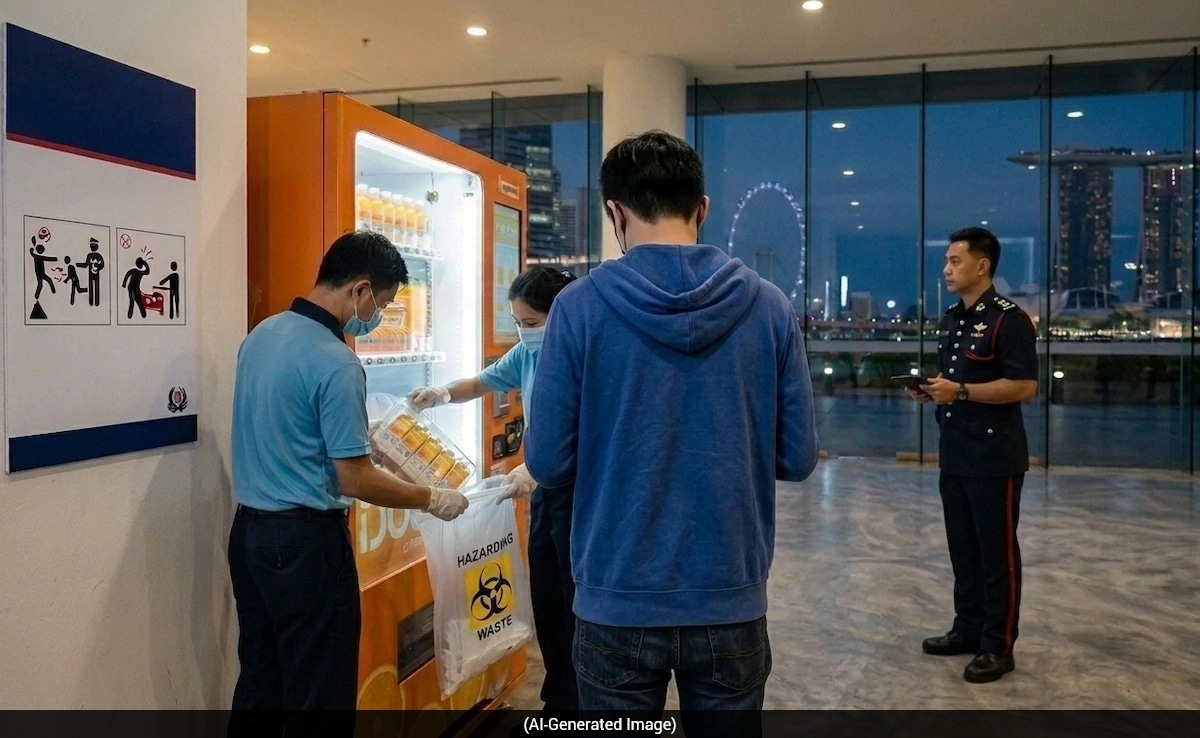
The internet loves a morality play. When news broke that a French student in Singapore faced two years in prison for "licking a straw" at a vending machine, the global peanut gallery followed a predictable script. Half the world screamed about draconian overreach and "Orwellian" policing. The other half—mostly Singaporeans and germaphobes—clapped for the swift execution of justice against a "disrespectful" foreigner.
Both sides are fundamentally wrong.
This isn’t a story about a straw. It isn’t even a story about hygiene or the threat of a virus. If you think this is about public health, you’ve been blinded by the surface-level noise. This is a cold, hard lesson in the asymmetry of social trust. We are witnessing the inevitable collision between a Western culture that treats public spaces as a "choose your own adventure" playground and a technocratic city-state that views the public square as a high-precision machine.
The "lazy consensus" is that Singapore is mean. The actual truth? Singapore is logical, and the rest of the world has forgotten how to maintain a civilization.
The Myth of the Victimless Crime
Critics argue that the punishment—potential jail time and a massive fine—doesn't fit the crime. "He just licked a straw," they say. "Nobody died."
This logic is the hallmark of a declining society. It prioritizes the individual’s intent over the collective’s cost. When that student licked that straw, he didn't just transfer saliva; he injected a high-voltage shock of distrust into a system that relies on 99.9% compliance to function.
In cities like London, San Francisco, or Paris, the public environment is already degraded. You expect the subway seat to be sticky. You expect the park bench to be vandalized. Because the baseline is "chaos," a single act of stupidity is just a drop in the bucket.
Singapore operates on a different operating system. Its baseline is functional perfection.
When you break that perfection, you aren't just committing a "minor" offense. You are vandalizing the psychological safety of every citizen who uses that vending machine. The cost isn't the price of the straw. The cost is the audit of the machine, the loss of revenue, the CCTV review, and the erosion of the belief that "things just work here."
Why the West Misinterprets the "Strict" Label
Western media loves to use the word "draconian" because it makes them feel superior while their own public transit systems crumble and their streets fill with trash. They see Singapore’s legal system as a relic of the past.
In reality, Singapore is the future.
As urban populations become more dense, the margin for error shrinks to zero. In a village of 50 people, you can tolerate a village idiot. In a hyper-connected city-state of nearly six million, the village idiot is a systemic threat.
The student’s defense—likely some variation of "it was a prank" or "I didn't think"—is actually an admission of guilt. It is the ultimate expression of Main Character Syndrome. It assumes that your momentary need for a laugh or a social media clip outweighs the right of every subsequent person to use a clean facility.
I’ve seen this play out in global markets and corporate boardrooms for years. The person who cuts corners "just this once" because "it doesn't really matter" is always the person who eventually sinks the ship. Singapore simply has the guts to identify the leak before the ship goes down.
The Geometry of Deterrence
Let’s look at the math of the "two-year sentence."
The legal framework involved usually falls under "public nuisance" or "mischief." In many jurisdictions, these are "slap on the wrist" offenses. But Singapore utilizes a concept called Calculated Deterrence.
$D = P \times S$
In this equation, $D$ is the Deterrence effect, $P$ is the Probability of being caught, and $S$ is the Severity of the punishment.
If the probability of being caught is low (though in Singapore, with its ubiquitous surveillance, it’s quite high), then the severity must be astronomically high to keep the $D$ value effective. If the punishment for licking a straw was a $50 fine, every bored teenager with a TikTok account would do it. The cost of policing that behavior would exceed the city’s budget.
By making the punishment life-altering, the state shifts the burden of policing from the police to the individual’s own survival instinct. It is a highly efficient, low-cost way to manage a population.
The Foreigner’s Fallacy: "But I Didn't Know"
There is a specific brand of arrogance that comes with Western travel. It’s the belief that your "intent" travels with you like a diplomatic passport.
- "I didn't mean any harm."
- "It was just a joke."
- "Where I come from, this isn't a big deal."
These phrases are the dying gasps of the entitled. When you enter a sovereign nation, you are signing a contract. You are trading your presence for your total submission to their norms.
The French student didn't just fail a hygiene test; he failed an intelligence test. He assumed that the "rules" were suggestions, or that they applied to other people—the "locals"—but not to a sophisticated European visitor. This is the Expat Blindspot. I have seen executives move to Singapore and lose their jobs within months because they thought they could "leverage" their Western casualness in a high-consequence environment. It doesn't work that way.
Why We Should Stop Defending "Youthful Indiscretion"
The most tiring argument in this entire saga is the "he’s just a kid" defense.
Twenty years old is not a kid. At twenty, you are an adult capable of signing contracts, voting, and operating heavy machinery. If you are old enough to navigate an international airport and enroll in a foreign university, you are old enough to understand the concept of "do not put your mouth on things that don't belong to you."
By infantilizing the offender, we excuse the behavior. We create a culture where accountability is a sliding scale based on how "relatable" the criminal is.
The student’s actions were a deliberate middle finger to the host culture. It was a performance of superiority: "I can defile your public space because your rules are beneath me." Singapore’s response is a calibrated reminder: "Our rules are the reason you wanted to come here in the first place."
The Brutal Truth About "Freedom"
People love to talk about freedom until they have to live in a city where everyone is "free" to be a nuisance.
- Freedom to play loud music on the bus.
- Freedom to leave trash in the park.
- Freedom to lick straws in a vending machine.
That isn't freedom; it’s entropy.
True freedom is the ability to walk through a city at 3:00 AM and know you won't be mugged. It’s the freedom to buy a drink from a machine and know it hasn't been tampered with by a bored influencer. That version of freedom requires a high entry price. That price is the absolute, uncompromising enforcement of the law, even when the "crime" looks small to an outsider.
The Downside No One Admits
Is there a risk to Singapore’s approach? Of course.
The downside is a sterile society where creativity is often stifled because the fear of "stepping out of line" permeates every aspect of life. You don't get a vibrant, messy, "anything goes" arts scene in a place where the police are checking the CCTV for straw-lickers.
But Singapore has made its choice. It has traded the "vibrancy" of chaos for the "reliability" of order. If you don't like the trade, don't go there. But don't go there, enjoy the safety, enjoy the cleanliness, enjoy the infrastructure, and then complain when they protect the very things you’re consuming.
Stop Asking if the Jail Time is "Fair"
The question of "fairness" is a Western obsession that has no place in a discussion about Singaporean law. The law isn't designed to be "fair" in a cosmic, empathetic sense. It is designed to be predictable.
The rules were clear. The cameras were visible. The consequences were documented.
If you walk into a cage with a sign that says "LION WILL EAT YOU," you don't get to debate the "fairness" of the lion’s hunger after you jump the fence.
This student didn't face jail for licking a straw. He faced jail for thinking he was the one person in Singapore for whom the rules didn't apply. He’s about to find out that in a high-functioning society, there is no such thing as a "minor" breach of the social contract. There is only the contract, and the penalty for tearing it up.
Don't want to go to jail in Singapore? It’s the easiest task in the world: Don't be a nuisance.
If that’s too high a bar for you to clear, stay home. The rest of the world is already messy enough without your "pranks."
The straw wasn't the point. The point was the machine. And the machine always wins.