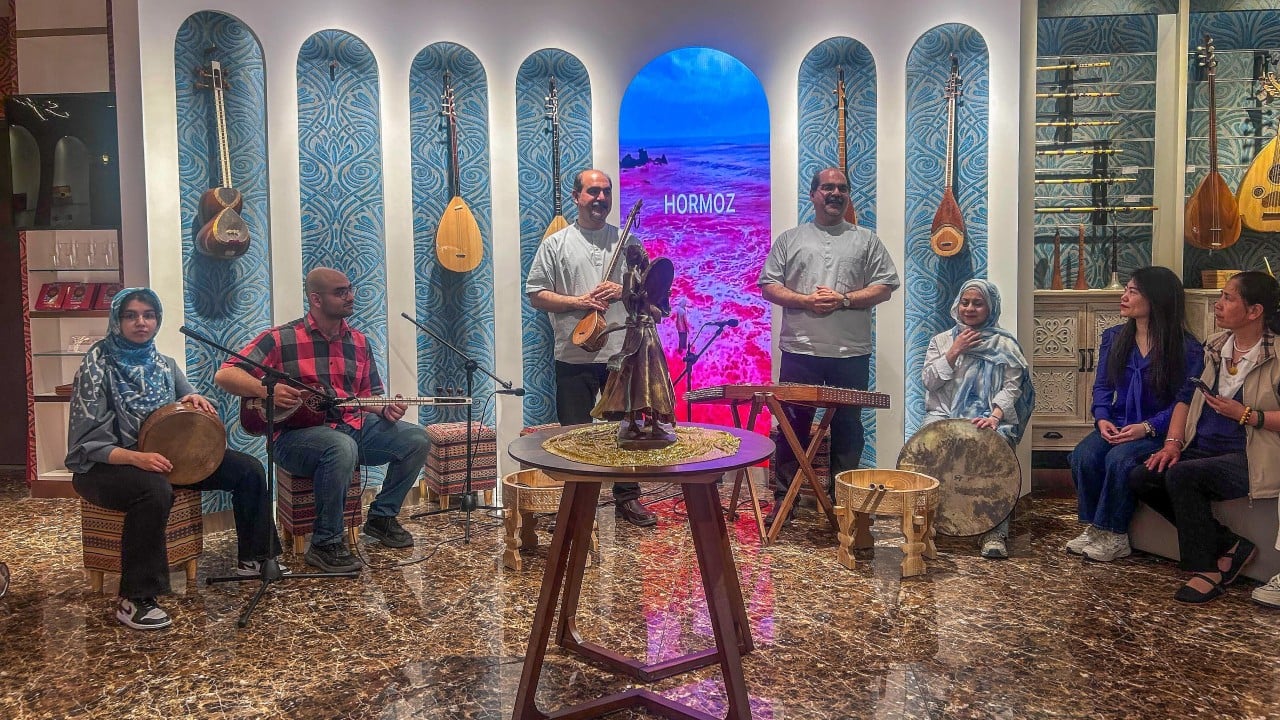
The wood of the tar is thin. It is carved from mulberry, hollowed out until the walls are a mere few millimeters thick, stretched over with the translucent skin of a lamb’s fetus. In a small, sun-drenched studio in Shanghai, Arash Behzadi runs his fingers over the strings. Beside him, his brother, Soroush, readies the tonbak, a chalice-shaped drum.
Outside the window, the hyper-modern pulse of China’s financial heart beats with the rhythm of electric buses and digital commerce. But inside, the air begins to vibrate with a frequency that is centuries old. It is the sound of Persia. It is a sound that shouldn't, by the logic of modern geopolitics, be finding its sanctuary here.
We live in a time defined by friction. Borders are hardening. The digital world, once promised to be a global village, has fractured into gated communities of thought. Yet, in the middle of this hardening, two brothers from Tehran have found a way to use a vibrating string to do what diplomacy often fails to achieve: keep the bridge open.
The Weight of the Instrument
To understand why this matters, you have to understand the stakes of silence. When a country is shrouded in the fog of sanctions and the looming shadow of conflict, its culture often becomes the first casualty of international perception. People stop seeing the art. They only see the headlines.
Arash and Soroush didn't come to China to be activists. They came as musicians. But music is never just a collection of notes when your homeland is a place the rest of the world views through a cracked lens.
The brothers play the Radif, a collection of old melodies that form the basis of Persian classical music. It is a complex, improvisational system. It requires the performer to be both a scholar and a medium. When they play in a Shanghai concert hall, they aren't just performing; they are translating. They are taking a history of longing, of desert winds, and of high mountain passes, and depositing it into the ears of a Chinese audience that shares a hidden, ancient DNA with them.
The Silk Road wasn't just a track for spices and silk. It was a nervous system. Information, religion, and sound traveled its length for two millennia. When the brothers strike a note on the tar, they are tapping into a trade route that hasn't disappeared—it has simply gone underground, waiting for the right frequency to re-emerge.
Finding Harmony in the Megacity
Adaptation is a brutal process. Imagine moving from the high, dry plateau of Tehran to the humid, neon-soaked density of Shanghai. The brothers faced the immediate wall of language and the even steeper wall of cultural anonymity. In the beginning, they were outsiders in a land that is notoriously difficult to penetrate socially.
But a strange thing happens when you play an instrument that sounds like a human voice crying out.
The Chinese pipa, a four-stringed lute, is a distant cousin of the Persian barbat. When Arash collaborated with local musicians, they didn't need a translator. They found that the pentatonic scales of the East and the microtonal "quarter tones" of the Middle East could sit side-by-side. It wasn't a collision. It was a conversation.
Consider the physics of a string. When you pluck it, it creates a fundamental tone, but it also creates overtones—frequencies that are mathematically related to the base note but often go unheard. These overtones are what give an instrument its "color" or timbre. Culture works the same way. The fundamental tone might be "Iranian" or "Chinese," but the overtones are universal. They are the shared human experiences of grief, celebration, and the search for home.
By weaving Persian melodies into Chinese cinematic scores and local folk songs, the brothers created a hybrid space. They proved that identity isn't a zero-sum game. You don't have to lose your Persian soul to find a Chinese heart.
The Invisible Stakes of the Song
Why does this matter now? Why should we care about two brothers playing ancient music in a foreign city while the world feels like it’s tearing at the seams?
Because art is the only thing that remains when the politics of the day have rusted away.
History is littered with the ruins of empires that tried to define themselves through walls. But the things that actually survived—the stories, the recipes, the songs—are the things that crossed those walls. The brothers are operating on a timeline that ignores the 24-hour news cycle. They are thinking in centuries.
There is a specific kind of bravery in being a cultural ambassador when your home is under pressure. It is the bravery of vulnerability. By standing on a stage and sharing the most intimate parts of their heritage, Arash and Soroush are forcing the audience to acknowledge the humanity behind the headlines. They are making it impossible to see "The Middle East" as a monolith of conflict. Instead, the audience sees a brotherly bond. They see a craftsmanship that takes decades to master. They see a beauty that is fragile and must be protected.
The Architecture of Connection
The real problem with modern communication is that it is too fast. We react. We don't listen.
Persian music demands a different kind of attention. It is slow. It meanders. It builds tension over twenty minutes before providing a resolution. It teaches the listener how to wait. In the frantic pace of Shanghai, this music acts as a psychological anchor. It creates a pocket of stillness.
When the brothers perform, the audience isn't just hearing a different culture. They are experiencing a different relationship with time. This is the "bridge" that the title of so many articles mentions, but rarely explains. It’s not a bridge made of bricks. It’s a bridge made of shared temporal experience. For the duration of the song, the listener and the performer are breathing in the same rhythm.
This synchronization is the antidote to the "othering" that fuels war. It is very hard to hate someone whose breath has matched yours for an hour.
Beyond the Horizon
The sun sets over the Huangpu River, casting long shadows across the studio. Arash puts down the tar. The silence that follows is heavy, but it isn't empty. It is a charged silence, the kind that exists after a truth has been told.
The brothers know they cannot stop the movement of armies or the pens of bureaucrats. They are realistic about their influence. They are two men with wooden boxes and strings.
But they also know that a small vibration, if it hits the right resonance, can shake a massive structure. They have seen the eyes of their Chinese students light up when they recognize a melody that feels oddly familiar, like a memory from a dream they can’t quite place. They have felt the warmth of a community that has adopted them not because they are "useful," but because they bring a beauty that was missing.
They continue to play. They play through the sanctions. They play through the uncertainty. They play because the bridge requires constant maintenance, and the only tools they have are their hands and a few pieces of mulberry wood.
The music isn't a luxury. It isn't a hobby. In a world that is increasingly defined by what divides us, their performance is a quiet, rhythmic act of defiance. It is a reminder that even when the roads are closed, the air remains open. And as long as the air can vibrate, the story of Persia will continue to echo in the streets of Shanghai, a ghost of the Silk Road that refuses to be laid to rest.
The final note of the tar lingers, a thin silver thread of sound that stretches out, thinner and thinner, until it becomes part of the city’s hum, invisible but present, holding the world together by a single, vibrating string.