The heat hits first. It isn't the gentle warmth of a summer afternoon; it is a physical weight, a shimmering, oppressive force that vibrates off the rust-colored earth of the South Australian Outback. At 120 degrees Fahrenheit, the air stops being something you breathe and starts being something you survive. Above ground, Coober Pedy looks like a mistake. It is a moonscape of mullock heaps—giant cones of discarded dirt—and rusted machinery that seems to have been abandoned by a civilization that simply gave up.
But then you see the pipes.
White PVC vents poke out of the scorched earth like periscopes. They are the only outward sign that a thousand people are living, sleeping, and dreaming directly beneath your boots. To understand Coober Pedy, you have to stop looking at the horizon and start looking at the shadows.
The Architecture of Necessity
Nobody moved here for the view. They came for the fire in the stone. Since 1915, this patch of desert has produced most of the world's precious opal. The town was born from the grit of soldiers returning from the trenches of World War I, men who were already intimately familiar with living in the dirt. When they realized the surface temperatures would melt the resolve of even the toughest soul, they did the only logical thing.
They kept digging.
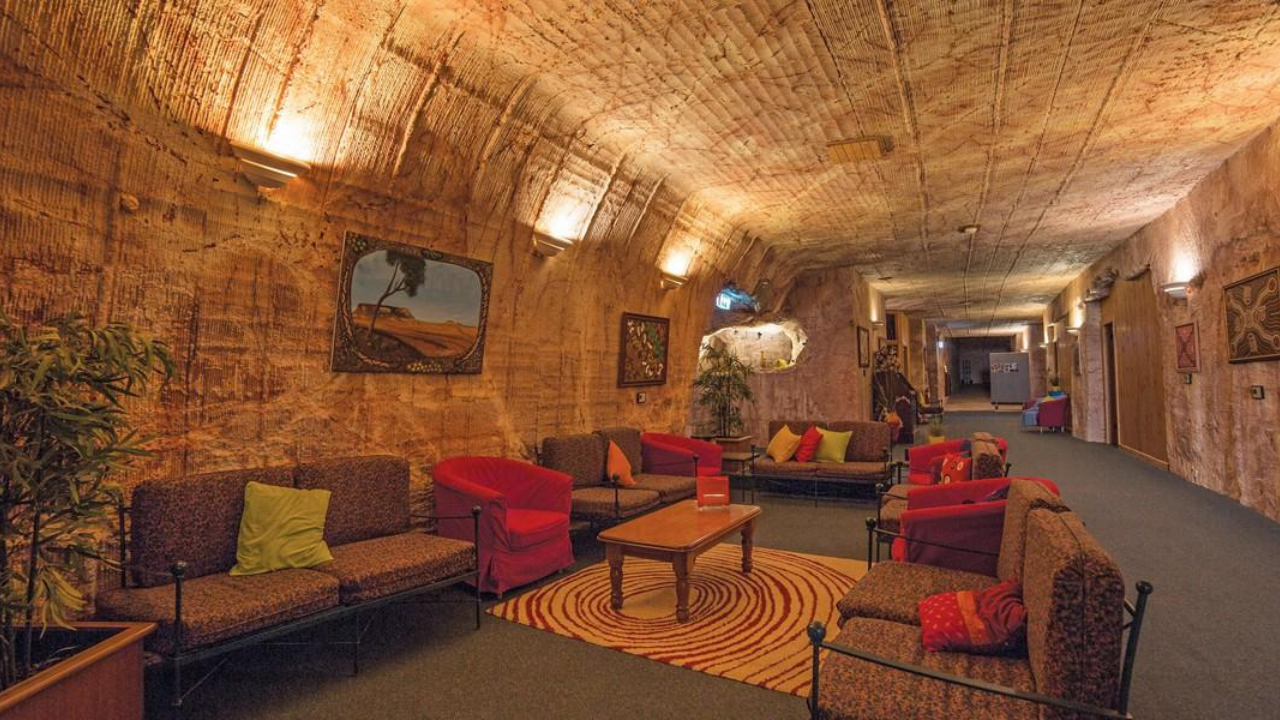
In a standard home, you worry about the roof leaking or the siding rotting. In a Coober Pedy "dugout," your primary concern is the hardness of the sandstone. These aren't damp, claustrophobic burrows. They are carved sanctuaries. Walking into a dugout for the first time is a sensory shock. The roar of the desert wind vanishes instantly. The temperature drops thirty degrees in a single step. It is a constant, cool 73 degrees, maintained not by expensive HVAC systems, but by the thermal mass of the earth itself.
The walls are a mesmerizing swirl of rose, ochre, and gold sandstone, sealed with polyurethane to keep the dust at bay. There are living rooms, modern kitchens, and walk-in closets, all hacked out of the rock. If you want a new bookshelf, you don't go to IKEA. You grab a jackhammer.
Faith and Beer in the Deep
Man does not live by bread alone, even in a hole in the ground. The social fabric of the town is stitched together in the cool dark. Consider the Serbian Orthodox Church. While most cathedrals reach for the heavens with spires and flying buttresses, this one plunges into the bedrock.
Standing in the nave, you feel the weight of the world above you, but it doesn't feel heavy. It feels protective. The acoustic quality of a stone room carved thirty feet deep creates a silence so profound it feels like a physical presence. The light doesn't stream through stained glass from the sun; it glows from recessed lamps that catch the natural glitter of the silica in the walls.
It is a place where the divine feels grounded.
Then there is the social life. In the local pubs and underground hotels, the "frontier" spirit isn't a marketing slogan. It is a survival strategy. You meet people like "Digger" Dave—a hypothetical composite of the dozens of miners you’ll find leaning against the bar. Dave doesn’t talk about the heat. He talks about the "trace"—the thin line of color in the rock that suggests a pocket of opal might be inches away.
That is the gamble that keeps the town breathing. The invisible stakes are everywhere. Every wall in every home was once a potential payday. People live inside their own mines, forever separated from a fortune by a few feet of sandstone. It creates a specific kind of local psychology: a blend of rugged independence and a quiet, shared understanding that the desert is the boss.
The Cost of the Cool
Living beneath the surface requires a radical reimagining of what we take for granted. Water is more precious than opal here. It is pumped in from an artesian bore 25 miles away, desalinated, and sold at a premium. Trees are so rare that the town’s famous golf course is entirely "greenless." Golfers carry a small piece of artificial turf to tee off from, and the "greens" are actually "blacks"—sand soaked in oil to keep it from blowing away.
It sounds bleak. To an outsider, it might even seem desperate.
But talk to a local who has lived underground for forty years, and they will tell you they feel sorry for the people in the cities. They pity the people trapped in glass towers, slave to the power grid, watching their cooling bills climb as the climate shifts.
In the dugout, there is no hum of the air conditioner. There is no noise from the neighbors. There is only the rock.
The town exists as a living laboratory for a future we are all beginning to contemplate. As global temperatures rise, the idea of retreating into the earth becomes less of a quirky tourist attraction and more of a blueprint. Coober Pedy isn't a relic of the past; it’s a postcard from a possible future.
The Silence of the Stone
The sun begins to set over the breakaways outside of town. The sky turns a violent shade of violet and bruised orange. On the surface, the heat finally begins to break, but the wind picks up, carrying the fine, red dust that gets into everything—your teeth, your lungs, your soul.
Down below, someone is turning on a lamp in a room with no windows. They are pouring a glass of water and sitting in a chair carved from 150-million-year-old seabed. They don't hear the wind. They don't feel the dust.
They are wrapped in the arms of the earth, safe in the only place on this scorched patch of planet where a human being was ever meant to find peace. The silence isn't empty. It is solid. It is the sound of a thousand people holding their breath, waiting for the next flash of color in the dark.
The desert wins every battle above the ground, but down here, in the cool, rose-colored quiet, the people have found a way to call it a draw.