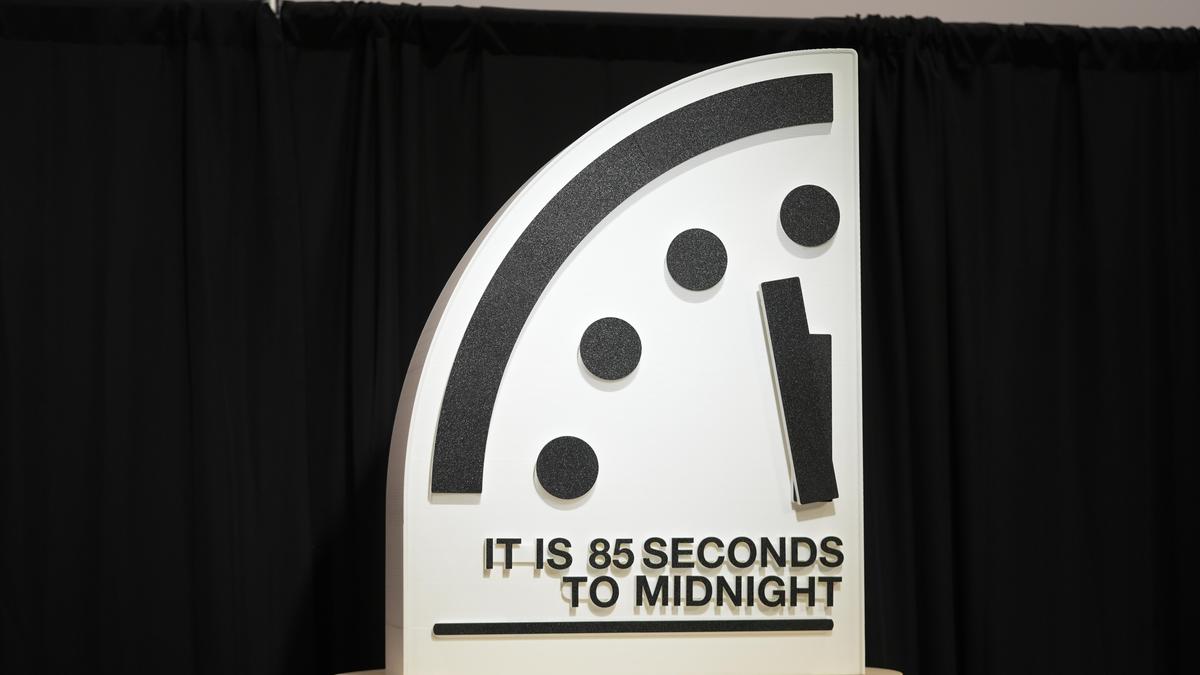
The Doomsday Clock operates as a psychological heuristic rather than a predictive model, functioning as a lagging indicator of geopolitical friction instead of a leading indicator of systemic collapse. While the Bulletin of the Atomic Scientists utilizes the metaphor of "minutes to midnight" to aggregate complex risks—nuclear proliferation, climate change, and disruptive technologies—the metric fails to provide a functional roadmap for risk mitigation because it lacks a clear denominator. To move beyond symbolic alarmism, we must decompose existential risk into three distinct variables: Hazard Probability, Vulnerability Coefficient, and Intervention Latency.
The Mechanism of Modern Existential Risk
The original 1947 conceptualization of the Clock focused almost exclusively on nuclear exchange, a binary state of high-impact, low-probability catastrophe. Modern risk profiles have shifted toward "creeping" systemic failures where the threshold for irreversible damage is obscured by feedback loops.
The current 90-second setting reflects a convergence of factors that traditional diplomacy is ill-equipped to handle. We can categorize these into three distinct pressure points:
- Kinetic Escalation and Nuclear Signaling: The erosion of arms control treaties (such as the suspension of New START) has removed the structural guardrails that previously limited the velocity of escalation.
- Atmospheric Carbon Forcing: Unlike a nuclear launch, climate change represents a distributed risk where the "trigger" is pulled incrementally over decades. The Clock struggles to map this linear progression onto its circular, midnight-focused interface.
- Autonomous and Biological Proliferation: The democratization of dual-use technologies—specifically AI-driven cyber-warfare and benchtop synthetic biology—creates a "long tail" of risk where non-state actors can achieve strategic impact.
The Decoupling of Awareness and Agency
The primary failure of symbolic risk metrics is the "Desensitization Gradient." When a metric remains at its maximum setting for prolonged periods, its utility as a signaling device evaporates. The Clock has moved closer to midnight over the last decade, yet global defense spending and carbon emissions have largely continued their upward trajectories. This indicates a decoupling between the perception of risk and the implementation of policy.
To fix this, we must evaluate the Intervention Latency—the time required for a global system to recognize a threat and deploy a neutralizing response. In the case of a nuclear strike, the latency is measured in minutes. For climate change, it is measured in decades. By compressing these vastly different temporal scales into a single "clock," the Bulletin inadvertently creates a sense of paralysis rather than a prioritization framework.
Structural Bottlenecks in Risk Mitigation
Strategic paralysis occurs because the incentives for individual nation-states often run counter to the requirements for global stability. This is a classic Game Theory conflict: the Nash Equilibrium suggests that as long as one actor pursues an advantage (e.g., developing more advanced AI or faster hypersonic missiles), others must follow to avoid obsolescence, even if the collective result is an increase in total systemic risk.
The Nuclear Paradox
Nuclear deterrence relies on the perceived rationality of all actors. However, as command-and-control systems integrate AI to decrease response times, the risk of "flash-war"—where automated systems escalate faster than human intervention can occur—increases. The mechanism of risk here is not intentional malice, but Systemic Complexity Failure.
The Climate Feedback Loop
The danger in climate risk is not just the temperature increase itself, but the crossing of "tipping points" (e.g., permafrost thaw or the collapse of the AMOC). These are non-linear events. A symbolic clock suggests we are moving toward a wall, but in reality, we are navigating a minefield where some mines have already been triggered, and their effects are merely pending.
The Three Pillars of Strategic Resiliency
If the goal is to move the hands of the clock back, the focus must shift from "alarm" to "architecture." This requires a transition from symbolic reporting to the construction of redundant, resilient systems.
1. Verification and Transparency Infrastructure
The lack of trust is the primary driver of the Clock’s progression. High-resolution satellite monitoring, open-source intelligence (OSINT), and blockchain-based verification for arms control could provide a "Ground Truth" that reduces the probability of accidental escalation. This moves the needle from "Assumption of Hostility" to "Verification of Intent."
2. Hard-Path Decarbonization
Soft-path solutions (policy agreements and carbon credits) have proven insufficient. Strategic resiliency requires the rapid deployment of "Hard-Path" technologies: modular nuclear reactors, grid-scale storage, and direct air capture. The objective is to decouple economic growth from carbon forcing through a fundamental shift in the energy density of our civilization.
3. Governance of Dual-Use Technologies
The "90 seconds to midnight" reality is heavily influenced by the lack of a global regulatory framework for AGI (Artificial General Intelligence) and CRISPR-based pathogen enhancement. A functional strategy involves creating international "compute-governance" standards, where the hardware required for massive AI training runs is tracked and regulated similarly to nuclear-grade uranium.
Measuring the Cost of Inaction
We can quantify the failure of current symbolic metrics by looking at the Risk-Adjusted Cost of Capital (RACC) for long-term global projects. As the Clock ticks closer to midnight, the uncertainty premium on everything from infrastructure bonds to insurance premiums should theoretically rise. However, the market has not yet integrated "Doomsday" into its pricing models. This suggests one of two things: either the market is blind to the risks highlighted by the Bulletin, or the Bulletin’s metric is viewed as a political statement rather than a data-driven forecast.
The gap between these two perspectives is where the real danger resides. If we treat existential risk as a cultural meme rather than a technical challenge, we forfeit the ability to engineer our way out of it.
The Engineering Approach to Survival
Instead of observing the Clock, policy-makers should focus on the Survival Probability Function:
$$P(s) = \prod_{i=1}^{n} (1 - P(f_i))$$
Where $P(s)$ is the probability of total system survival and $P(f_i)$ is the probability of failure for any given existential threat (nuclear, bio, climate, etc.).
This formula highlights a brutal reality: even if we solve for climate change ($P(f_{climate}) \to 0$), a high probability of nuclear or biological failure still drives the total survival probability toward zero. Strategy must therefore be concurrent, not sequential. We cannot afford to "focus on climate first" if the nuclear risk remains unaddressed.
Strategic Recommendation: Institutionalizing Redundancy
The final strategic move for global stability is not found in a return to 20th-century diplomacy, but in the institutionalization of planetary redundancy. This involves three specific tactical shifts:
- Decentralization of Critical Infrastructure: Moving away from centralized power grids and food supply chains reduces the systemic impact of any single "Midnight" event.
- Rapid Response Biosecurity: Establishing a global "Bio-Shield" capable of sequencing, synthesizing, and distributing vaccines for any novel pathogen within 30 days.
- The Establishment of a Kinetic De-escalation Protocol: A permanent, "always-on" communication channel between the AI-driven defense systems of major powers to prevent algorithmic feedback loops from triggering unintended conflict.
Moving the hands of the clock requires more than "hope" or "awareness." It requires the cold, calculated application of systems engineering to the most volatile variables of the human condition. The symbolic value of the Doomsday Clock has reached its limit; the technical phase of existential risk management must now begin.


