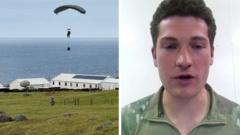
The deployment of medical relief to isolated geographies via airborne insertion represents a confluence of logistical friction, epidemiological risk, and high-stakes kinetic execution. When a suspected outbreak of Orthohantavirus occurs on a remote island, the response cannot be viewed as a simple delivery mission. It is a race against the viral incubation period, constrained by the "Last Mile" problem—the disproportionate difficulty of moving personnel and materiel through the final stage of a journey where infrastructure is non-existent.
The Epidemiological Burden of Hantavirus Pulmonary Syndrome
Orthohantaviruses, specifically those native to the Americas such as the Sin Nombre virus or the Andes virus, present a mortality rate approaching 35-40%. The primary transmission vector is the inhalation of aerosolized excreta from infected rodents, typically members of the Cricetidae family. Read more on a related issue: this related article.
In a remote island context, the viral threat is magnified by the lack of intensive care unit (ICU) resources. The clinical progression of Hantavirus Pulmonary Syndrome (HPS) moves through three distinct phases:
- The Prodromal Phase: Febrile illness lasting 3-5 days, mimicking common influenza.
- The Cardiopulmonary Phase: Rapid onset of pulmonary edema and shock. This transition is often measured in hours, not days.
- The Convalescent Phase: Recovery for those who survive the initial respiratory failure.
The mission objective in a parachuted aid drop is to intervene during the late prodromal phase. Once the patient enters the cardiopulmonary phase, the survival probability drops sharply without mechanical ventilation or Extracorporeal Membrane Oxygenation (ECMO). Air-dropping medical supplies and specialized personnel is the only mechanism to bridge the gap between the onset of symptoms and the arrival of a medical evacuation vessel or aircraft. Additional journalism by CDC delves into similar views on the subject.
Structural Barriers to Island-Based Medical Logistics
Standard medical logistics rely on cold-chain integrity and stable transport surfaces. Remote island intervention breaks these assumptions. The logistical architecture of a parachute-based insertion is defined by three primary variables:
1. The Kinetic Impact Constraint
Parachuting medical supplies involves managing the kinetic energy of the drop. Fragile diagnostics, such as portable Point-of-Care (POC) blood analyzers or sensitive reagents, require specialized shock-absorption housing. A standard military parachute drop can subject cargo to significant G-forces upon landing. Failure to calibrate the drop velocity against the structural integrity of the medical kit results in the delivery of useless equipment.
2. Environmental Interference
High-latitude islands are characterized by high-velocity wind shear and unpredictable thermal currents. These factors dictate the "drop window." If the wind exceeds 15-20 knots, the deviation from the intended drop zone increases exponentially. A medic landing 500 meters offshore or in a dense forest canopy faces a total mission failure before the medical intervention begins.
3. The Scalability Gap
Parachute insertion is a low-volume, high-precision tactic. It cannot transport the heavy oxygen generators or the volume of intravenous fluids required for a sustained outbreak. It is an "advance guard" strategy designed to stabilize the patient until a heavy-lift asset can arrive.
Tactical Framework for Airborne Medical Insertion
The operational logic of the mission follows a rigid sequence of events designed to minimize the time between the detection of a cluster and the administration of supportive care.
Stage 1: The Sensor-to-Shooter Loop (Detection)
The identification of a Hantavirus case in a remote setting usually begins with a distress signal or a tele-health report. The accuracy of this initial signal is the primary bottleneck. Because HPS symptoms are non-specific, there is a risk of deploying high-value airborne assets for a non-viral respiratory infection. The decision-making framework must weigh the cost of deployment against the probability of a false positive.
Stage 2: Loadout Configuration
The medical kit carried by a parajumper is a distilled version of an ER bay. It prioritizes:
- Rapid Diagnostics: Lateral flow assays or PCR kits to confirm the presence of Orthohantavirus.
- Fluid Management: Isotonic fluids to manage hypotension, though fluid administration in HPS must be extremely precise to avoid exacerbating pulmonary edema.
- Oxygenation: Portable oxygen cylinders and non-invasive ventilation masks.
- Personal Protective Equipment (PPE): High-level respiratory protection (N95 or PAPR) to prevent the responder from becoming the next vector or victim.
Stage 3: The High-Altitude Low-Opening (HALO) vs. High-Altitude High-Opening (HAHO) Decision
The method of entry is determined by the radar signature requirements (less relevant in humanitarian missions) and the precision of the landing. HAHO jumps allow for greater lateral travel, enabling the soldier to navigate toward a specific point from a distance, which is critical for small island targets. However, it increases the time the jumper is exposed to high-altitude winds.
The Physics of Parachute Precision in Relief Missions
The descent of a parajumper is governed by the relationship between gravity, drag, and horizontal velocity. The terminal velocity of a human in a belly-to-earth position is approximately 120 mph (53 m/s). To ensure a safe landing with 50-80 lbs of medical gear, the parachute must deploy at an altitude that allows for a controlled canopy flight.
$$F_d = \frac{1}{2} \rho v^2 C_d A$$
In this equation, the drag force ($F_d$) must be sufficient to decelerate the mass of the soldier and the medical kit to a landing speed of roughly 15-20 feet per second. The air density ($\rho$) at high-latitude islands is often higher due to lower temperatures, which slightly increases the lift but must be balanced against the increased turbulence of cold-front weather systems.
Epidemiological Containment Post-Landing
Upon landing, the mission shifts from a tactical insertion to a bio-hazard containment operation. The primary risk is the "Rodent-Human Interface." The soldier-medic must establish a sterile perimeter in a non-sterile environment. This involves:
- Vector Mapping: Identifying the rodent nesting sites near the human habitation to prevent further exposure.
- Decontamination: Using bleach-based solutions or specialized virucidals to neutralize aerosolized particles in the living quarters.
- Triage and Stabilization: Monitoring the patient’s oxygen saturation ($SpO_2$). A drop below 90% in an HPS-suspected patient indicates the imminent onset of the cardiopulmonary phase, triggering an immediate request for emergency extraction.
Financial and Opportunity Costs of Airborne Intervention
The cost-benefit analysis of a parachute-based medical mission is complex. The expense of a single flight—including fuel for a C-130 or similar transport, the specialized training of the personnel, and the risk to the airframe—often reaches tens of thousands of dollars.
However, the "Value of a Statistical Life" (VSL) and the preventing of a broader epidemic outbreak justify the expenditure. If a Hantavirus strain with human-to-human transmission potential (such as the Andes virus) is suspected, the mission is no longer just about saving a patient; it is about national security and global health stability.
Technical Limitations and Failure Points
The strategy is not without significant vulnerabilities.
- Visibility Barriers: Night-time insertions or heavy fog can render a parachute drop impossible.
- Equipment Malfunction: A single failure in the oxygen regulator or the diagnostic device renders the entire mission ineffective.
- Personnel Risk: The medic is at high risk of infection. If the PPE protocol is breached during the landing or the treatment, the mission creates two patients instead of one.
Strategic Optimization of Remote Medical Responses
To improve the efficacy of these missions, the focus must shift from reactive deployment to proactive technological integration.
- Autonomous Drone Pre-Drops: Deploying small, autonomous drones to deliver initial diagnostic kits and PPE before the human responder arrives. This allows for earlier confirmation of the virus and reduces the weight load on the parajumper.
- Tele-Medical Guidance: Real-time data links between the on-site medic and a team of infectious disease specialists at a central hub. Using satellite-linked augmented reality (AR) headsets, the medic can perform complex procedures under the guidance of top-tier surgeons or pulmonologists.
- Enhanced Cold-Chain Packaging: Utilizing phase-change materials (PCMs) to maintain the temperature of vaccines or reagents for 48-72 hours without external power, ensuring the viability of the medical supplies even if the extraction is delayed.
The integration of these technologies turns a "hail mary" rescue attempt into a calculated, data-driven medical intervention. The goal is to shrink the time-to-treatment until the remoteness of the island is no longer a factor in the patient’s survival.
Establish a permanent, tiered response protocol where autonomous drone delivery serves as the immediate Tier 1 response (0-6 hours), followed by Tier 2 parachute insertion of human medical assets (6-12 hours), and concluding with Tier 3 heavy-lift evacuation (24-48 hours). This staggered approach maximizes the probability of stabilization while managing the high costs and risks associated with human airborne insertion.