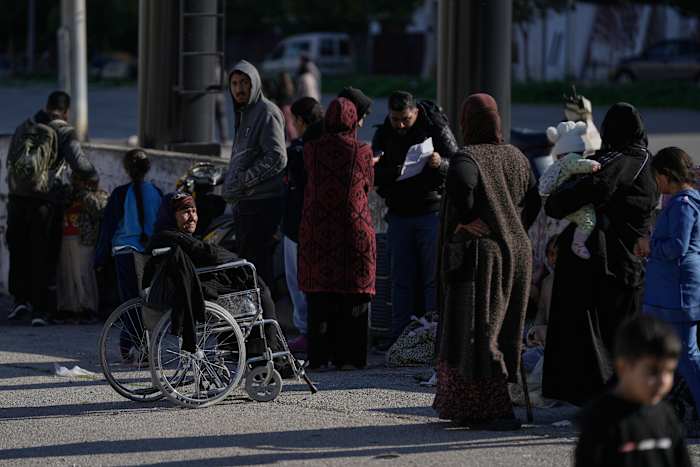
The sound is never what you expect. We watch the grainy footage on our smartphones, the silent flashes of light over ancient skylines, and we think we understand the geometry of war. We see the red streaks of interceptors and the dull thud of impact through a speaker that fits in our pocket. But for the people in Isfahan, or the families huddled in the outskirts of Tehran, the sound is a physical weight. It is a low-frequency hum that vibrates in the marrow of your teeth before the windows even begin to rattle.
When a missile finds its mark, it doesn’t just destroy a hangar or a radar array. It punctures the fragile silence of a million lives.
For weeks, the headlines have remained static. "Escalation." "Retaliation." "Strategic Depth." These are the sterilized words of high-ranking officials sitting in climate-controlled rooms in D.C., Jerusalem, and Tehran. They speak of "tit-for-tat" exchanges as if they are playing a grand game of chess. But a chessboard doesn't bleed. A chessboard doesn't have a mother in a basement wondering if the local grocery store will have bread tomorrow morning.
The current exchange between Israel and Iran has moved past the era of shadow boxing. For decades, this was a ghost war. It was fought in the dark corners of the internet with Stuxnet viruses, or through proxies in the hills of Lebanon and the deserts of Syria. Now, the ghosts have taken shape. They are made of aluminum, high explosives, and the terrifying precision of satellite guidance.
Consider the physics of a modern strike. A ballistic missile launched from Iranian soil travels at hypersonic speeds, arcing through the thin air of the upper atmosphere before screaming back down toward its target. On the other side, the Arrow and David’s Sling systems must perform the equivalent of hitting a speeding bullet with another speeding bullet in the pitch-black sky. It is a miracle of engineering, yet it feels like a failure of humanity. Every time an interceptor successfully detonates, it is a momentary reprieve—a stay of execution for a city—bought at the price of a million-dollar missile.
But the real story isn't the hardware. It is the invisible stakes.
Behind every "precision strike" reported on the evening news is a ripple effect that standard journalism fails to capture. When a military facility is hit near a civilian center, the local economy doesn't just dip; it vanishes. The shopkeeper who was planning to retire closes his doors because the supply chain from the port has been severed. The student who was studying for her medical exams finds the internet cut for "security reasons," and suddenly, her bridge to a better life is washed away.
We are witnessing the slow-motion collapse of the "Rules of the Game." For years, there was a tacit understanding that certain lines wouldn't be crossed. You don't hit the heart of the capital. You don't target the energy infrastructure that keeps the hospitals running. You don't aim for the nuclear research sites that, if ruptured, could poison the soil for generations.
Those lines are blurring. They are being rubbed out by the friction of constant contact.
Imagine, hypothetically, a baker named Elias. He doesn't care about the religious fervor of the IRGC or the strategic imperatives of the Israeli Cabinet. He cares about the temperature of his oven. But when the strikes move from the borderlands to the heartlands, the price of flour triples. The electricity becomes a flickering memory. Elias isn't a casualty of a missile, but he is a casualty of the war. His life is being dismantled by the "strategic calculations" of men he will never meet.
The irony of this escalation is that both sides claim to be seeking "deterrence." It is the great lie of the 21st century. Deterrence is built on the threat of what might happen. But when the threat is constantly carried out, it is no longer deterrence—it is simply war. And war doesn't have a volume control. It only knows how to get louder.
For the observer in London, New York, or Sydney, the "Middle East conflict" is a background noise. It is a recurring character in the soap opera of global politics. We have become desensitized to the smoke. We have become accustomed to the "Urgent" banner on our screens. But the current strikes on Iran are different. They are the sound of a lid being hammered shut on a powder keg.
Every time a missile is launched, the price of oil doesn't just go up. The cost of a human soul goes down. We are witnessing the normalization of the unthinkable. We are watching the steady, methodical destruction of a region that was once the cradle of civilization, now being reshaped by the cold, metallic logic of the military-industrial complex.
The truth is, we don't know where the breaking point is. History doesn't provide a map; it only provides a list of previous disasters. The scholars of war can tell you about the Peloponnesian War or the 1914 assassination of an Archduke, but they cannot tell you when a single strike on an Iranian airfield will finally be the one that triggers a firestorm that no one can put out.
We are all living in the shadow of those missiles. We are all waiting for the next "flash of gold" on the horizon.
A father in Tel Aviv is holding his child in a bunker. A mother in Esfahan is doing the same. They are separated by borders, religions, and centuries of history, but they are united by the same terror. They are the human element in a world that has forgotten how to speak in any language but fire.
The strikes continue. The analysts will talk about "strategic objectives" and "proportional responses." But as the sun sets over the desert, casting long shadows across the sands that have seen a thousand such conflicts, the only thing that remains is the silence that follows the blast. It is a hollow, aching silence. It is the sound of a world that has run out of words.
The horizon is glowing, and it isn't the sunrise.