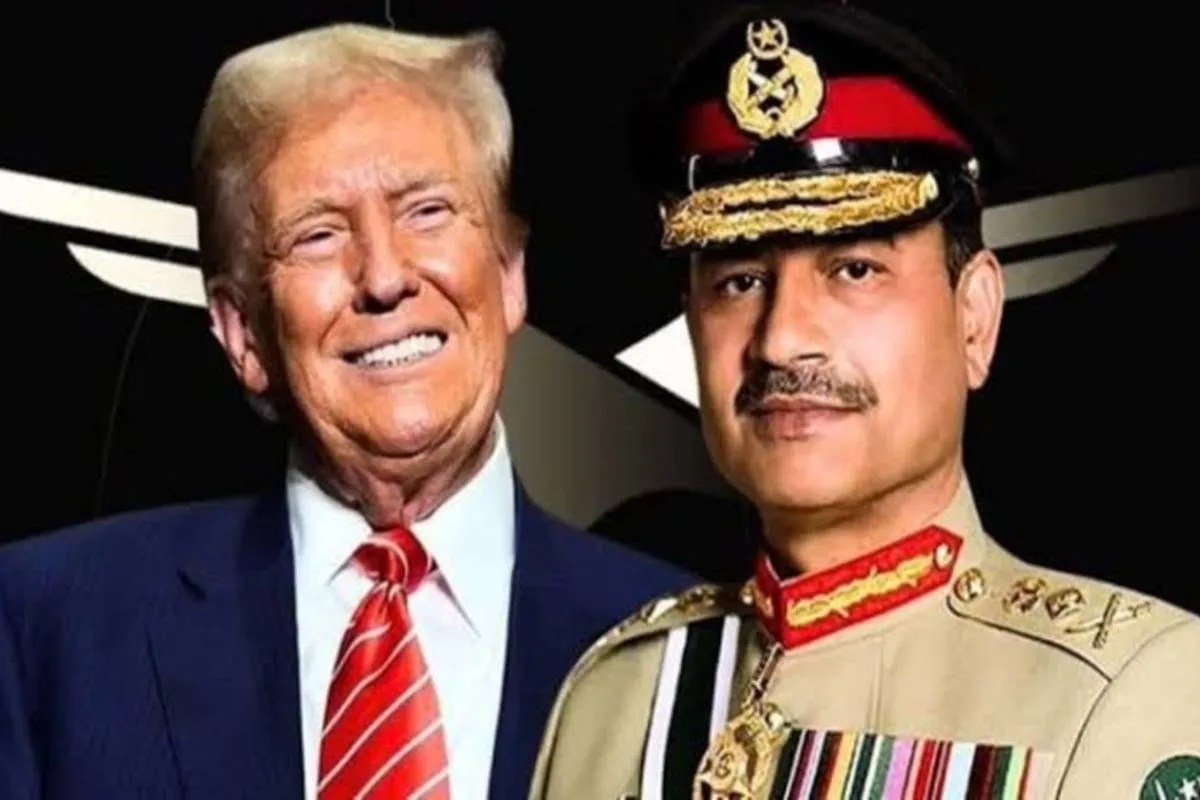
General Asim Munir’s recent diplomatic maneuvers in Tehran, coupled with the rhetorical weight of Donald Trump’s "Favorite Field Marshal" label, signal a pivot in Pakistan’s survival strategy. This isn't merely a series of disparate PR moments; it is a calculated attempt to arbitrage geopolitical tension. The Pakistani military establishment is currently operating within a high-stakes tri-border friction zone, attempting to balance a revitalized relationship with a returning Trump administration against the immediate security imperatives of the Iranian border. Understanding this requires moving beyond the surface-level reporting of "statements" and "visits" to examine the underlying structural stressors: fiscal insolvency, domestic legitimacy deficits, and the shift from "strategic depth" to "strategic hedging."
The Rhetorical Capital of the Favorite Field Marshal Label
The branding of General Munir as a "Favorite Field Marshal" by Donald Trump serves as more than a personal accolade. In the context of Pakistani internal politics, where the military's "neutrality" is under constant scrutiny, external validation from a projected US President acts as a form of non-monetary aid.
The utility of this label functions on two levels:
- Domestic Signaling: By projecting an image of being "in favor" with the West’s most transactional leader, the Pakistani military leadership attempts to neutralize the narrative that it has lost its international standing or its ability to secure US financial and military support.
- Institutional Continuity: The title "Field Marshal," though historically rare and technically inaccurate in Munir's current rank, implies a level of permanence and supreme authority. It reinforces the "One Page" doctrine—the idea that the military and the civilian government are a singular, military-led entity—thereby signaling to regional rivals that there is no internal fracture to exploit.
However, the cost of this rhetorical alignment is high. Trump’s transactionalism implies that "favor" is a line of credit, not a gift. The interest on this credit is usually paid in counter-terrorism concessions or the containment of Chinese influence—both of which directly conflict with Pakistan’s long-term infrastructure and regional security goals.
The Tri-Border Security Function
Munir’s subsequent visit to Tehran indicates that the Pakistani military understands the limitations of US-centric rhetoric. Pakistan faces a multi-front security bottleneck. The "Three Pillars of Border Stability" currently dictate Munir’s agenda:
- The Sistan-Baluchestan Nexus: Cross-border militancy in the Baloch region has shifted from a low-intensity nuisance to a high-frequency threat. The Iranian relationship is no longer a luxury of "brotherly ties" but a requirement for counter-insurgency.
- The Taliban Friction: With the western border with Afghanistan increasingly volatile over the TTP (Tehrik-i-Taliban Pakistan) issue, Pakistan cannot afford a "two-front" border war. Neutralizing Iranian suspicion is a prerequisite for focusing resources on the Afghan frontier.
- The CPEC Security Mandate: China’s continued investment in Gwadar is contingent on the security of the surrounding province. If Iran and Pakistan cannot synchronize their counter-terrorism efforts, the Chinese "security umbrella" may eventually bypass the military’s traditional role, undermining the GHQ’s economic leverage.
The Cost Function of Iranian Engagement
When General Munir delivers "big statements" in Tehran, he is managing a delicate cost function. The objective is to maximize security cooperation with Iran without triggering the "Trump Trigger"—sanctions or diplomatic cooling from a Washington administration that views Tehran as its primary Middle Eastern adversary.
The logic of the Tehran visit is built on Cross-Border Intelligence Partitioning. Pakistan is attempting to convince Iran that their security interests are aligned regarding Baloch separatism, while simultaneously signaling to the West that this engagement is strictly tactical and limited to border management. This creates a bottleneck: if Pakistan leans too far toward Iran, it risks losing the "Favorite" status in the US; if it stays too distant, it risks a permanent insurgent sanctuary on its western flank.
Strategic Hedging vs. Transactional Vulnerability
The current Pakistani strategy is a transition from Strategic Depth (controlling neighbors to gain space) to Strategic Hedging (playing rivals against each other to gain time). This shift is forced by the collapse of the Pakistani rupee and the exhaustion of traditional credit lines.
The Mechanism of Modern Pakistani Diplomacy
The military establishment's current logic follows a three-step cycle:
- Secure Western Legitimacy: Use high-profile interactions (like the Trump interaction) to maintain the flow of IMF support and FATF compliance.
- Stabilize Regional Peripheries: Visit Tehran and Beijing to ensure that domestic insurgencies do not collapse the state from within while the military manages the economy.
- Monetize Geography: Sell the "pivot to the West" to the East, and the "influence in the East" to the West.
The fundamental flaw in this mechanism is the Information Asymmetry between the players. Trump’s administration is historically averse to "double games." During his previous term, the suspension of security aid was a direct response to what he perceived as a lack of reciprocity. Munir is betting that his personal rapport and "Field Marshal" branding will provide a shield that his predecessors lacked.
The Economic Dependency Bottleneck
One cannot decouple Munir’s "big statements" in Iran from Pakistan’s internal economic reality. The military now manages the Special Investment Facilitation Council (SIFC), essentially making the Army Chief the de facto Chief Investment Officer of the country.
The Tehran visit likely included discussions on:
- The IP Gas Pipeline: A dormant project that serves as a massive potential liability. If Pakistan proceeds, it faces US sanctions. If it cancels, it faces Iranian legal penalties. Munir’s presence is an attempt to find a "Security-First" exemption for an economic necessity.
- Barter Trade Mechanisms: To circumvent the dollar shortage, Pakistan is looking for non-currency trade routes with Iran.
This creates a Binary Risk Profile. If the Trump administration returns and initiates a "Maximum Pressure 2.0" campaign against Iran, Pakistan’s attempts at "Barter Trade" and "Border Synchronization" will be viewed as sanctions-busting. The "Favorite" status would evaporate instantly, replaced by the "New Year's Day Tweet" style of public condemnation that characterized Trump’s 2018 policy.
Security Realignment and the TTP Variable
The most significant cause-and-effect relationship missed by standard analysis is how the Iran-Pakistan thaw affects the Afghan-Pakistan conflict. By engaging Iran, Munir is attempting to encircle the Taliban's influence.
If Pakistan can secure its southern flank (Iran), it can reallocate the XI Corps and other paramilitary resources to the northern tribal areas. The "big statement" in Iran is a message to Kabul: "We are no longer isolated in the region." This is a classic application of the Force Multiplier Principle—using diplomatic alignment to reduce the physical manpower required to hold a border.
The Structural Limits of the "Field Marshal" Persona
While the "Favorite Field Marshal" narrative provides a temporary boost to the military's ego and domestic standing, it does not solve the fundamental contradictions of Pakistani foreign policy.
- Constraint A: The US-China rivalry. No amount of Trump-Munir rapport can erase the fact that Pakistan is the lynchpin of China’s Belt and Road Initiative.
- Constraint B: The IMF's structural requirements. These requirements often demand cuts to the very military spending that Munir needs to maintain the "Field Marshal" image of a powerhouse.
- Constraint C: The Iranian-Saudi Rivalry. Pakistan’s "favorable" status with the US (and by extension, the Gulf) is always at odds with deep integration with Tehran.
General Munir is essentially attempting to maintain a Superposition of Alliances—being simultaneously pro-US, pro-China, and pro-Iran. In physics, superposition collapses upon observation. In geopolitics, it collapses upon a crisis.
Strategic Forecast
The Pakistani military will continue to emphasize the "Favorite Field Marshal" narrative to project stability to the IMF and private investors. However, the Tehran engagement will remain strictly limited to intelligence sharing and border policing. Pakistan will not risk a formal defense pact or a completion of the gas pipeline as long as the US dollar remains the oxygen of the Pakistani economy.
The strategic play for the GHQ is to use the "Trump favor" as a shield to suppress domestic political opposition while using the "Iran outreach" as a pragmatic tool to keep the Baloch insurgency from reaching a breaking point. The success of this dual-track policy depends entirely on the US not forcing a "with us or against us" choice regarding Iran—a choice that Trump is statistically likely to force.
Pakistan must prepare for a "Transactional Shock." If the Trump administration demands a total cessation of ties with Iran in exchange for the "Favorite" status, the military will be forced to choose between border security (Iran) and financial solvency (US). Given the current debt-to-GDP ratio, the military will choose solvency, likely leading to a renewed spike in cross-border friction with Iran by late 2026. The "big statement" in Tehran today is a hedge against a choice they hope they never have to make.