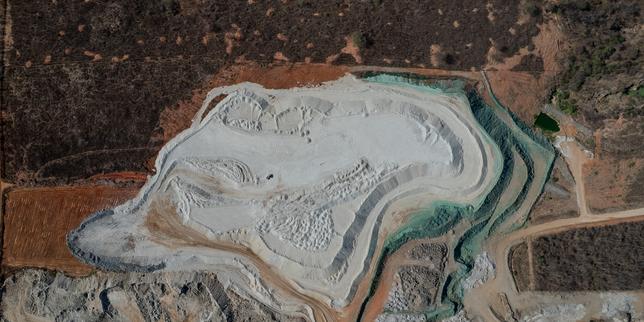
The global shift toward electrification has transformed Brazil’s Jequitinhonha Valley from a forgotten semi-arid region into a critical nodal point in the global supply chain. However, the conversion of geological wealth into localized economic development is failing due to a fundamental misalignment between extraction velocity and regional absorptive capacity. The promise of "Lithium Valley" ignores a core economic reality: high-tech mineral extraction is a capital-intensive, low-labor-density activity that frequently exacerbates existing wealth disparities rather than narrowing them.
Lithium mining in the state of Minas Gerais functions as an enclave economy. In this model, the industry operates as an island of high productivity and international capital, disconnected from the local economic fabric. While the extraction of "white gold" generates significant royalties and export taxes, the structural mechanisms required to transmute those flows into sustainable poverty reduction are absent. Learn more on a similar issue: this related article.
The Triple Constraint of Resource-Led Development
The failure to deliver social progress in the Jequitinhonha Valley can be analyzed through three specific structural constraints: the Labor Mismatch, the Fiscal Lag, and the Ecological Externality.
1. The Labor Mismatch and Skill Gaps
Modern lithium extraction relies on highly automated processes and specialized engineering. The local population, historically underserved by educational infrastructure, cannot satisfy the technical requirements of these roles. This creates a two-tier labor market: Additional analysis by Financial Times delves into comparable perspectives on the subject.
- Imported Technical Labor: High-paying engineering and managerial roles are filled by professionals brought in from Belo Horizonte, São Paulo, or abroad. These individuals often maintain a "fly-in-fly-out" lifestyle, meaning their high salaries are spent in their home cities, not in the local shops of Araçuaí or Itinga.
- Low-Skill Local Labor: Local residents are relegated to construction, security, and manual maintenance—roles that are often temporary and offer little upward mobility. Once the mine’s infrastructure is built, the demand for this labor drops significantly.
This disparity creates localized inflation. The presence of high-earning outsiders drives up the price of housing, food, and basic services, effectively reducing the purchasing power of the local population who did not secure mining employment.
2. The Fiscal Lag and Revenue Leakage
Brazil’s CFEM (Contribution for the Extraction of Mineral Resources) provides a percentage of gross revenue to municipalities. On paper, this is a windfall. In practice, the "Fiscal Lag" prevents this wealth from reaching the street level.
- Administrative Friction: Municipalities in the Jequitinhonha Valley often lack the administrative maturity to manage sudden, massive influxes of capital. Without long-term investment strategies, funds are frequently diverted to short-term political projects or absorbed by rising operational costs of expanded bureaucracy.
- The Single-Commodity Trap: Because the local economy becomes over-reliant on lithium royalties, it becomes hypersensitive to global price volatility. If the price of lithium carbonate drops on the London Metal Exchange, the local municipal budget collapses, halting social programs mid-execution.
3. Ecological Externalities and Resource Competition
Lithium mining is an intensive user of water. In the semi-arid climate of Northern Minas Gerais, water is the primary constraint on both life and traditional agriculture.
- Hydrological Stress: The extraction process risks lowering the water table or diverting flows necessary for subsistence farming. When a mining operation competes with a small-scale farmer for water, the high-margin industrial entity inevitably wins.
- The Displacement of Traditional Economies: As land is consolidated for mining claims, traditional cattle ranching and artisanal farming are squeezed out. This destroys the existing, albeit modest, safety nets of the rural poor before the "new" economy is ready to absorb them.
The Value Chain Bottleneck
The fundamental reason the "Lithium Valley" remains poor is its position in the global value chain. Brazil is currently positioned as a raw material exporter. The higher-value stages of the lithium lifecycle—chemical refining into battery-grade precursors, cathode manufacturing, and battery cell assembly—take place elsewhere, primarily in China, South Korea, or the United States.
By exporting spodumene concentrate rather than finished batteries, Brazil captures only a fraction of the total economic value of the mineral. The "Economic Multiplier" of raw mineral export is notoriously low compared to manufacturing. For every dollar of raw lithium exported, several dollars of value-add are realized in foreign factories. Until the Jequitinhonha Valley moves from an extraction site to a processing hub, the "Masterclass" in development will remain a theoretical exercise.
Quantifying the Social Deficit
The gap between corporate ESG (Environmental, Social, and Governance) reports and the reality on the ground can be measured through the divergence of the Human Development Index (HDI) and Gross Domestic Product (GDP) per capita. In many mining-heavy jurisdictions, we see "GDP decoupling": the town’s GDP skyrockets while its health and education metrics remain stagnant.
This decoupling is driven by the Cost Function of Displacement. When a mining company enters a region, it does not just bring jobs; it brings a total reorganization of the social order.
- Housing Scarcity: Rental prices in mining towns often triple within 24 months, forcing the poorest residents into informal settlements (favelas).
- Infrastructure Strain: Local roads, healthcare centers, and schools designed for a quiet rural population are suddenly overwhelmed by the logistics of a multi-billion dollar industrial operation.
- Social Fragmentation: The influx of a transient workforce often leads to increased rates of crime and the erosion of community cohesion, social costs that are rarely factored into the "profitability" of the mine.
Structural Requirements for Reversal
To transform the Jequitinhonha Valley into a genuine success story, the strategy must shift from passive extraction to active industrial policy. This requires a three-pronged intervention that transcends traditional corporate social responsibility.
Mandatory Local Integration Ratios
State and federal regulators must move beyond "suggesting" local hires. There must be a mandate for Vertical Knowledge Transfer. This involves:
- Funding specialized technical institutes within the valley, operated by the mining companies as a condition of their license.
- Incubating local supply chains for non-mining needs—ensuring that the uniforms, food, and basic machinery repairs are sourced from local cooperatives rather than external vendors.
The Sovereign Wealth Model at the Municipal Level
Rather than treating lithium royalties as current income, municipalities should be required to funnel a portion of CFEM into a regional "Future Fund." This fund should be legally protected from being used for daily operational expenses and instead be earmarked for post-mining economic diversification. This addresses the "Finite Resource" problem: every ton of lithium removed is a ton that will never be there again. The wealth must be converted into an enduring asset like a high-speed digital grid or a permanent water desalination infrastructure.
Regional Refining Clusters
The Brazilian government must incentivize the domestic refining of lithium. If the lithium is converted into lithium hydroxide or carbonate within Minas Gerais, the province gains a more stable industrial base. This creates "Secondary Employment"—jobs in chemistry, logistics, and specialized packaging—that are more permanent and higher-paying than the extraction roles themselves.
The Strategic Forecast
The current trajectory of the Jequitinhonha Valley suggests a repeat of the "Iron Ore Cycle" seen in other parts of Minas Gerais: decades of intense extraction, a temporary spike in municipal revenue, followed by environmental degradation and a return to economic stagnation once the highest-quality deposits are exhausted.
The window to avoid this outcome is narrow. As global manufacturers seek "clean" and "ethical" lithium, the social metrics of the Jequitinhonha Valley will eventually become a liability for the mining companies themselves. Tesla, BYD, and European automakers are increasingly under pressure to prove their supply chains do not rely on "poverty-produced" minerals.
The strategic play for the Brazilian state and the mining conglomerates is a radical shift in the ROI (Return on Investment) calculation. They must recognize that social stability and local human capital are not "costs" to be minimized, but "infrastructure" necessary for the long-term viability of the project. Without a mandated shift toward localized value-added processing and rigid administrative oversight of royalty flows, the Lithium Valley will remain a textbook case of the resource curse: a region that is rich underground but remains stubbornly poor on the surface.