The subway car is a masterclass in silent observation. On a Tuesday morning in Manhattan, the air is thick with the smell of damp wool and overpriced espresso. Everyone is performing a version of themselves. There is the woman in the sharp-shouldered blazer, her eyes fixed on a glowing screen, thumbs dancing a frantic rhythm. There is the teenager with oversized headphones, staring at nothing. But lately, a new character has entered the frame.
She isn't looking at a phone. She is holding a physical book.
It’s a thick, deckle-edged hardback. The spine is uncreased. She holds it at a specific angle—just high enough for the person across from her to catch the title, but low enough to suggest she is deeply, intellectually occupied. She isn’t just reading; she is signaling. And the fashion world, ever the vulture for a new aesthetic, has finally caught the scent.
The Weight of the Paper Trail
For a decade, we were told the book was dead. The Kindle was supposed to be the tombstone. We transitioned to sleek, gray plastic slabs that could hold ten thousand libraries but possessed the soul of a microwave. We sacrificed the tactile for the efficient. But humans are sensory creatures. We missed the smell of glue. We missed the way a shelf looks like a map of a person’s brain.
Now, the pendulum has swung back with a vengeance. Reading is no longer a private act of consumption; it is a public performance of "slow living." It is the ultimate luxury in an era of TikTok-shortened attention spans. To read is to prove you have the time to be still.
This brings us to Coach.
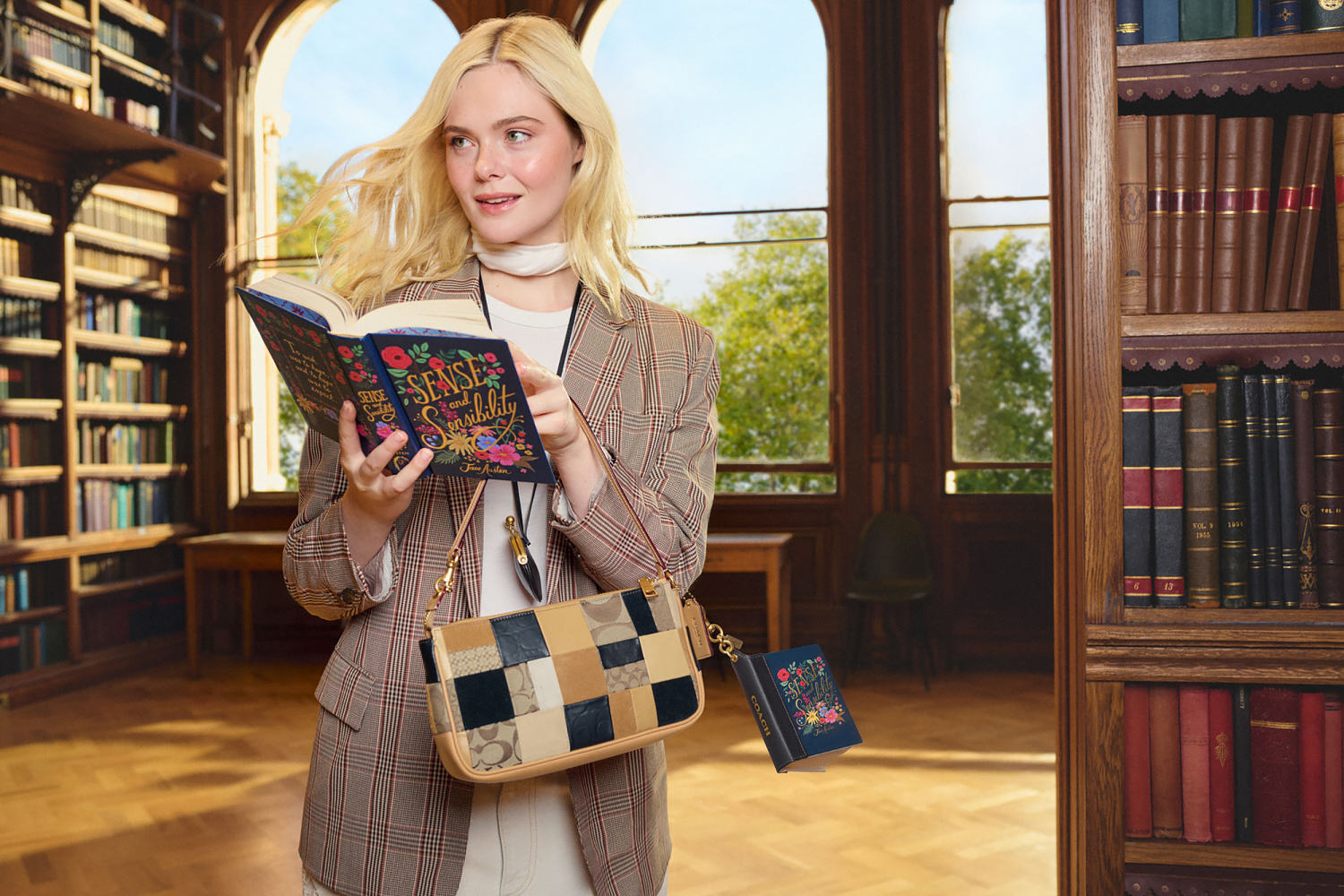
The heritage leather brand recently released a line of book-themed charms. These are tiny, meticulously crafted leather miniatures of books designed to dangle from the strap of a thousand-dollar handbag. They don't open. You can’t read the pages. They are pure iconography. They represent the idea of being a reader without the burden of actually carrying three hundred pages of prose.
It is a fascinating, slightly cynical bit of alchemy. Coach has looked at the surging "BookTok" community—where creators get millions of views for "bookshelf wealth" and color-coordinated libraries—and realized that the book has officially transitioned from a tool of enlightenment to a high-fashion accessory.
The Aesthetic of Intelligence
Consider a hypothetical shopper named Clara. Clara works in digital marketing. Her life is a blur of Slack notifications and data visualization. She feels a constant, low-grade anxiety that her personality is being flattened by algorithms. One Saturday, she walks into a boutique. She sees the book charm.
It’s adorable. It’s "intellectual." It’s $95.
When Clara clips that tiny leather book to her bag, she isn't buying a product; she is buying a bridge. She wants to be the kind of person who spends rainy afternoons in a wood-paneled library. She wants the world to see her as someone who values depth, even if she spent her entire morning scrolling through thirty-second clips of people doing laundry.
This is the "invisible stake" of the trend. We are terrified of being shallow. As our lives become increasingly digital and ephemeral, we cling to the symbols of the analog world. We wear glasses we don’t need. We buy vinyl records we never play. And now, we buy leather charms of books we haven’t read.
The Math of the Trend
The numbers support this pivot. According to data from the Association of American Publishers, print book sales have remained remarkably resilient, often outperforming e-books in key demographics like Gen Z. This isn't because young people suddenly developed a loathing for technology. It’s because a physical book is one of the few things left that cannot be "optimized."
You cannot speed up a physical book. You cannot "double-tap" a paragraph to like it. It demands a one-to-one relationship.
Coach’s move is a calculated bet on this resilience. By shrinking the book into a charm, they are tapping into a specific psychological phenomenon: the commodification of the hobby. We see it in "Gorpcore," where people wear $800 North Face parkas designed for Everest to walk to a Starbucks. We see it in "Tenniscore," where people wear pleated skirts but have never held a racket.
Now, we have "Bookcore."
The charm is a signal. It says, "I am a person of substance." It says, "I value the classics." It does all the heavy lifting of an identity without the dust.
The Ghost in the Accessory
There is a tension here that feels almost tragic. There is a deep, human hunger for the real. We are starving for something we can touch, something that has weight, something that doesn't require a charger.
But when a brand like Coach turns that hunger into a trinket, something is lost in the translation. A book is a conversation between a writer long dead and a reader in the present. It is a messy, transformative, often uncomfortable experience. A leather charm is static. It is a closed loop. It is a costume piece.
Yet, perhaps we shouldn't be so hard on Clara.
Maybe the charm is a gateway. Maybe she buys the tiny leather book because she misses the feeling of the real thing. Maybe, as it clinks against her keys, it serves as a nagging reminder of the person she wants to be. It’s a placeholder for a life that isn’t lived at 5G speeds.
The New Library
Walking through the flagship stores in Soho, the shift is undeniable. Fashion houses are no longer just selling clothes; they are selling curated lives. They are selling the "Reader." They are selling the "Writer." They are selling the "Seeker."
The book charm is just the beginning. We are entering an era where our intellectual lives are being mined for aesthetic value. It’s a strange, mirrored world where the symbol of the thing becomes more valuable than the thing itself.
But the real power of a book doesn't lie in its leather binding or its ability to look good on a handbag. The power is in the way a sentence can rip your heart out. The power is in the way a story can change the way you see the person sitting across from you on the subway.
As the train pulls into the station, the woman across from me finally closes her book. She slips it into her bag. It has dog-eared pages and a coffee stain on the cover. It isn't a charm. It’s a mess. And as she walks away, I realize that no matter how many leather miniatures are sold, you cannot manufacture the look of someone whose world has just been expanded by a single, perfect sentence.
The charm is pretty. The book is alive.
One is an ornament for a bag; the other is an ornament for the soul.