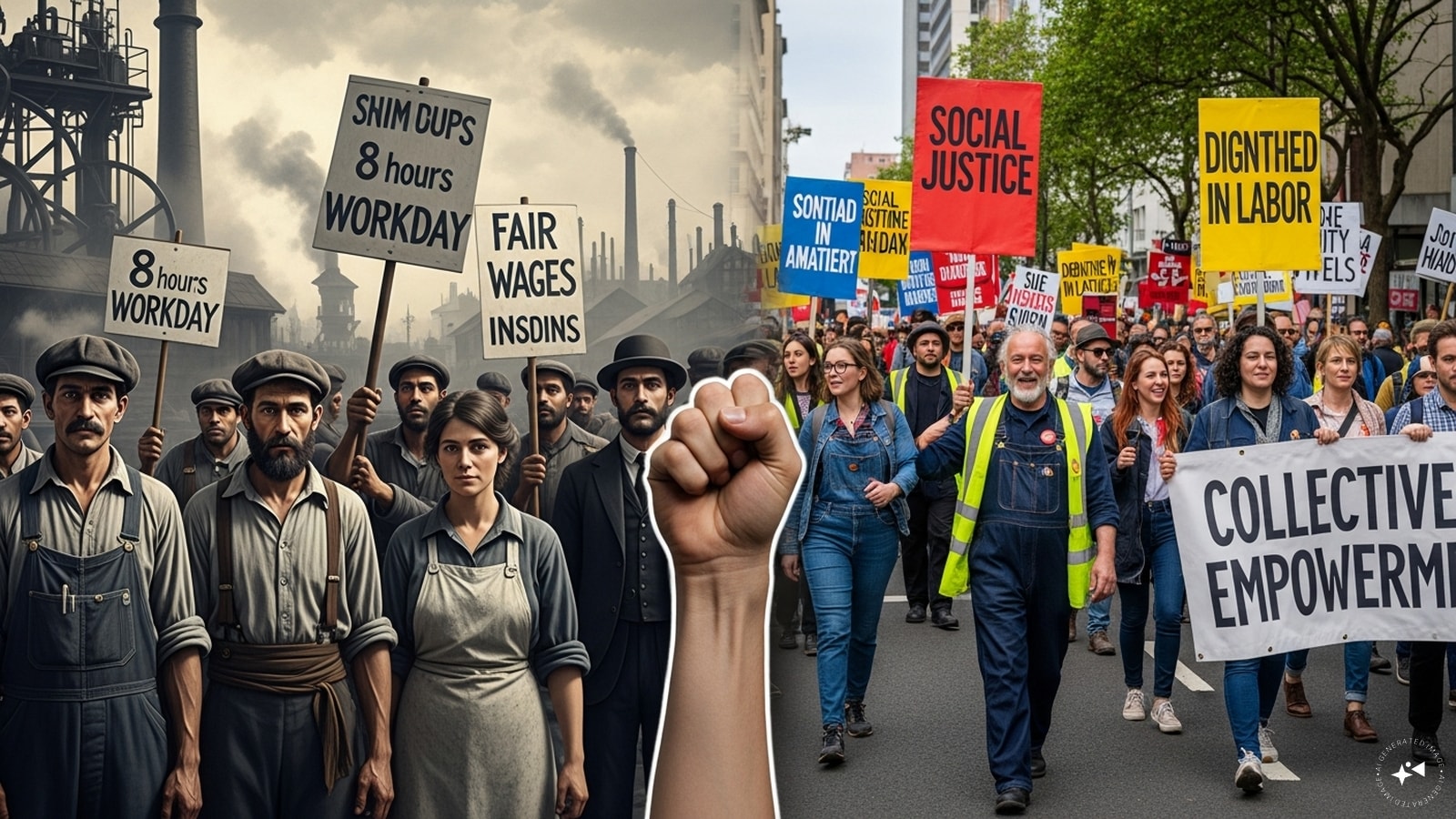
The annual tradition of celebrating Labour Day has become a hollow performance of corporate gaslighting and historical amnesia. We trade 260 days of grueling, often meaningless output for a single Monday of lukewarm potato salad and performative LinkedIn posts about "work-life balance." If you think this holiday is about honoring the worker, you’ve been sold a lie designed to keep you compliant. The reality is far more cynical.
The original intent of the May Day riots and the subsequent labor movements wasn't to secure a "three-day weekend." It was a radical, bloody demand for agency. Today, that agency has been replaced by the "Quiet Quitting" era—a slow-motion surrender where employees pretend to work and employers pretend to care. We aren't celebrating labor; we are celebrating the fact that we’ve reached a stalemate in the war for our own time. If you liked this article, you should check out: this related article.
The Eight-Hour Day is a Productivity Prison
The most sacred cow of the labor movement is the eight-hour workday. "Eight hours for work, eight hours for rest, eight hours for what we will." This slogan was revolutionary in 1886. In 2026, it is an anchor dragging down the modern economy.
The eight-hour day was designed for the assembly line. It assumes that output is a linear function of time. If you are stamping steel plates, the eighth hour is as productive as the first. But for the modern knowledge worker, the programmer, or the strategist, this is demonstrably false. Cognitive throughput follows a curve of diminishing returns. For another angle on this story, refer to the recent update from MarketWatch.
Research into deep work suggests that the human brain can only sustain peak intensity for about four hours a day. Forcing a creative professional to sit in a swivel chair for the remaining four hours isn't "labor"—it’s theater. We have institutionalized "presenteeism," where the metric of success is visibility rather than value. By clinging to the eight-hour standard, Labour Day celebrates the triumph of the clock over the craft.
The Myth of the "General Strike" and the Death of Leverage
Every year, editorials romanticize the power of the collective. They point to the Haymarket Affair or the Pullman Strike as proof that the "masses" hold the cards. This is a comforting fairy tale. In a globalized, automated economy, the "masses" are increasingly interchangeable.
The harsh truth is that labor leverage has shifted from the collective to the individual specialist. The unionized factory worker of the 1950s had power because they could shut down a physical plant. Today, a company’s most valuable assets walk out the door every evening and live in their heads.
If you want to understand why wages have stagnated relative to productivity since the 1970s, look at the decoupling of skills from the local labor market.
$$Productivity \neq Compensation$$
When labor is commoditized, the price goes to the floor. Celebrating "Labor" as a monolithic block ignores the fact that the top 1% of performers in any technical field produce $10\times$ the value of the average worker but are often capped by legacy "fairness" structures born of 20th-century union logic. If you are excellent at what you do, Labour Day isn't for you. It’s a celebration of the median.
Your Benefits Package is a Golden Handcuff
We are told to be grateful for the "protections" labor laws provide. Health insurance tied to employment, 401(k) matching, and "unlimited" PTO (which no one actually takes).
I have watched companies spend millions on "culture initiatives" and "wellness perks" while simultaneously laying off 10% of their staff via a Zoom webinar. These benefits are not a sign of respect; they are a retention strategy designed to increase the "switching cost" of your life.
By tying your physical health and your retirement to a single entity, the modern labor structure has recreated a sophisticated form of company store. You aren't a free agent; you are a tenant-farmer of your own career. The "significance" of Labour Day, as the brochures call it, is actually the celebration of the umbilical cord that keeps you from ever taking a real risk.
The Theme of This Year is Obsolescence
Every year, the International Labour Organization (ILO) picks a theme. They use words like "Social Justice" or "Decent Work." They are missing the asteroid hitting the planet: the total decoupling of human intelligence from economic value.
While we argue over the ethics of remote work versus "Return to Office," the underlying architecture of work is being rewritten by Large Language Models and autonomous agents. The "history" we celebrate on May 1st is about physical bodies in factories. The "future" is about the displacement of the white-collar middle class.
If your job consists of moving data from one spreadsheet to another, or "synthesizing" reports, you aren't a laborer; you are a placeholder. Labour Day should be a day of mourning for the jobs that are being automated while we’re busy grilling burgers.
Stop Asking for a Seat at the Table
The "People Also Ask" sections of the internet are filled with queries like "How can I improve my work-life balance?" or "How do I ask for a raise on Labour Day?"
These are the wrong questions. They assume you are a beggar in a system you don't control.
Actionable advice doesn't involve "quiet quitting" or waiting for a government-mandated holiday. It involves becoming "uncomfortably expensive."
- Kill the Generalist: The market pays for solved problems, not "hard work." Hard work is a commodity. Rare skills are an asset.
- Own the Distribution: If you don't own the means of reaching your customers or the equity in your output, you are just a high-paid migrant worker in the digital economy.
- Reject the 40-Hour Fiction: Stop measuring your worth by the hours you log. Measure it by the magnitude of the problems you eliminate. If you can do in two hours what your peer does in ten, you shouldn't be "rewarded" with eight more hours of work. You should be gone.
The Industry Insider’s Truth
I’ve sat in the boardrooms where "workforce optimization" is discussed. I’ve seen the spreadsheets where employees are listed as "FTEs" (Full-Time Equivalents)—dehumanized units of cost to be minimized. The executives who send out the "Happy Labour Day" emails are the same ones looking for ways to replace you with a Python script.
They love Labour Day. It’s a pressure valve. It lets the steam out of the system just enough to prevent a real explosion. It gives you a taste of freedom so you’ll go back to the cubicle on Tuesday without burning the place down.
Stop sentimentalizing the struggle of the past to justify the stagnation of your present. The 19th-century labor movement won the battle for the weekend, but they lost the war for the soul of work.
The only way to truly honor your labor is to make it so valuable that you don't need a holiday to give you permission to rest. Anything else is just participating in your own managed decline.
Burn the apron. Delete the "Happy May Day" post. Go to work on Tuesday and figure out how to make yourself obsolete before the company does it for you.