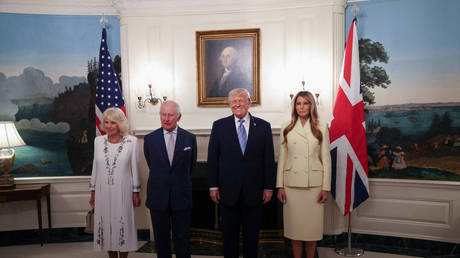
British diplomats are currently scrambling to protect King Charles III from a public dressing-down during his visit to Washington. The fear isn't just about a minor social gaffe or a missed handshake. It's about a "Zelensky-style" confrontation where President Donald Trump might use a live microphone to berate the British monarch in front of the global press.
You probably remember the cringe-inducing footage from earlier this year. Trump sat alongside Ukrainian President Volodymyr Zelensky in the Oval Office and essentially told him his country was "buried" and that he wasn't winning. It was a brutal, televised lecture that left Zelensky looking stuck in a political ambush. Now, UK officials are terrified that Charles, despite his decades of diplomatic training, could be the next target for a similar live-on-air ambush.
The strategy to keep the cameras out
To prevent this, the White House and Buckingham Palace have reportedly reached an agreement. The most substantive parts of the meeting between the King and the President will happen off-camera. While they'll pose for the initial "sprig" of photos—the standard smiling handshake at the start of the session—the cameras will be ushered out before any real talking begins.
It's a defensive move. British officials don't want to risk Trump using the King as a prop to criticize Prime Minister Keir Starmer or the UK's refusal to join American military strikes in Iran. By closing the door, they're hoping to maintain the dignity of the Crown and avoid a viral moment that could damage the "special relationship" even further.
Why the tension is boiling over right now
The backdrop for this visit is incredibly messy. We aren't just talking about two different personalities; we're talking about a fundamental rift in foreign policy.
- The Iran Conflict: Trump has been vocal about his frustration with the UK. He's called Keir Starmer's refusal to join strikes in Iran a "tragic mistake."
- Trade Threats: There’s a constant threat of Trump ripping up the trade deal signed last year or imposing fresh tariffs if the UK doesn't scrap its digital services tax.
- Ukraine and NATO: While the King is expected to voice support for Ukraine during his address to Congress, Trump has been leaning toward a ceasefire deal that many in London fear would leave Kyiv vulnerable.
The King finds himself in a bizarre position. As a constitutional monarch, he can't actually negotiate trade or sign off on military action. But he's being sent in as Britain’s "greatest soft power tool" to try and soothe a President who seems to have little patience for traditional diplomatic niceties.
The risk of the Congressional address
While the Oval Office meeting is being shielded, the King still has to stand before a joint session of Congress. This is only the second time a British monarch has done this—the first was his mother in 1991.
The speech is a minefield. If he talks about the environment or climate change, topics he's championed for 50 years, it'll be seen as a direct swipe at Trump’s energy policies. If he’s too vocal about Ukraine, he risks alienating the "America First" wing of the GOP. Palace officials are likely obsessing over every syllable to ensure he sounds "principled" without sounding "political." It's a nearly impossible tightrope walk.
Managing the Trump factor
Let's be real: Trump actually likes the royals. He’s praised the King as a "great guy" and "brave." He respects the pageantry and the history. However, his respect for the institution doesn't always translate to restraint when a camera is rolling. He likes to dominate the room, and he likes to win the news cycle.
British officials are betting that Trump's fondness for the monarchy will keep him on his best behavior during the formal dinners, but the Oval Office is different. That’s his turf. That’s where the "Zelensky-style" clash happened. In that room, the power dynamic shifts, and the King is just another visitor in Trump’s world.
What to watch for during the visit
- Body Language: Watch the handshake during the photo op. Any sign of the "Trump tug" or a visible lack of warmth will be analyzed by every diplomat in London.
- The Speech Subtext: Look for phrases in the King's Congress speech that mention "shared values" or "international order." These are code for "please don't leave NATO."
- The Social Shield: Foreign Secretary Yvette Cooper is expected to be nearby at all times. Think of her as a human shield, ready to jump in if the conversation turns toward Starmer’s domestic policies or trade disputes.
This trip is a high-stakes gamble. The UK government is hoping that royal charm can bridge a gap that traditional politics can't. If it works, it might buy the Starmer administration some breathing room. If it fails, and Charles is publicly humiliated or drawn into a political spat, it could be the moment the special relationship officially hits the rocks.
Don't expect many "live" updates from the inner sanctum of the White House. For the UK, no news is good news. If we don't see a video of Trump lecturing the King, the diplomats will consider the mission a success. Keep a close eye on the official transcripts and the tone of the King's address to Congress—that's where the real story will be hidden between the lines.