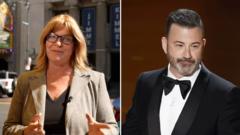
Jimmy Kimmel isn't going anywhere. Every time a joke lands him in hot water, the internet erupts with demands for his immediate firing. People pull up old sketches or point to a monologue they found offensive and wait for the guillotine to drop. It hasn't happened. It probably won't. If you're looking for a simple answer to whether he should be fired, you have to look past the outrage of the week. Late-night television operates on a different set of rules than the rest of the world.
The debate usually centers on whether a joke crossed a line. But the line is a moving target. What was a standard punchline in 2005 is now a career-ending offense for some. Kimmel’s history is well-documented. He’s had the "Man Show" era, the blackface sketches, and the more recent political jabs that alienate half the country. Yet, he remains behind the desk. This isn't just about luck. It’s about the mechanics of network television and the shifting definition of what we expect from our entertainers.
The Business Behind the Outrage
Networks don't fire people because they're offended. They fire people when they become a liability to the bottom line. ABC, owned by Disney, is a massive corporate machine. They look at ratings, ad revenue, and brand safety. As long as Kimmel brings in the numbers and keeps advertisers happy, he stays.
Outrage is often loud but thin. Social media makes it feel like the entire world is calling for someone’s head, but the actual viewership data often tells a different story. For every person tweeting a hashtag to get him fired, there are hundreds of thousands of people who just want to watch a monologue before they go to sleep. Kimmel has built a loyal audience over two decades. You don't throw that away because of a bad week on Twitter.
Advertisers are the real bosses here. In the past, we've seen hosts lose their jobs when companies like Procter & Gamble or General Motors pull their spots. That happened to Bill O’Reilly. It happened to Tucker Carlson. So far, Kimmel’s sponsors haven't budged. They see him as a safe, mainstream personality who occasionally gets poked by the culture war.
Apologies and the Art of the Pivot
Kimmel has mastered the art of the public pivot. When his past "Man Show" sketches or his Karl Malone impression resurfaced, he didn't double down in the way some comedians do. He didn't scream about "cancel culture" for three hours. He issued a statement, acknowledged the growth he’s undergone, and moved on.
This is a specific strategy. By acknowledging the mistake without becoming a martyr, he de-escalates the situation. He shifted his persona from the "beer and bikinis" guy of the early 2000s to a more serious, politically active father figure. This transition was brilliant. It allowed him to stay relevant as the culture changed around him.
Critics argue this is hypocritical. They say he shouldn't be allowed to lecture the public on morality when he has a vault of "problematic" content. But in the world of entertainment, growth—or at least the appearance of it—is a valid currency. If we fired every entertainer who made a joke that aged poorly, the airwaves would be silent.
The Politics of Late Night
We can't talk about Kimmel's job security without talking about politics. Since 2016, late-night TV has become a battleground. Kimmel, along with Stephen Colbert and Seth Meyers, leaned heavily into a specific political lane. This was a gamble. It guaranteed that half the country would dislike him, but it also made him a hero to the other half.
When you become a voice for a specific movement or ideology, you gain a shield. His audience now sees attacks on him as attacks on their own values. This makes it much harder for a network to fire him. If ABC let him go during a political controversy, they risk alienating their most loyal viewers.
However, this political pivot changed the nature of his comedy. It’s less about "is this funny?" and more about "is this right?" This shift is why the calls for his firing often feel so partisan. People don't want him fired because the joke was bad; they want him fired because they don't like his targets.
Comedic License vs Social Responsibility
Does a comedian have a right to be offensive? Historically, yes. Comedy has always been about pushing boundaries and saying the things people think but don't say. The problem is that the "boundaries" are now enforced by the public in real-time.
When Kimmel makes a joke about a public figure or a sensitive topic, he’s doing his job. That job is to provide commentary. Sometimes that commentary is biting. Sometimes it's mean. If we demand that every joke be perfectly sanitized and inoffensive to everyone, we aren't asking for comedy. We're asking for a press release.
There’s a massive difference between a joke that fails and actual misconduct. We've seen stars fired for harassment, assault, or genuine hate speech. Conflating a satirical monologue with those actions dilutes the seriousness of actual wrongdoing. Kimmel might be annoying to some, and his jokes might miss the mark, but he hasn't crossed the threshold that usually triggers a corporate termination.
Why the Internet is the Worst Judge
Social media is a terrible place to decide someone's career. It lacks nuance. It thrives on "gotcha" moments. A ten-second clip from twenty years ago can be stripped of its context and used to fuel a week-long news cycle.
The people calling for Kimmel to be fired often aren't even his viewers. They’re people who saw a headline and felt an immediate surge of dopamine from being part of a digital mob. Networks know this. They've started to develop "outrage fatigue." They know that if they just wait 72 hours, the mob will find something else to be mad about.
If you want to see someone off the air, the solution isn't a petition. It’s changing the channel. Ratings are the only metric that matters in the long run. If people stop watching, the show gets canceled. It's that simple.
The Future of the Host
The late-night format is dying anyway. Ratings are down across the board as younger viewers move to YouTube, TikTok, and podcasts. Kimmel’s biggest competition isn't another talk show host; it’s a guy in his basement with a webcam and a better sense of what people actually care about.
ABC is holding onto Kimmel because he represents stability in a crumbling industry. He’s a known quantity. He’s professional. He delivers what’s expected of him every single night. In a world where everything is fragmented, having a recognizable face at 11:35 PM is worth a lot of money to Disney.
Firing him would create a vacuum that is incredibly hard to fill. Look at the trouble "The Daily Show" had finding a replacement for Trevor Noah. It’s a grueling job that requires a very specific set of skills. You have to be an interviewer, a stand-up, an actor, and a political commentator all at once. There aren't many people who can do that five nights a week without losing their minds.
What Happens Next
If you’re waiting for the "big one" that finally takes Kimmel down, don't hold your breath. Unless there’s a massive scandal involving actual illegal activity, he’s likely to retire on his own terms. The era of the all-powerful late-night host is ending, and he’s one of the last ones standing.
If you don't like his jokes, stop sharing them. Don't engage with the clips. Don't give the show the engagement it needs to stay relevant to advertisers. The power in the digital age isn't in the hands of the people yelling the loudest; it's in the hands of the people who walk away.
Stop looking for a moral victory in a corporate firing. Start looking for better comedy elsewhere. There are thousands of creators who are actually taking risks and telling jokes that haven't been vetted by a legal team and a dozen producers. Go find them. Leave the late-night drama to the people who still have cable.