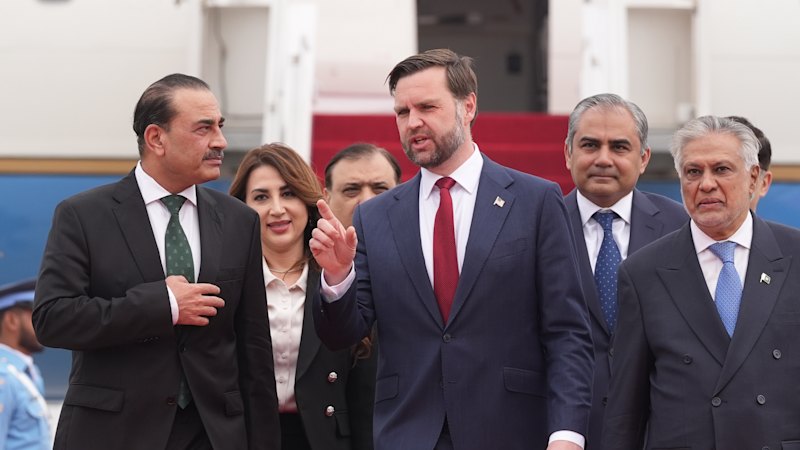
Vice President JD Vance’s arrival in Islamabad marks a desperate pivot in American foreign policy as the administration attempts to use Pakistan’s residual influence over Tehran to prevent a total collapse of order in the Middle East. The primary objective is clear: convince Iran to decouple its regional proxies from the escalating war in Lebanon before the window for a diplomatic ceasefire slams shut. While the public narrative centers on "de-escalation," the private reality is a frantic search for a middleman capable of talking the Islamic Republic back from the brink of a direct confrontation with Israel that neither Washington nor Tehran can afford.
Pakistan finds itself in an uncomfortable but uniquely useful position. Despite its own domestic economic turbulence, Islamabad maintains a functional, if cautious, security relationship with Iran. By dispatching Vance, the White House is betting that the Pakistani military establishment can deliver a message that Swiss channels and European intermediaries no longer carry with sufficient weight. The impasse over Lebanon isn’t just a tactical disagreement; it is a fundamental collision of two incompatible security architectures, and Vance is currently trying to buy the time necessary to prevent them from grinding each other into dust.
The Pakistani Conduit and the Iranian Calculus
Washington’s decision to route this message through Islamabad reflects a cold calculation about who Iran still listens to. Traditional backchannels in Doha and Muscat are exhausted. Iran views the current American administration with deep-seated suspicion, yet it maintains a pragmatic border and trade relationship with Pakistan. Vance isn’t in Pakistan to talk about bilateral trade; he is there because the Pakistani Inter-Services Intelligence (ISI) has historically held the keys to regional stabilization efforts that involve non-state actors.
The Iranian leadership is currently weighing the survival of Hezbollah against the risk of a direct strike on its own soil. If Lebanon falls into a prolonged, scorched-earth conflict, Iran’s most expensive and effective deterrent against Israel is neutralized. Vance’s mission is to present a "conditional exit"—a scenario where Iran restrains Hezbollah’s long-range capabilities in exchange for a limited Israeli drawdown. However, this assumes that Tehran believes the U.S. can actually control the Israeli cabinet’s next moves.
The Lebanon Impasse and the Proxy Trap
Lebanon has become the graveyard of conventional diplomacy because the stakes have moved beyond territory. For Israel, the presence of an armed-to-the-teeth Hezbollah on its northern border is an existential threat that can no longer be managed through periodic "mowing the grass" operations. For Iran, Hezbollah is the crown jewel of its "Axis of Resistance." To give ground in Lebanon is to admit that the proxy strategy, which has defined Iranian foreign policy for forty years, is failing.
This creates a deadlock. The United States wants a return to the status quo of the 1701 UN Resolution, which mandates that Hezbollah move north of the Litani River. Hezbollah, sensing that any retreat will be viewed as a surrender, has dug in. Vance is reportedly offering Pakistan incentives—ranging from debt restructuring support to security assistance—if they can convince the Iranians that a tactical retreat in Lebanon is the only way to save the broader regime in Tehran from an inevitable direct military engagement with American assets in the Mediterranean.
Why the Islamabad Strategy Might Fail
History is littered with failed American attempts to use Pakistan as a regional fixer. The "Double Game" that defined the Afghan War remains a fresh wound in the minds of the D.C. foreign policy establishment. There is no guarantee that Islamabad has the leverage it claims to have, or that Iran won't simply use the Pakistani channel to stall for time while it reinforces its positions.
- The Credibility Gap: Iran knows that Vance represents a domestic political landscape in the U.S. that is fractured. They may choose to wait out the current administration rather than make concessions now.
- Economic Desperation: Pakistan is currently under the thumb of strict IMF mandates. While this makes them compliant with U.S. requests, it also makes them a weak messenger. A messenger who is perceived as a "client" of the U.S. carries less weight in the halls of power in Tehran.
- The Israeli Variable: Even if Vance succeeds in Islamabad, and Islamabad succeeds in Tehran, the Israeli government has shown an increasing willingness to ignore Washington’s "red lines" when it comes to Lebanese security.
The Shadow of the Nuclear Program
Underneath the immediate crisis in Lebanon lies the ticking clock of Iran’s nuclear enrichment. Analysts familiar with the briefing materials suggest that Vance’s visit also carries a veiled warning: if the Lebanon impasse leads to a regional war, the "sanctuary" of Iran’s nuclear sites will no longer be respected by the international community.
By bringing this conversation to Pakistan—a nuclear-armed state itself—the U.S. is subtly reminding all parties of the terrifying scale of what happens if conventional diplomacy fails. The goal is to create a "strategic pause." This pause isn't peace; it is a managed tension designed to prevent a total regional firestorm.
The Cost of the Stalemate
For the people of Lebanon, the impasse means a continuation of the slow-motion collapse of their state. For the U.S., it means being tethered to a conflict that drains resources away from the Pacific theater. Vance is trying to navigate a narrow corridor where the exit signs are written in languages the U.S. has struggled to speak for decades.
The real test of this mission will not be a signed treaty or a joint press conference. It will be the movement of rocket batteries in the Bekaa Valley and the tone of the sermons in Tehran over the next seventy-two hours. If the shells keep falling and the rhetoric remains unyielding, the Islamabad gambit will be remembered as the last gasp of a failed regional strategy.
The time for shuttle diplomacy is over. Now, it is a matter of whether the regional players believe the threat of total war is more dangerous than the political cost of backing down. Vance has placed the ball in Islamabad’s court, but the rackets are being held in Jerusalem and Tehran.
The silence following these meetings will be more telling than any official communiqué. If the borders don't go quiet within the week, the impasse in Lebanon will shift from a diplomatic problem to a purely military one.