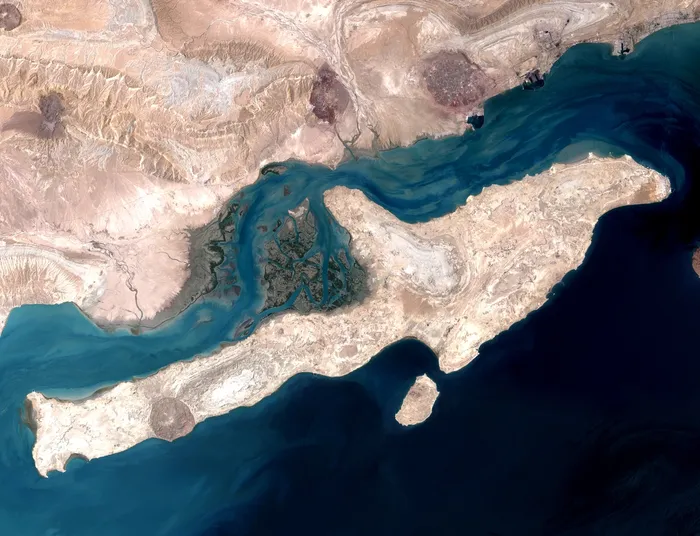
A single drop of salt water hits the rusted railing of a container ship, and somewhere three thousand miles away, the price of a gallon of milk ticks upward. This is the invisible machinery of our lives. We don’t see the currents. We don’t think about the steel hulls. We certainly don’t think about the twenty-one miles of turquoise water that separate the jagged cliffs of Iran from the rocky outposts of Oman.
But Tehran thinks about it every second.
The Strait of Hormuz is not a "geopolitical flashpoint." That is the language of dry white papers and television pundits with nothing at stake. In reality, it is a carotid artery. If you press hard enough on it, the world goes light-headed. If you cut it, the global economy bleeds out in a matter of days. Iran has spent decades perfecting its grip on this specific pressure point, and now, they are signaling that the grip will never loosen.
The Mathematics of a Chokehold
Consider a man named Elias. He is a hypothetical merchant mariner, the kind of person who keeps the world’s lights on while we sleep. Elias stands on the bridge of a Very Large Crude Carrier (VLCC). Under his boots are two million barrels of oil. As his ship enters the Strait, the horizon narrows. To his port side, the Iranian coast looms, a series of silent, watchful ridges.
Elias knows the math. The shipping lanes are only two miles wide in each direction, separated by a two-mile buffer zone. It is a tightrope walk for a vessel the size of the Empire State Building. In this corridor, there is no room to maneuver. There is only the path.
Iran’s recent declarations aren't just about military posturing; they are about a permanent psychological shift. They have moved from "we might close it" to "we own the rules of the passage." By claiming a lasting grip on the Strait after years of simmering conflict, Tehran is essentially installing a permanent toll booth on the world's energy supply. One-sixth of global oil consumption and one-third of the world’s liquefied natural gas pass through this tiny needle’s eye.
If that flow stops, the shockwaves wouldn't just hit gas stations. They would hit the plastic factories in Ohio, the fertilizer plants in Brazil, and the heating grids in Berlin. Everything we touch—the phone in your pocket, the polyester in your shirt—is a ghost of the oil that Elias carries through those twenty-one miles.
The Invisible Fleet in the Mist
The threat isn't just coming from massive destroyers or recognizable warships. That would be too simple. The real power of the Iranian strategy lies in what experts call "asymmetric" dominance.
Picture hundreds of small, fast-attack craft. They are tiny compared to Elias’s tanker, like a swarm of hornets around a slow-moving bull. These boats are cheap, fast, and equipped with sophisticated missiles. They hide in the coves and inlets of the Iranian coastline, invisible to traditional radar until they are already on top of their target.
Then there are the mines.
Laying mines in a narrow strait is the maritime equivalent of scattering broken glass on a dark playground. You don't need a billion-dollar navy to do it. You just need a few fishing boats and a dark night. Once a single mine is spotted, insurance premiums for every ship in the region skyrocket. Shipping companies, driven by the cold logic of the bottom line, stop sending vessels. The Strait closes not because of a physical blockade, but because the risk becomes unmarketable.
Iran has realized that they don't need to win a war to control the world. They only need to control the fear. By vowing a "lasting grip," they are telling the West that the era of "freedom of navigation" is over, replaced by a new reality where every barrel of oil requires their silent permission.
The High Stakes of the Silent War
We often talk about war as a series of explosions. In the Strait of Hormuz, the war is often silent. It is a war of electronic interference, of spoofed GPS signals that trick tankers into drifting into Iranian territorial waters. It is a war of "environmental inspections" that happen to detain a ship for weeks during sensitive political negotiations.
Tehran’s resolve to maintain this grip isn't a sudden whim. It is a calculated response to decades of sanctions. They have looked at their geography and realized they hold the world's most valuable real estate. Why play by the rules of a global system that seeks to isolate them when they can simply redefine the rules of the system's most vital passage?
Some argue that technology will save us. We hear talk of pipelines cutting across the Arabian Peninsula to bypass the Strait. There are pipes that lead to the Gulf of Oman, bypassing the chokehold entirely.
But the capacity isn't there.
Even with every bypass pipe running at maximum pressure, more than 15 million barrels of oil a day would still be trapped behind the Iranian gate. There is no magic "undo" button for geography. The mountains of the Musandam Peninsula and the flats of the Iranian coast are fixed in stone.
The Ghost in the Machine
The real human cost of this "lasting grip" is felt in the uncertainty. When a nation vows to never let go of a chokehold, they are baked into the price of everything. We are living in a world where the cost of living is tied to the mood of a few commanders in the Islamic Revolutionary Guard Corps.
Think of a small business owner in a suburb. Let's call her Sarah. She runs a delivery fleet. She doesn't know where the Strait of Hormuz is. She has never heard of a VLCC. But when she goes to renew her fuel contract and finds the price has doubled because of a "incident" in the Middle East, her life changes. She lets go of an employee. She cancels an expansion.
The Strait is a ghost that haunts Sarah’s ledger. It is the invisible hand that pulls the rug out from under the global middle class.
Iran’s strategy is to make this haunting permanent. By moving away from temporary threats and toward a stated policy of "lasting grip," they are effectively saying that the volatility is the new baseline. They are not just holding a gate; they are holding the thermostat of the global economy.
A Horizon Without an Exit
As the sun sets over the Persian Gulf, the water turns a deep, bruised purple. From the deck of a ship, the lights of the Iranian coast look peaceful, almost inviting. But every sailor on that water knows the truth. They are moving through a corridor where the law of the sea has been replaced by the law of the land.
There is a specific kind of silence that happens on a ship when the engines are cut. It is a heavy, expectant quiet. That is the silence the world is leaning into right now. We are waiting to see if the grip tightens or if it merely holds steady.
But holding steady is its own kind of victory for Tehran. They have successfully moved the goalposts. The world used to debate whether Iran could close the Strait. Now, we are forced to accept that they are the ones who decide when it is open.
The gate is iron. The hands on the lever are firm. And the rest of the world is left to wonder how we became so dependent on a few miles of water that we no longer truly control.
On the bridge of his ship, Elias looks at the radar. The green sweep shows the coastlines closing in. He check his coordinates. He checks his speed. He does everything right, but he knows he is a guest in someone else’s house, and the host has just locked the door from the inside.