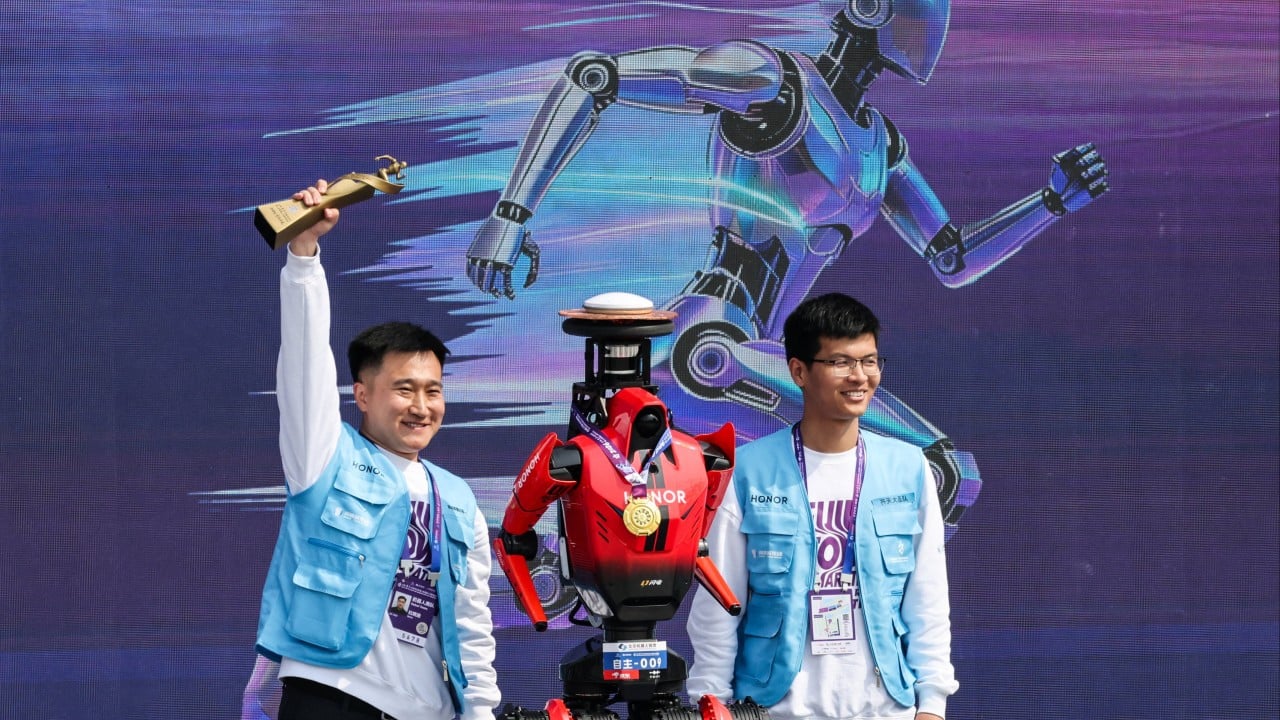
The convergence of sovereign industrial policy and massive capital allocation in China has shifted the robotics sector from experimental laboratory curiosity to a high-rate production race. While Western firms largely prioritize the pursuit of Artificial General Intelligence (AGI) through high-cost, low-volume hardware, Chinese tech conglomerates are executing a strategy of aggressive vertical integration and cost-curve suppression. This movement is not merely about "growth"—it is a calculated play to control the physical layer of the next computing era by commoditizing the mechanical actuators and sensory arrays required for humanoid operation.
The Three Pillars of the Chinese Robotic Offensive
The expansion of China’s robotics ecosystem rests on three distinct structural advantages that differentiate it from the Silicon Valley or Japanese models.
1. Massive Decoupled Prototyping
Unlike the singular, iterative focus of firms like Boston Dynamics or Tesla, the Chinese landscape features dozens of well-funded competitors (Unitree, Fourier, UBTECH, and Xiaomi) simultaneously testing varied hardware architectures. This creates a genetic algorithm for hardware: a high failure rate among individual firms leads to a faster collective identification of the optimal mass-production form factor. The objective is to find the minimum viable humanoid (MVH) that can perform 80% of warehouse tasks at 20% of the current market cost.
2. Supply Chain Proximity and Component Density
The Pearl River Delta provides a geographic advantage that reduces the R&D-to-production cycle by months. When a design change is made to a harmonic drive or a brushless DC motor, the proximity to specialized manufacturing allows for overnight prototyping. This density has led to a rapid drop in the bill of materials (BOM) for humanoid robots. A humanoid that cost $250,000 to produce five years ago is being targeted for a $20,000 to $30,000 production cost within the 2026-2028 window.
3. Policy-Driven Demand Simulation
The Chinese government provides more than just subsidies; it creates artificial early-stage demand. By integrating robotics into state-owned manufacturing facilities and public infrastructure projects, the state ensures that these companies achieve the scale necessary to move down the experience curve. This prevents the "valley of death" where robotics firms run out of capital before reaching unit-economic viability.
The Cost Function of Humanoid Scalability
The primary bottleneck in robotics is not software—it is the physics of the actuator. The cost of a humanoid robot is a function of its Degrees of Freedom (DoF) and the precision of its torque delivery. Chinese firms are attacking this cost function through a transition from expensive, proprietary components to standardized, high-volume parts.
$$C = \sum_{i=1}^{n} (A_i + S_i) + M + P$$
In this equation:
- $C$ represents the total production cost.
- $A_i$ is the cost of the $i$-th actuator (joint).
- $S_i$ is the cost of the $i$-th sensor.
- $M$ represents the structural material and assembly.
- $P$ is the amortized R&D and processing hardware cost.
By focusing on $A_i$, Chinese manufacturers are replacing expensive Swiss and Japanese planetary gears with locally produced cycloidal drives that offer 90% of the performance at 30% of the price. The "good enough" engineering philosophy allows for faster deployment, which in turn generates more real-world data to feed into the AI models controlling the hardware.
Intelligence vs Embodiment: The Strategic Divergence
A critical distinction exists in how intelligence is deployed. Western strategy focuses on "Foundation Models" for robotics—building a massive neural network that can generalize across tasks. The Chinese approach is "Task-Specific Embodiment."
Rather than waiting for a robot to understand the concept of "cleaning," Chinese firms are deploying robots that are hard-coded for specific industrial maneuvers, then slowly layering on vision-language-action (VLA) models to increase flexibility. This bottom-up approach prioritizes immediate utility and cash flow over the long-term promise of a general-purpose digital soul.
The second limitation of the "intelligence-first" model is latency. High-level reasoning requires significant compute power, often offloaded to the cloud. Chinese industrial robots increasingly utilize edge computing to ensure that reflex-level actions (balancing, grip adjustment) are processed locally with near-zero latency, while the "mission-level" logic is handled by a slower, more complex model.
Labor Arbitrage and the Demographics of Necessity
The move toward robotics is often framed as a luxury or a tech showcase, but for China, it is an existential hedge against demographic contraction. The working-age population is shrinking, and the wage gap that once fueled the "world's factory" is closing.
Humanoid robots represent the next phase of labor arbitrage. When the cost of operating a robot per hour falls below the hourly wage of a human factory worker, the transition will be instantaneous rather than gradual.
- Phase 1: Substitution. Robots replace humans in "3D" jobs (Dirty, Dangerous, Dull).
- Phase 2: Augmentation. Humans manage fleets of 10-20 robots, acting as exception handlers rather than primary laborers.
- Phase 3: Integration. Factories are designed from the ground up for robotic movement, removing human-centric constraints like lighting, walkways, and safety buffers.
Constraints and Strategic Risks
The trajectory is not without friction. Significant barriers remain that could stall the Chinese robotics push:
The Semiconductor Bottleneck
High-performance robotics requires advanced AI chips for real-world perception and path planning. Ongoing trade restrictions on high-end GPUs and NPUs (Neural Processing Units) limit the "intelligence" ceiling of Chinese-made robots. While they can excel at the mechanical level, they may struggle to compete in complex, unstructured environments (like home care) without access to the most efficient silicon.
Precision Engineering Gaps
While China has mastered the mass production of mid-tier components, the extreme high-end—specifically high-torque density motors and sub-micron precision sensors—remains dominated by Japanese and European firms. If China cannot close this "precision gap," their robots will remain relegated to low-precision industrial tasks rather than high-stakes surgery or delicate assembly.
The Data Silo Problem
Training a robot requires massive amounts of video and tactile data. Currently, there is no standardized "ImageNet for Robotics." Each company is collecting data in its own silo. Without a unified data-sharing protocol, the learning rate for Chinese robotics will be slower than a collaborative or open-source ecosystem might allow.
The Strategic Play for 2026
The shift from 2025 to 2026 marks the transition from "humanoid prototypes" to "pilot deployments in active supply chains." For investors and competitors, the play is not to watch the hardware, but to watch the integration layers.
The immediate opportunity lies in the "Robot Operations" (RobOps) sector—the software frameworks required to manage heterogeneous fleets of robots from different manufacturers. As Chinese hardware floods the market at commodity prices, the value will migrate up the stack to the orchestration software that can make these diverse machines work in unison.
Strategic advantage will be held by those who control the interface between the LLM-driven intent and the low-level motor control. The race is no longer about who can make a robot walk; it is about who can make 10,000 robots work for 20 hours a day with 99.9% uptime. The focus must shift from the spectacle of the humanoid form to the cold efficiency of the robotic fleet.


:max_bytes(150000):strip_icc()/Term-Definitions_monopoly-fa34a19571eb4168876f3a6947aa1a6f.jpg)