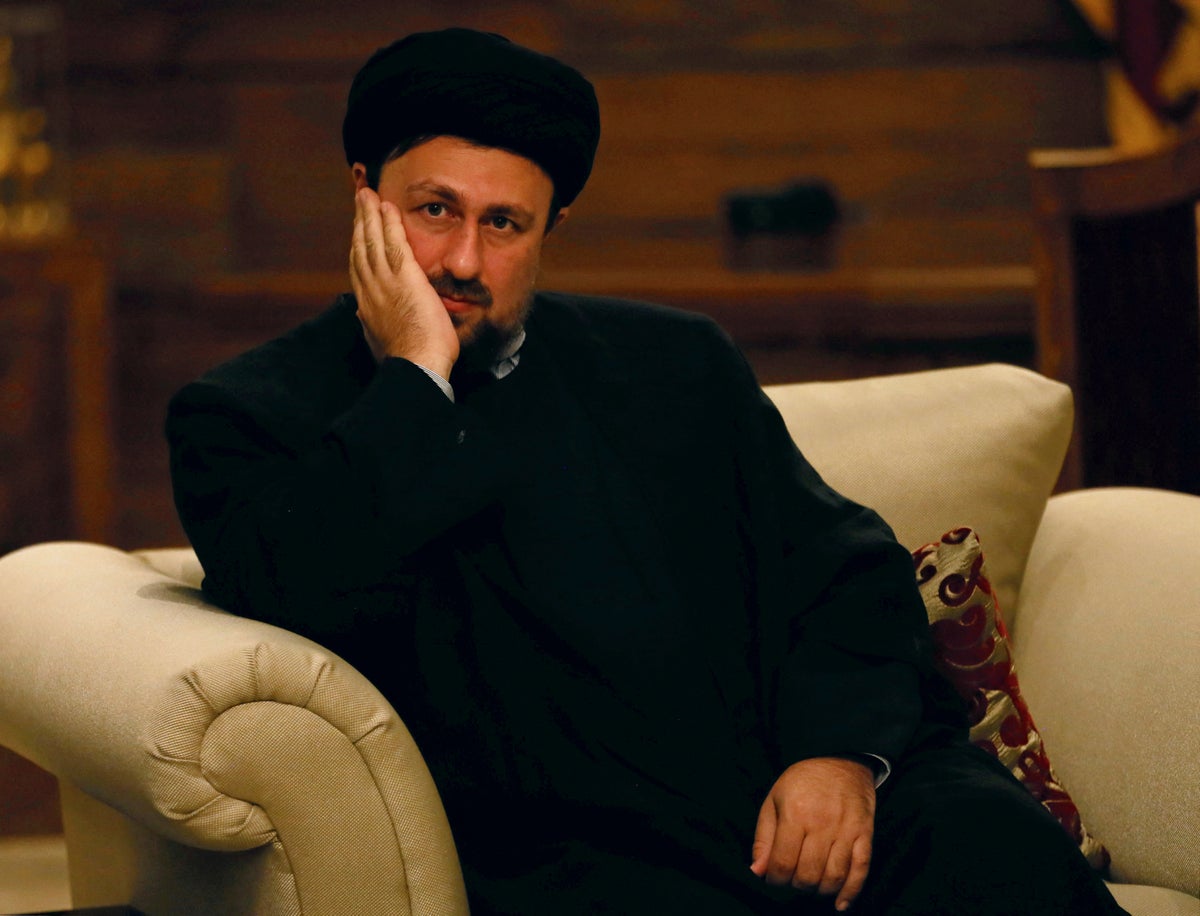
The international press loves a lineage. They see a famous surname, a black turban, and a "reformist" tag, and they start printing coronation programs. For years, the narrative surrounding Hassan Khomeini has been one of a "bridge-builder" or a "shadow king" waiting to reclaim the legacy of his grandfather, Ayatollah Ruhollah Khomeini. It is a comforting story for those who want to believe the Islamic Republic can be fixed from within by a charismatic scion.
It is also total fiction. Meanwhile, you can read other stories here: The Cold Truth About Russias Crumbling Power Grid.
Hassan Khomeini is not the future of Iran. He is a carefully maintained museum exhibit. The obsession with his "potential" as a Supreme Leader successor misses the brutal mechanics of how power actually flows in Tehran. If you are betting on the Khomeini brand to save the Iranian economy or shift its foreign policy, you aren't just wrong—you’re fundamentally misreading the hardware of the state.
The Myth of the Sacred Surname
In any other political system, being the grandson of the founding father is a golden ticket. In the labyrinth of the Assembly of Experts and the Guardian Council, it is a liability. To explore the complete picture, we recommend the recent report by Al Jazeera.
Western analysts often argue that Hassan’s bloodline gives him "undeniable legitimacy." This ignores the fact that the current Supreme Leader, Ali Khamenei, spent thirty-plus years systematically decoupling the Office of the Supreme Leader from the Khomeini family. The transition from charismatic authority (Ruhollah) to institutional authority (Ali) required the marginalization of the Khomeini clan.
When the Guardian Council disqualified Hassan Khomeini from running for the Assembly of Experts in 2016, they weren't just checking his homework on Ijtihad (independent legal reasoning). They were sending a memo: The name Khomeini is a brand we respect in speeches, but we will not allow it to hold the keys to the building.
To understand why he is stuck in the waiting room, you have to look at the "People Also Ask" fodder that keeps popping up in briefing papers:
"Is Hassan Khomeini a mujtahid?" The establishment says no. In the Shia clerical hierarchy, your ability to interpret Islamic law determines your rank. By denying him the status of a mujtahid (someone capable of issuing legal rulings), the hardline clerics effectively stripped him of his professional license. It’s the equivalent of telling a Harvard JD he’s not qualified to be a paralegal. It’s a move designed to humiliate, not just exclude.
The Reformist Kiss of Death
The media labels Hassan a "reformist" because he smiles at cameras and speaks about civil rights. In the current Iranian political climate, being labeled a reformist is like being labeled "organic" in a famine—it sounds nice, but it doesn't feed anyone.
The reformist movement in Iran is currently a hollowed-out shell. Since the 2009 Green Movement and the subsequent crackdowns, the "moderate" wing of the clergy has been systematically stripped of its teeth. By hitching his wagon to the reformist camp, Hassan Khomeini didn't broaden his base; he trapped himself in a shrinking room.
I have watched analysts suggest that his "popularity" makes him a threat. Popularity is a vanity metric in a system where the voters don't pick the Supreme Leader. The Assembly of Experts picks the leader, and that body is currently packed with "Ultra-Principlists" who view Hassan’s brand of moderation as a gateway drug to Western decadence.
The Revolutionary Guard Problem
Any discussion of the next Supreme Leader that doesn't start and end with the Islamic Revolutionary Guard Corps (IRGC) is a waste of ink.
The IRGC has evolved from a military branch into a sprawling conglomerate that controls roughly 30% to 50% of the Iranian economy. They have a vested interest in a Supreme Leader who maintains the status quo of "Resistance." They need a leader who justifies their budget and their regional interventions.
Hassan Khomeini represents a return to a more "clerical-centric" rule that might actually try to rein in the IRGC's economic monopoly to save the national budget. Do you think the generals who control the ports, the construction firms, and the telecommunications networks are going to hand the scepter to a man who might sign a deal with the West and open the market to competition?
Imagine a scenario where a billionaire CEO is asked to vote for a board member who wants to liquidate the CEO's private jet fleet. That is the IRGC looking at Hassan Khomeini.
The Economy Doesn't Care About Lineage
While the West debates the nuances of clerical succession, the Iranian street is screaming about the price of eggs and the collapse of the Rial.
The "Khomeini" name used to mean a populist promise of free electricity and water. Today, it’s associated with the very elite that has presided over decades of stagflation. Hassan Khomeini lives a life of relative comfort and prestige while the average Iranian deals with 40% inflation.
If the current system collapses or undergoes a radical shift, the protesters won't be looking for "Khomeini Lite." They are increasingly moving past the entire framework of the Islamic Republic. By the time a succession crisis actually hits, the name Khomeini might be more of a target than a shield.
The "lazy consensus" says he is a dark horse candidate. The reality is he’s a decorative horse on a carousel—he moves up and down, he looks the part, but he’s not actually going anywhere.
Stop Asking if He’s Next
The question "Will Hassan Khomeini be the next Supreme Leader?" is the wrong question. It assumes the selection process is a meritocracy of charisma or a dynastic hand-off. It isn't.
The right question is: "Who does the IRGC believe will best protect their balance sheet?" When you look through that lens, Hassan Khomeini disappears from the list entirely. He lacks the military connections, the hardline credentials, and the institutional backing. He is a man with a famous grandfather and a nice library, nothing more.
If you are looking for the next leader of Iran, look at the men who don't talk to the Western press. Look at the men who have spent the last decade building alliances within the intelligence apparatus. Look at the men who the IRGC already trusts to sign the checks.
Hassan Khomeini is a ghost of a revolution that has already moved on. Stop waiting for the grandson to fix what the grandfather built; the house has new owners now, and they aren't planning on moving out.