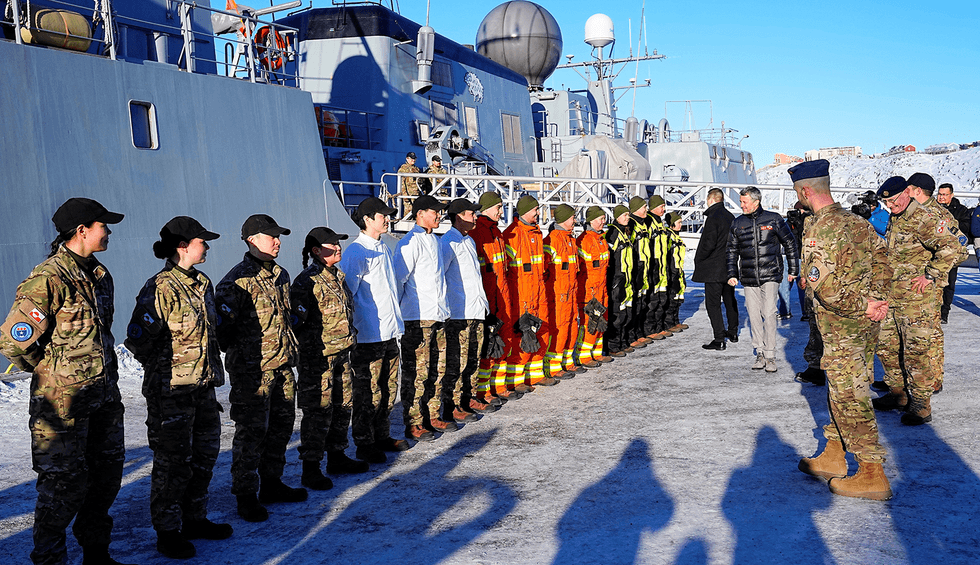
Imagine standing on a frozen runway in Nuuk, holding enough high-grade explosives to turn the asphalt into a cratered wasteland. That wasn't a thriller movie plot in January 2026. It was the literal reality for Danish soldiers. They weren't there for a routine drill. They were preparing for the unthinkable: a military move by the United States against its own ally.
If you think the "Buy Greenland" talk from 2019 was just a eccentric real estate joke that died out, you haven't been paying attention to the second Trump term. By early 2026, the rhetoric shifted from "I’d like to buy it" to "We’re going to do something whether they like it or not." This wasn't just posturing. Reports now confirm that Copenhagen was so rattled by the threat of American annexation that they prepped for a hot war on the ice.
The blood bags and the blasting caps
In the second week of January 2026, the Danish military took steps that haven't been seen since the Nazi occupation in 1940. We now know from investigative reports by the Danish broadcaster DR that soldiers flown into Greenland weren't just carrying extra parkas. They were carrying crates of explosives specifically destined for the runways at Nuuk and Kangerlussuaq.
The logic was brutal but simple. If the U.S. attempted a forced landing or an airborne seizure of key hubs, the Danes were going to blow the doors shut. You don't bring runway-breaching charges to a friendly exercise. You also don't fly in massive quantities of emergency blood supplies from mainland Danish hospitals unless you expect people to start bleeding.
This level of desperation tells you everything you need to know about the state of the "special relationship" between Washington and Copenhagen. For decades, Denmark has been the loyal partner, allowing the U.S. to operate the Pituffik Space Base (formerly Thule) as a cornerstone of early warning systems. But when the White House started framing Greenland’s autonomy as a "dangerous risk to the survival of the planet," the Danes realized the old rules of diplomacy were officially dead.
Why the Arctic suddenly became a tinderbox
It's easy to dismiss this as a personality clash, but there's a cold, hard logic behind the American pressure. As the Arctic ice thaws, it's revealing a treasure map of critical minerals—zinc, copper, graphite, and rare earth elements that are currently controlled mostly by China.
- Mineral Security: Washington sees Greenland as a "near-domestic" solution to breaking China's grip on the EV battery supply chain.
- The Russia-China Ghost: The administration argued that Denmark is too small to defend the island from Russian or Chinese "encroachment," despite no evidence of a pending invasion from either.
- The Venezuela Effect: The rapid U.S. military operation in Venezuela in early January 2026 served as a terrifying proof-of-concept. It showed Europe that the current administration was willing to use "the hard way" to secure strategic interests.
When Stephen Miller’s wife, Katie Miller, posted a map of Greenland covered by the American flag with the caption "SOON," the Danish intelligence services didn't see a meme. They saw a warning.
Europe finally found its spine
For years, people have talked about "European strategic autonomy" like it was a boring homework assignment. The Greenland crisis made it a survival instinct. When Trump threatened a 25% tariff on any European nation that interfered with the "Greenland transition," he expected them to fold.
Instead, they did something rare: they stood together. France, Germany, the UK, and the Nordic countries didn't just send angry letters. They sent troops. Under the guise of "Operation Arctic Endurance," a multinational force touched down in Greenland in mid-January.
The strategy was clever. By placing French, German, and British soldiers alongside the Danes, they created a "tripwire." If the U.S. moved in, they wouldn't just be steamrolling a tiny Danish contingent; they’d be firing on the core members of NATO. It was a high-stakes game of chicken that pushed the alliance to the absolute brink of collapse.
The Davos Pivot and the "Greenland Framework"
By January 21, 2026, the tension peaked. At the World Economic Forum in Davos, the world expected a declaration of economic war. Instead, we got a classic pivot. After a closed-door session with NATO Secretary General Mark Rutte, the tone shifted. The "hard way" was off the table—at least for now.
The resulting "Greenland Framework" isn't a sale. It’s a massive expansion of American influence that stops just short of taking the flag down. It involves:
- Joint resource development (meaning U.S. mining companies get first dibs).
- Expanded "security cooperation" that looks a lot like a permanent U.S. footprint.
- The withdrawal of the threatened 25% tariffs.
The Danes are calling it a victory for sovereignty. The White House is calling it a win for American energy. In reality, it's a messy compromise that has left a permanent scar on the Atlantic alliance.
What this means for you
If you're looking at this and thinking it's just a spat over a frozen island, think again. The Greenland crisis of 2026 changed the "protected" status of European borders. It proved that in a world of resource scarcity, even your best friend might come for your backyard if it contains the minerals they need for the next decade's tech.
Don't expect the pressure to vanish. While the military threat has receded, the economic "integration" is just beginning. Keep an eye on the mining permits being issued in Nuuk over the next six months. If you see American firms like Critical Metals Corp getting exclusive rights to the best deposits, you'll know exactly what the "peace deal" actually cost.
Next steps for following this story:
- Monitor the "Arctic Sentry" mission updates to see if European troops actually stay on the island long-term.
- Check the 2026 Danish election results on March 24; the fallout from this standoff is likely to topple the current government.