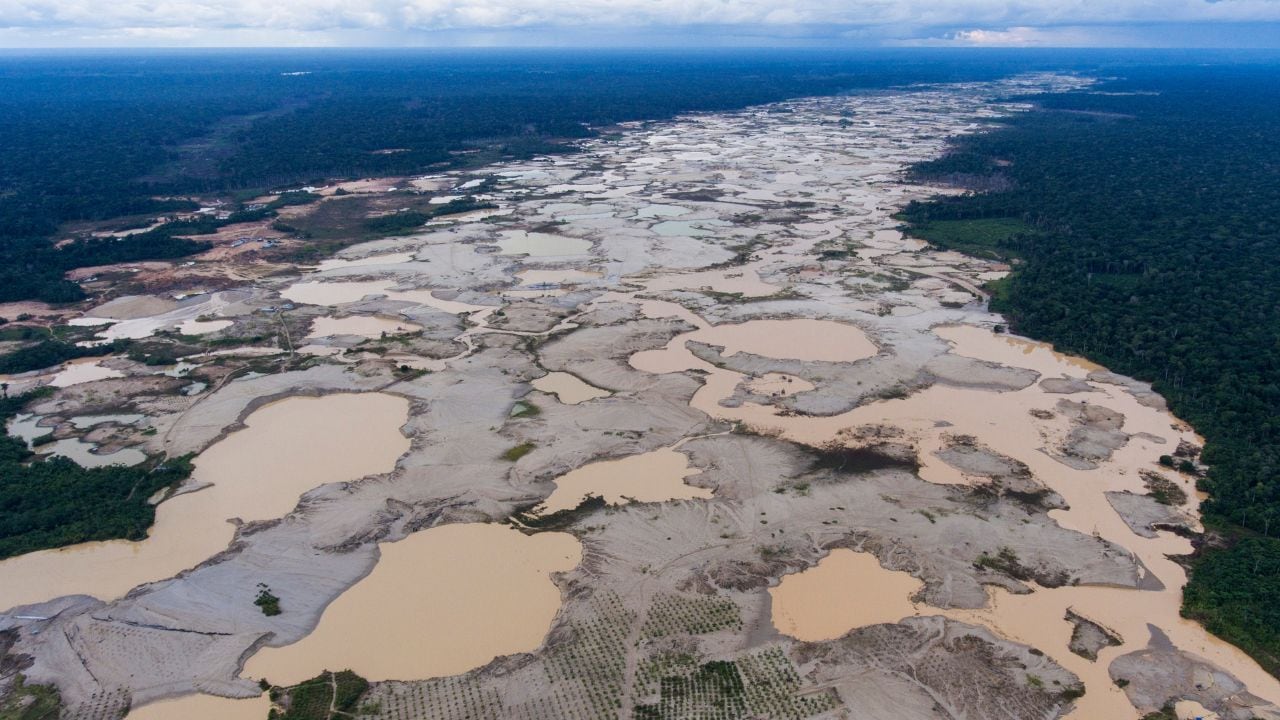
The Peruvian Amazon is being dismantled, hectare by hectare, by an industry that remains largely invisible to the global consumer but is currently more profitable than cocaine. As the 2026 general election approaches, the political class in Lima remains paralyzed, offering only vague platitudes about "order" while the rainforest is converted into a moonscape of toxic craters. This is not just an environmental failure; it is a total collapse of state sovereignty in the face of organized crime.
Illegal gold mining is no longer a localized issue of "artisanal" workers trying to survive. It has mutated into a multi-billion dollar criminal enterprise that fuels human trafficking, extortion, and the systematic poisoning of the continent's water supply. While candidates like Keiko Fujimori and Rafael López Aliaga trade barbs over urban security and "mano dura" policies, the actual frontier of Peruvian lawlessness—the Amazon—remains a secondary thought.
The New Economics of Illicit Gold
Gold has become the ultimate laundered asset. Unlike coca leaves, which must be processed into a highly illegal powder with a volatile price point, gold is a legitimate global commodity. Once an illegal nugget is mixed with legally sourced ore, it becomes indistinguishable. It enters the global supply chain, ending up in jewelry stores in Zurich or the circuit boards of smartphones in Silicon Valley.
In the Madre de Dios region, the epicenter of the crisis, the scale of the destruction is staggering. More than 11,500 hectares were deforested in the last year alone. The buffer zone of the Tambopata National Reserve has seen a 21% increase in the number of active dredgers since 2024. These are not hand-held pans; these are massive, industrial-scale machines that tear up riverbeds and discharge mercury directly into the ecosystem.
The economic incentive is clear. With global gold prices hitting record highs, the "pull factor" for criminal syndicates is irresistible. INTERPOL estimates that illegal mining now accounts for up to $48 billion a year in criminal proceeds globally, with Peru serving as a primary extraction point. For a criminal organization, gold offers a safer, more stable return on investment than narcotics, with the added benefit of a much easier path to laundering.
The Political Blind Spot
The 2026 election cycle should be a turning point, yet the campaign platforms of the frontrunners are remarkably thin on specifics regarding the Amazon. Keiko Fujimori’s "Peru with Order" plan focuses heavily on urban crime and sports-based prevention programs. Rafael López Aliaga has proposed billion-dollar investments in police intelligence, but primarily through the lens of "urban terrorism" and migrant-led crime.
This urban-centric focus ignores the reality that the most powerful criminal structures in Peru are currently being built in the jungle. These organizations do not just mine gold; they govern territory. In mining towns like La Pampa, the state is a ghost. Criminal "syndicates" provide the security, the electricity, and the justice system. They also run the bars and brothels where women, often lured from impoverished Andean regions with promises of waitressing jobs, are held in debt bondage.
The lack of a concrete plan to dismantle these rural criminal economies is a glaring omission. Merely sending the military to burn a few dredgers—a tactic used repeatedly over the last decade—has proven to be a temporary fix. The miners simply wait for the helicopters to leave, rebuild their equipment, and return to the pits within weeks.
The Mercury Legacy
Beyond the immediate violence is a slower, more insidious catastrophe. Mercury is used to separate gold from sediment, and it is handled with a terrifying lack of precaution. It is estimated that for every kilogram of gold produced, at least two kilograms of mercury are released into the environment.
The mercury does not stay in the pits. It enters the atmosphere during the "burning" process and settles into the rivers, where it enters the food chain. Indigenous communities, who rely on river fish for their primary protein source, are the first to suffer. High levels of mercury exposure lead to permanent neurological damage, birth defects, and kidney failure.
The Overlap of Legal and Illegal
One of the most complex hurdles to solving the crisis is the blurred line between legal concessions and illegal activity. Peru’s Geological, Mining, and Metallurgical Institute (INGEMMET) continues to process thousands of new mining applications, many of which overlap with indigenous territories and protected areas.
In many cases, legal concessions are used as a "front" for illegal extraction. A company may hold a permit for a small plot of land but use it to "legalize" gold pulled from a nearby national park. This systemic corruption within the regulatory bodies makes it nearly impossible to track the true origin of Peruvian gold.
The Transborder Threat
The crisis has moved beyond Peru’s borders. Illegal mining enclaves are now firmly established along the "hot borders" with Ecuador, Colombia, and Bolivia. These are lawless zones where transnational gangs coordinate the movement of gold, fuel, and mercury.
- Ecuadorian Border: Recent deforestation in the Chinchipe and Condorcanqui basins shows a rapid expansion of illegal enclaves.
- Putumayo Tri-border: A nexus for Colombian and Peruvian criminal groups who share logistics and protection networks.
- Bolivian Border: The Madre de Dios river serves as a highway for illicit gold moving toward La Paz, where regulations are often even more lax.
Without a coordinated, multi-national security strategy, any local success in Peru will simply push the activity across the border.
The Path Forward
Solving the illegal mining crisis requires more than just "mano dura." It requires a complete reimagining of the state's presence in the Amazon.
First, the formalization process for artisanal miners must be overhauled. The current system is a bureaucratic nightmare that drives well-meaning miners into the arms of criminal financiers. If the state cannot provide a clear, accessible path to legality, the cartels will provide the alternative.
Second, the financial networks must be targeted. Burning dredgers is theater; freezing the bank accounts of the "gold shops" in Lima and Juliaca that buy the illicit ore is strategy. The trail of the money is much easier to follow than the trail of the gold once it reaches the city.
Finally, the 2026 candidates must be forced to address the Amazon as a matter of national security, not just environmental conservation. As long as the jungle remains a playground for organized crime, the "order" promised in Lima will remain an illusion. The state cannot claim to be in control of the country while it cedes 60% of its territory to the golden cartels.