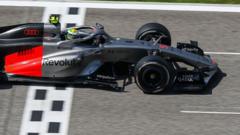
The silence is the first thing that hits you. Not the silence of an empty track, but the eerie, digital hush of a simulated cockpit in a darkened room in Brackley or Maranello.
A driver—let’s call him Leo, a composite of the twenty titans currently grappling with this new reality—stares at a screen flickering with telemetry. It is 2026. Outside the simulator’s hydraulic legs, the world thinks Formula 1 is just about faster cars and louder engines. Inside, Leo is learning how to dance with a ghost. Recently making waves recently: The Mohamed Salah Decision Matrix Liverpools Financial and Sporting Equilibrium.
For a decade, the formula was a known quantity. You braked, you turned, you mashed the throttle, and a complex piece of engineering called the MGU-H harvested heat from the exhaust to keep the turbo spinning. It was seamless. It was invisible.
It is also gone. Additional details on this are covered by Yahoo Sports.
The Return of the Human Variable
The 2026 regulations have stripped away the "magic" bits of the engine that masked a car's imperfections. By deleting the MGU-H, the FIA hasn't just simplified the power unit; they’ve reintroduced a monster F1 thought it had slain: turbo lag.
Consider what happens next: Leo exits a slow hairpin. In 2025, the power was instant, a digital kick in the spine. Now, as he plants his right foot, there is a yawning chasm of nothingness. For a fraction of a second, the 1.6-liter V6 is breathless, waiting for the exhaust gases to spin up the turbine manually.
Then, the world explodes.
The power doesn’t just arrive; it hits with a 50/50 split between fire and lightning. The internal combustion engine and the beefed-up MGU-K (the kinetic recovery system) now share the load equally. We are talking about nearly 1,000 horsepower, but half of it is being delivered by a battery that is three times more powerful than its predecessor.
Leo isn't just a driver anymore. He is a high-speed accountant. He has to balance a ledger of joules and megajoules while pulling five Gs.
The Weight of the Air
The cars have shrunk. They are 10 centimeters narrower and 20 centimeters shorter. They’ve shed 30 kilograms, dropping the minimum weight to 768kg. On paper, "smaller and lighter" sounds like a gift. In practice, it makes the car a nervous, twitchy animal.
But the real problem lies elsewhere. It’s in the wings.
Formula 1 has finally embraced "Active Aero." In the past, we had DRS—a simple flap that opened to help you pass. Now, the entire car is a shapeshifter. On the straights, the front and rear wings flatten out into "X-mode," shedding drag like a skin. The car pierces the air with terrifying efficiency.
As Leo approaches the braking zone, the car must transition to "Z-mode." The flaps snap shut, the downforce returns, and the air suddenly becomes like set concrete, slamming the tires into the asphalt so he can make the corner.
If the software glitches—if the front wing stays flat while the rear wing closes—the balance of the car vanishes. It becomes an unguided missile. The stakes aren't just about a lap time; they are about the fundamental trust between a man and a machine that is constantly changing its own shape.
The Strategy of the Surge
The "Overtake Mode" is the new weapon of choice. Gone is the predictable DRS train. In its place is a manual Boost button, a digital reservoir of energy that a driver can trigger when they are within a second of the rival ahead.
But there is a catch. The energy isn't infinite.
If Leo uses his full 350kW boost to blast past a competitor on the back straight at Monza, he is essentially emptying his clip. For the next half-lap, he is a sitting duck. His car will "clip"—a term engineers use when the battery runs dry and the car hits a digital wall—leaving him defenseless as the driver he just passed recharges and prepares to strike back.
It is a high-speed game of poker played at 340 km/h.
A New Bloodline
This technical upheaval isn't just about the teams we know. It has shifted the tectonic plates of the sport. The complexity of these rules is what lured Audi into the fray, taking over the Sauber outfit to prove German engineering can master the 50/50 power split. It’s why Ford has returned, partnering with Red Bull to ensure the reigning champions don't stumble in this new era.
They are all chasing the same thing: the perfect harvest.
Under the 2026 rules, the amount of energy recovered under braking has doubled to 8.5 MJ per lap. The cars are now 100% powered by sustainable synthetic fuels, a laboratory experiment designed to prove that the internal combustion engine doesn't have to be a relic of the past.
But for the fans in the grandstands, the science is secondary to the spectacle. They will see cars that are harder to drive, drivers who are more prone to error, and a pecking order that has been tossed into a blender.
The 2026 era isn't a "game-changer"—a term too sterile for the chaos it promises. It is a reset. It is a return to a time when the driver mattered more than the wind tunnel.
Leo finishes his sim session. He climbs out of the cockpit, drenched in sweat, his hands shaking slightly from the effort of managing the "Boost" and the "Active Aero" and the "Turbo Lag."
He looks at his lead engineer.
"It's a beast," he says.
The engineer smiles. "Good. We were worried it might be too easy."
The ghost in the machine has never been more alive.
Would you like me to analyze how these 2026 changes specifically impact the rivalry between the established manufacturers and the newcomers like Audi and Ford?