The Weight of Still Water
The map makes it look easy. A narrow blue ribbon of water, barely twenty-one miles wide at its tightest point, separates the rugged coast of Iran from the Arabian Peninsula. In a briefing room in Washington or a campaign trail in the Midwest, the Strait of Hormuz looks like a problem that can be solved with a hammer. We hear the rhetoric often: if the oil stops flowing, we send in the fleet. We kick the door open. We show them what a superpower can do.
But water is deceptive. It hides the past as easily as it hides a mine.
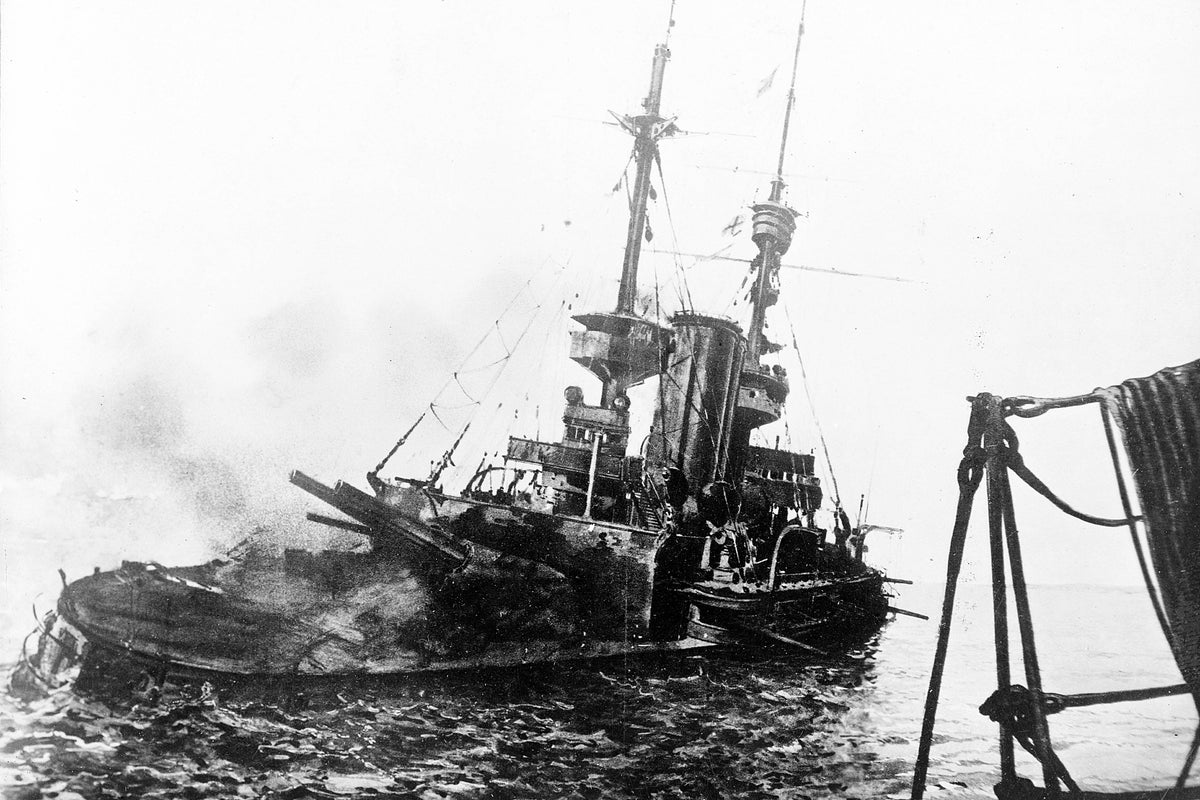
To understand why a massive naval assault in the Strait would likely end in a historic catastrophe, you have to look away from the Persian Gulf. You have to look back to a spring morning in 1915, on a jagged coastline in Turkey called Gallipoli. There, the greatest naval power the world had ever seen—the British Royal Navy—tried to do exactly what some suggest we do today. They tried to force a narrow waterway with sheer, unadulterated steel.
They failed. Not because they lacked courage, but because they ignored the math of the shoreline. Today, that same math is screaming at us from the cliffs of the Hormuz.
The Arrogance of the Dreadnought
Imagine a young sailor in 1915, standing on the deck of a British battleship. He is surrounded by the pinnacle of industrial technology. These ships were the "indestructible" giants of their era. The plan was simple: sail through the Dardanelles, knock out the Turkish forts with long-range guns, and dictate terms in Constantinople. The admirals were so confident they didn't even think they needed the army.
But the Turkish defenders weren't playing by the rules of the open sea. They didn't meet the British in a fair fight. Instead, they used the geography. They hid mobile howitzers behind hills. They laid rows of mines in the dark of night. When the British fleet steamed in, the "invincible" ships found themselves trapped in a kill zone.
The HMS Irresistible and the HMS Ocean didn't sink because they were outgunned by another fleet. They sank because they were outmaneuvered by a coastline. The geography of a strait turns a ship—even a modern destroyer—into a target in a shooting gallery.
In the Strait of Hormuz, this problem is magnified by a century of lethal innovation. If the United States tries to "take" the Strait by force, we aren't fighting a navy. We are fighting a geography that has been weaponized.
The Invisible Swarm
In the open ocean, a U.S. Carrier Strike Group is a god of war. It moves with a bubble of protection that extends for hundreds of miles. But move that same group into the Strait, and the bubble pops.
Consider the hypothetical perspective of a drone operator tucked into a limestone cave along the Iranian coast. He doesn't need a billion-dollar ship. He needs a dozen high-speed, explosive-laden motorboats. He needs a battery of anti-ship cruise missiles hidden in a nondescript truck. He needs a swarm.
When you are in a narrow channel, your reaction time disappears. A missile launched from the shore can reach its target in seconds. Even the most advanced Aegis combat system has a physical limit to how many incoming threats it can track and neutralize at once. In a swarm attack, the goal isn't to win a ship-to-ship duel. It's to overwhelm the computer's ability to choose what to shoot first.
One hits. Then two. Then the "indestructible" symbol of American power is listing in the tide, blocking the very channel it was sent to open.
The Price of a Gallon
We talk about "securing" the Strait as if it’s a binary switch—on or off. But the global economy doesn't react to reality; it reacts to risk.
If a single tanker is hit by a limpet mine or a shore-based missile, the insurance rates for every other ship in the region quadruple overnight. Tankers stop moving. Not because the Strait is physically blocked by debris, but because the cost of moving through it becomes a mathematical impossibility for the shipping companies.
The invisible stakes are the quiet moments in a suburban kitchen three weeks later. It's the parent staring at a gas pump, watching the numbers climb past seven, eight, nine dollars a gallon. It's the collapse of "just-in-time" supply chains that bring medicine to pharmacies and components to factories.
When we talk about "taking the Strait by force," we are talking about gambling the entire global economy on the hope that modern sensors are better than 1915 mines. History suggests that's a losing bet. The defender only has to be lucky once. The superpower has to be perfect every single second.
The Mirage of Control
There is a seductive quality to military force. It promises a clean ending. But a naval war in the Strait of Hormuz is the opposite of clean. It is a grinding, asymmetric nightmare where the environment itself is the enemy.
The cliffs of the Musandam Peninsula and the jagged islands of Greater and Lesser Tunb act as natural fortresses. They are honeycombed with siloes and bunkers. You can't "clear" them with an airstrike because you can't see them until they fire. And by then, the missile is already skimming the wave-tops at Mach 2.
We often forget that the Iranian military has spent forty years studying our strengths and their own terrain. They aren't building a navy to fight us in the Atlantic. They are building a "keep out" sign made of sea mines, speedboats, and shore-to-ship fire. They have turned the Strait into a terrestrial extension of their own land defense.
To "take" the Strait would require a full-scale land invasion of the Iranian coastline—a mountainous, treacherous stretch of earth that would make the insurgencies of the last two decades look like a rehearsal.
The Silent Lesson
The wreckage of the British fleet still sits at the bottom of the Dardanelles. It serves as a rusted monument to the idea that technology can bypass the brutal realities of geography.
We live in an era of hypersonic missiles and satellite surveillance, yet we are still bound by the same physical constraints as the sailors of 1915. A narrow strip of water is a trap. It is a place where the mighty are humbled by the small, and where the cost of "victory" is often indistinguishable from the cost of defeat.
If we ignore the ghost of Gallipoli, we aren't just risking a few ships. We are risking the stability of the modern world on a plan that has failed every time it has been tried. The Strait of Hormuz cannot be taken by force because the Strait is not just a body of water. It is a geographical reality that refuses to be conquered by fire.
The true strength of a superpower isn't knowing when to swing the hammer. It's knowing when the hammer will only shatter in your hand.