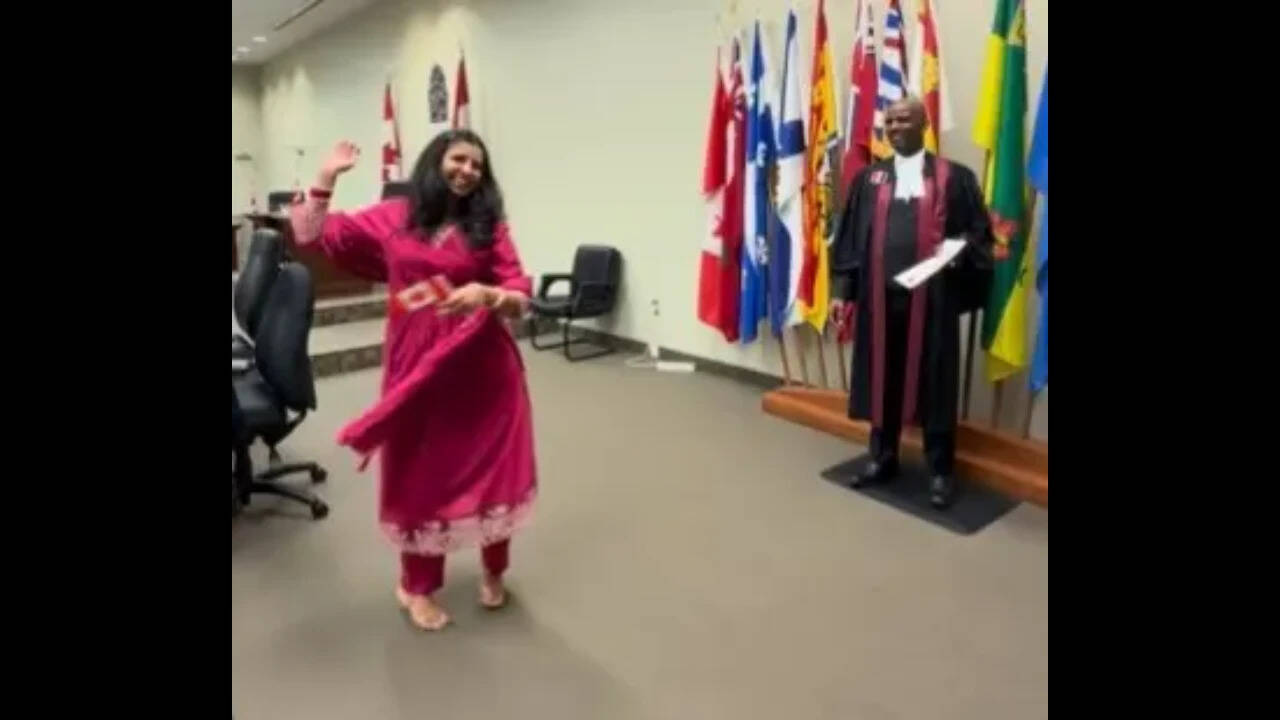
The viral reaction to a neo-citizen performing a Garba dance during a Canadian citizenship ceremony is not a simple instance of social media friction; it is a data point revealing the tension between multicultural integration policies and the perceived erosion of civic solemnity. This event exposes a growing divergence in how "citizenship" is valued by three distinct stakeholders: the immigrant, the host state, and the digital public. To understand why a 30-second dance triggered a global discourse on national identity, we must analyze the structural mechanisms of cultural signaling and the transactional nature of modern migration.
The Tripartite Friction of Modern Citizenship
Citizenship ceremonies function as a formal transition from alien status to sovereign membership. The backlash against the Garba performance suggests a breakdown in the Performative Contract of Naturalization. This contract operates on three specific layers of expectation:
- The Solemnity Expectation: Host populations often view citizenship as a hard-earned, sacred privilege. When a candidate introduces high-energy, ethnocentric cultural expression into a bureaucratic ritual, it creates a perceived mismatch in "gravity." The act is interpreted not as celebration, but as a devaluation of the host nation's primary civic identity.
- The Integration Signaling Paradox: Immigrants are expected to demonstrate "integration," yet modern liberal democracies like Canada explicitly promote "multiculturalism." The dancer likely viewed the act as a successful synthesis of her heritage and her new home. Critics, however, viewed it as a failure of assimilation, signaling that the individual's primary loyalty remains anchored to their country of origin rather than the new legal entity.
- The Digital Outrage Loop: Social media platforms serve as a global amphitheater where local events are stripped of context and weaponized by ideological groups. For those within India, the video becomes a tool for "brain drain" critiques; for those in Canada, it becomes a flashpoint for immigration policy debate.
The Economic Logic of Citizenship Arbitrage
The phrase "Indians doing everything to escape India" suggests a purely desperate exodus, but a rigorous analysis of migration data indicates a calculated Citizenship Arbitrage. Individuals are not merely "escaping"; they are optimizing their global mobility and economic security through a strategic swap of passports.
The "cost" of the Indian passport is measured in its limited visa-free access and the bureaucratic friction it imposes on global professionals. The Canadian passport, by contrast, represents a high-yield asset that provides:
- Unrestricted global mobility.
- Access to a social safety net funded by a different tax base.
- The "Plan B" security of a Western legal system while often maintaining professional or family ties to the Indian subcontinent.
The Garba performance, in this context, is seen by critics as "having one's cake and eating it too." The resentment stems from the perception that the individual is claiming the high-value benefits of Canadian citizenship while refusing to undergo the expected cultural dilution that historically accompanied such a transition. This creates a friction point in the "Cost Function of Identity," where the new citizen keeps 100% of their original cultural capital while gaining 100% of the new state's legal capital.
Mechanisms of Cultural Branding vs. Civic Identity
Host nations rely on a shared sense of "Civic Religion"—the idea that regardless of origin, all citizens adhere to a specific, unified set of behaviors in public spaces. When cultural branding (like Garba) supersedes civic ritual, it triggers a "System Error" in the observer’s mental model of national stability.
The Feedback Loop of Symbolic Displacement
The backlash is driven by a mechanism called Symbolic Displacement. Long-standing residents of the host nation observe the ceremony and see their own cultural norms being replaced or ignored.
- The Stimulus: A traditional Indian dance during a Western legal rite.
- The Interpretation: A signal that the host culture is no longer the "default" but merely one of many competing options.
- The Reaction: Hostility rooted in the fear that the social contract is being rewritten without their consent.
This displacement is exacerbated by the "Permanent Diaspora" phenomenon. In previous centuries, migration meant a physical and psychological severance from the homeland. Today, digital connectivity and high-frequency travel allow migrants to remain fully immersed in their original culture. The Garba move is a physical manifestation of this digital reality—the candidate is physically in a Canadian government building but psychologically and culturally in Gujarat.
The Architecture of the "Brain Drain" Narrative
Within the Indian domestic context, the reaction to the video is filtered through the lens of Human Capital Flight. The visceral anger from some Indian netizens reflects a collective insecurity regarding the country’s ability to retain its most ambitious citizens.
The "Escape India" narrative is a simplification of a complex Incentive Structure:
- Educational Mismatch: India produces millions of high-skill graduates for an economy that often lacks the institutional infrastructure to absorb them at Western-level wages.
- Quality of Life Delta: The desire for cleaner air, better infrastructure, and predictable legal outcomes outweighs nationalistic sentiment for a significant portion of the upwardly mobile middle class.
- The Status Tax: As more people from a specific social circle migrate, the "social cost" of staying in India increases, creating a snowball effect where migration becomes the expected status symbol of success.
When these individuals celebrate their departure with such visibility, it acts as a public rejection of the Indian state’s progress. The "flak" received is a defensive mechanism by those remaining, attempting to re-frame the exit as a betrayal or a shallow pursuit of "Westernization" to mitigate the sting of the talent loss.
Policy Implications and Social Cohesion
The Canadian government’s tolerance (or encouragement) of such displays is part of a deliberate Brand Strategy to attract global talent. Canada positions itself as the "Post-National State," where the traditional requirement of assimilation is replaced by a "mosaic" model.
However, this model has a structural vulnerability: it assumes that the host population will remain indefinitely tolerant of the dissolution of their own cultural dominance. The backlash to the ceremony indicates that the "Threshold of Tolerance" is being reached. When the ceremony—the very mechanism of becoming "one of us"—looks like a celebration of remaining "one of them," the utility of the citizenship ritual as a tool for social cohesion is compromised.
The primary bottleneck for future integration will not be economic, but semiotic. If the state cannot define what it means to be a citizen beyond "holding a piece of paper," the domestic population will increasingly view new arrivals as "economic tourists" rather than fellow stakeholders. This creates a fragmentation of the body politic, where different groups operate under different sets of cultural and civic rules, leading to a low-trust society.
Strategic Realignment of Migration Narratives
The current discourse is trapped in a binary of "celebration" versus "hate." A more sophisticated approach requires acknowledging the Transactional Reality of 21st-century migration.
Governments and institutions must recognize that:
- Civic Branding is Non-Negotiable: Ceremonies must maintain a high-friction, solemn atmosphere to preserve the perceived value of the "asset" (citizenship). Making it a casual or hyper-multicultural event reduces its psychological weight.
- Diaspora Management: Sending nations like India must shift from a "Brain Drain" grievance model to a "Global Network" model, accepting that mobility is a permanent feature of the modern professional class.
- The Digital Frontier: Public figures and influencers must realize that in a hyper-connected world, there is no such thing as a "local" ceremony. Every act is a global signal.
The path forward requires a rigorous re-imposition of civic standards that transcend ethnicity. If citizenship is to remain a cohesive force, the ritual of its acquisition must prioritize the Universal Civic Identity over the Particular Cultural Identity. Failure to maintain this hierarchy will only accelerate the polarization seen in the response to the Canadian ceremony, turning every act of individual celebration into a site of nationalistic conflict.
The strategic priority for host nations is the recalibration of the naturalization ritual to emphasize the adoption of the new social contract over the preservation of the old one. This is not a matter of cultural suppression but of Institutional Integrity. For the immigrant, the strategic play is the recognition that the "Citizenship Asset" is most valuable when its acquisition is seen as a legitimate, high-stakes merger rather than a low-effort acquisition.