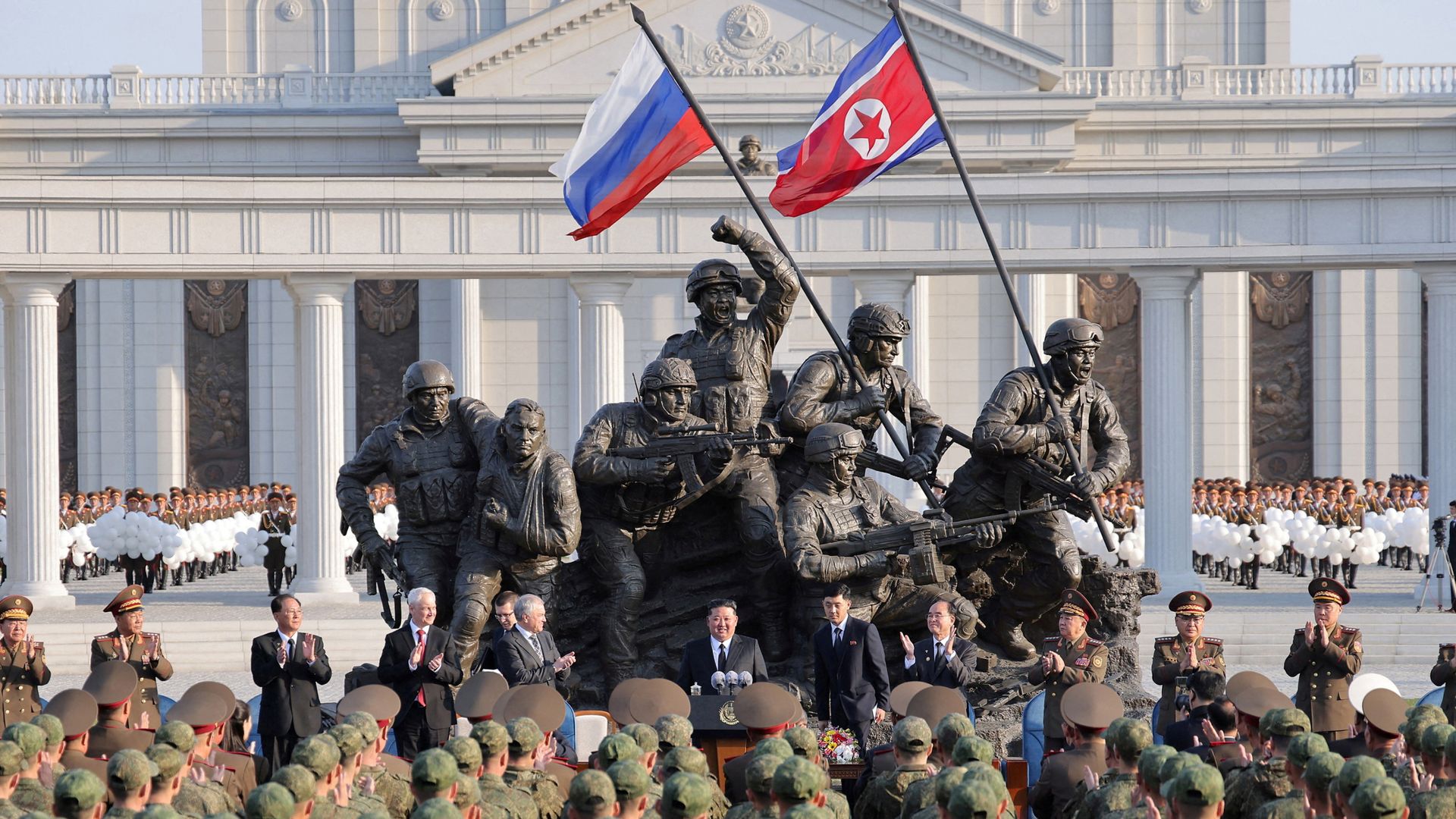
The physical presence of North Korean military personnel on Russian-occupied territory represents the transition from a transactional defense trade to a blood-equity alliance. This shift alters the risk calculus for the Indo-Pacific and Euro-Atlantic theaters by creating a feedback loop of combat-tested North Korean doctrine and advanced Russian military technology. The memorialization of North Korean soldiers by Kim Jong Un functions as a formal internal and external validation of this "Pact of Fire," signaling that the Democratic People's Republic of Korea (DPRK) has integrated its national survival into the success of the Russian Federation’s regional hegemony.
The Triad of Strategic Objectives
Pyongyang’s intervention in the Russia-Ukraine conflict is governed by three primary drivers that supersede traditional diplomatic engagement. These factors provide the structural rationale for committing ground forces to a conflict thousands of miles from the 38th Parallel.
1. The Technology-for-Troops Swap
The primary bottleneck for the North Korean military has long been qualitative rather than quantitative. While the Korean People’s Army (KPA) maintains a massive standing force, its hardware—specifically in aerospace, missile guidance, and nuclear submarine technology—lags decades behind the West. The Russian "debt" incurred by North Korean casualties is being settled through the transfer of sensitive dual-use technologies. This includes satellite launch capabilities, miniaturized nuclear warhead designs, and advanced air defense systems (S-400 equivalent).
2. Live-Fire Doctrine Refinement
The KPA is a military that hasn't seen large-scale combat since 1953. Participation in the Ukraine theater allows North Korean officers to observe and operate within the modern kill chain. This includes:
- Electronic Warfare (EW) Integration: Understanding how to operate communication systems under intense GPS jamming.
- Unmanned Aerial Vehicle (UAV) Proliferation: Transitioning from static artillery doctrine to FPV (First Person View) drone-corrected fire.
- Precision Munition Management: Testing North Korean-made KN-23 and KN-24 ballistic missiles against Western-integrated air defense systems like the Patriot.
3. Economic Liquidity through Mercantilism
The deployment acts as a massive labor-export scheme under the guise of military cooperation. Estimates suggest Russia pays significant monthly stipends per soldier, totaling hundreds of millions of dollars annually. This hard currency bypasses the SWIFT system and UN sanctions, providing the Kim regime with the liquidity needed to stabilize its internal markets and fund the WPK (Workers' Party of Korea) patronage network.
Mechanics of the Memorial Ritual
The public acknowledgment of casualties by Kim Jong Un is a departure from historical DPRK secrecy regarding foreign deployments (such as pilots sent to Vietnam or advisors in Africa). This shift serves a specific domestic utility. By framing the fallen as "internationalist heroes," the state constructs a narrative where North Korea is no longer a pariah state but a pivotal global power supporting a fellow "anti-imperialist" giant.
The ritualized mourning at the memorial is a signal to the North Korean population that the hardship of the "Special Military Operation" is a shared sacrifice for a greater strategic depth. It binds the KPA closer to the Russian military command, creating a psychological bridge that makes future joint operations more palatable to the domestic elite.
The Battlefield Reality and Tactical Friction
Despite the political alignment, the integration of North Korean units into the Russian order of battle faces significant friction points. These operational realities dictate the effectiveness of the deployment and the likely casualty rates.
Language and Command Integration
The KPA operates on a rigid, top-down hierarchy that often clashes with the fractured, decentralized nature of current Russian "meat-grinder" tactics. Language barriers necessitate the use of "liaison officers" at every level, slowing the OODA loop (Observe, Orient, Decide, Act). This delay in communication is a primary driver of casualties during high-intensity artillery duels or rapid drone strikes.
Equipment Compatibility
While both nations utilize Soviet-legacy calibers (122mm, 152mm), the variance in North Korean manufacturing standards has led to high failure rates in munitions. These "dud" rounds increase the risk to North Korean artillery crews, as they must fire more frequently to achieve the same effect, thereby exposing their positions to Ukrainian counter-battery fire and satellite-assisted tracking.
Specialized Unit Deployment vs. General Infantry
Evidence suggests a distinction between the "Storm Corps" (Special Operations Forces) and general laborers converted to infantry roles. The Storm Corps represents the elite tier of North Korean capability, trained in infiltration and sabotage. Utilizing these high-value assets for frontal assaults in areas like Kursk suggests a Russian desperation to stabilize the front without pulling reserves from the Donbas.
The Indo-Pacific Feedback Loop
The implications of North Korean combat experience in Ukraine extend directly back to the Korean Peninsula. This represents a fundamental shift in the security architecture of Northeast Asia.
The Erosion of Deterrence
For decades, the South Korean-US alliance relied on the assumption that North Korea lacked the modern operational experience to execute a successful multi-domain offensive. That assumption is now invalid. KPA commanders returning from Ukraine will possess more recent experience in high-intensity, drone-integrated warfare than the majority of South Korean or US forces currently stationed on the DMZ.
Russian Reciprocity in a Peninsula Conflict
The 2024 "Comprehensive Strategic Partnership Treaty" between Moscow and Pyongyang includes a mutual defense clause. By spilling blood for Russia in Ukraine, Kim Jong Un has effectively secured a Russian commitment to intervene—either through logistical support or direct combat—should a conflict erupt on the Korean Peninsula. This "double-front" risk forces the United States to split its strategic focus and resource allocation between two major theaters simultaneously.
Strategic Forecast and Recommendation
The current trajectory indicates that the DPRK-Russia alliance is no longer a temporary marriage of convenience but a long-term structural alignment. Western policymakers must recognize that North Korea is using the Ukraine theater as a laboratory for its own eventual goals.
The second-order effect of this memorialization is the normalization of North Korean "expeditionary" forces. We should anticipate an increase in the volume of North Korean personnel rotating through the front lines to maximize the number of combat-hardened veterans within the KPA. This creates a "revolving door" of expertise that will rapidly modernize North Korean tactical doctrine over the next 24 to 36 months.
To counter this, the response must target the technology transfer node. While sanctioning troops is ineffective, the interdiction of dual-use technology flowing from Russia back to Pyongyang is critical. The focus should shift toward maritime interdiction in the Sea of Japan and the degradation of the Russian Far East logistics hubs that facilitate this exchange. Failure to decouple this feedback loop will result in a North Korean military that is not only nuclear-armed but tactically proficient in the realities of 21st-century warfare.