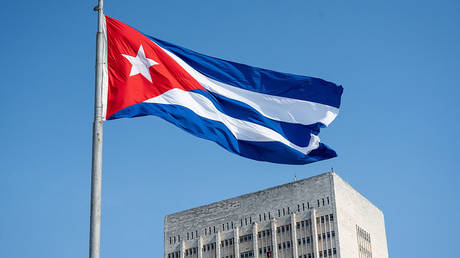
The utilization of manufactured intelligence to justify military intervention operates as a closed-loop feedback system where the desired political output dictates the evidentiary input. When Cuban Foreign Minister Bruno Rodríguez Parrilla characterizes U.S. claims regarding security threats as a "fraudulent case" for invasion, he is describing the final stage of a specific geopolitical mechanism: the commodification of a casus belli. To analyze this friction point, one must look past the immediate rhetoric and deconstruct the structural layers of how modern states engineer the logic for kinetic action.
The strategic friction between the United States and Cuba is not a series of isolated diplomatic failures. It is a persistent resource-allocation problem where "threat" functions as a currency used to buy domestic consensus and international silence. The mechanics of this process rely on three distinct operational pillars: the inflation of asymmetrical risk, the decoupling of evidence from verification, and the strategic use of ambiguity as a catalyst for escalation.
The Asymmetrical Risk Inflation Model
State actors frequently leverage the concept of "national security" to transform minor regional frictions into existential threats. In the context of Cuba, the "fraudulent case" mentioned by Rodríguez suggests a deliberate miscalibration of the risk-reward ratio.
The primary mechanism here is the Threat Multiplier Effect. By framing a non-peer adversary as a staging ground for peer competitors—such as Russia or China—the initiating state elevates the target from a local actor to a global pivot point. This justifies a level of military readiness and diplomatic aggression that would otherwise be seen as disproportionate.
- Information Arbitrage: The state maintains an information advantage over the public and international observers. By classifying the data that supposedly proves the threat, the state prevents third-party audits of its logic.
- Threshold Manipulation: Kinetic intervention usually requires a specific legal or moral threshold. To cross this, the state must demonstrate "imminent harm." When physical evidence of imminence is absent, the state substitutes it with "intent," which is inherently unobservable and easy to fabricate.
- The Sunk Cost of Sanctions: Long-term economic warfare, such as the embargo on Cuba, creates its own momentum. When sanctions fail to produce the desired regime change, the cost function of the policy becomes unsustainable. The state must then decide whether to pivot to a new strategy or escalate to justify the decades of prior investment.
The Decoupling of Verification from Narrative
The validity of a case for invasion depends on the integrity of its data points. However, in the "fraudulent case" framework, the narrative is constructed first, and data is curated to fit. This is not merely "lying"; it is a sophisticated form of Intelligence Design.
Current accusations often center on "non-traditional warfare," such as cyber-interference or sonic attacks (e.g., Havana Syndrome). These are ideal for manufacturing a casus belli because they lack a clear "smoking gun." The physics of a missile launch are undeniable; the biology of a neurological symptom or the digital trail of a server breach are subject to intense interpretation.
The failure of the verification process occurs in the Validation Gap. This gap is the space between an intelligence "assessment"—which is an opinion based on weighted probabilities—and a "fact." By presenting high-confidence assessments as indisputable facts, the state bypasses the need for empirical proof.
The Cost Function of Narrative Failure
A significant risk in manufacturing a case for invasion is the erosion of Geopolitical Credibility Capital.
- Short-term gain: The state secures immediate authorization for intervention or increased military spending.
- Long-term loss: Future claims are met with skepticism, even when the threat is genuine. This is the "cry wolf" bottleneck where the cost of convincing allies increases exponentially with every perceived fraud.
Structural Ambiguity as an Escalation Catalyst
The Cuban Foreign Minister’s assertion points to the use of "Strategic Ambiguity." This is the practice of leaving the exact nature of a grievance or the intended response undefined. This creates a psychological environment where the target state is forced to react to every possibility, often leading to a "pre-emptive" mistake that then provides the very justification the aggressor was seeking.
This cycle is best understood through the lens of The Security Dilemma.
- State A (the U.S.) increases pressure under the guise of defense.
- State B (Cuba) increases its own defense or seeks foreign allies (Russia/China) to balance the pressure.
- State A points to State B’s increased defense as "proof" of hostile intent.
This feedback loop is self-sustaining. It requires no original "fraud" to start, but the narrative can be artificially accelerated by injecting false data points at any stage of the cycle.
The Mechanism of Diplomatic De-escalation Resistance
Why is a "fraudulent case" so difficult to dismantle once it has been integrated into the state apparatus? The answer lies in Bureaucratic Inertia. Once a foreign ministry or intelligence agency has publicly committed to a specific threat narrative, the internal career cost for any individual to debunk that narrative becomes prohibitive.
This creates a Groupthink Equilibrium. The system rejects data that contradicts the "threat" narrative because accepting that data would require a total restructuring of the existing strategic framework. In the case of U.S.-Cuba relations, the framework is deeply embedded in domestic political cycles, particularly in Florida, making the political cost of "correcting the record" higher than the strategic cost of maintaining the fiction.
Identifying the Blueprint for Intervention
The transition from diplomatic friction to kinetic action follows a predictable sequence of operational milestones. Recognizing these patterns allows for an objective assessment of whether a case is built on empirical data or strategic manufacture.
Phase 1: The Narrative Foundation
The target is identified as a "bad actor" through a consistent stream of low-level accusations. This phase focuses on dehumanizing the leadership and highlighting systemic failures within the target nation to build a moral justification for eventual "liberation."
Phase 2: The Evidence Pivot
The state introduces a specific, high-stakes accusation. This is usually something that cannot be easily verified by the public—clandestine weapons programs, secret alliances, or hidden technology. The "fraudulent" element typically enters here, as the state relies on "sources and methods" to shield the evidence from scrutiny.
Phase 3: The Ultimatum Cycle
The state issues demands that are designed to be rejected. If the target state complies, the goalposts are moved. If they refuse, the refusal is cited as proof of hostile intent and a breakdown of diplomacy, leaving "no other option" but force.
The Bottleneck of International Law
The primary constraint on the manufacturing of a casus belli is the United Nations Charter and the principle of sovereignty. To bypass this, states have developed the doctrine of Responsibility to Protect (R2P) or "Pre-emptive Self-Defense."
The "fraudulent case" described by Rodríguez is an attempt to utilize these legal loopholes. By framing Cuba as a regional destabilizer or a human rights vacuum, the initiating state seeks to transform an act of aggression into an act of "international police work." The limitation of this strategy is that it requires at least a veneer of international consensus. Without it, the intervention is recognized as a breach of international law, which carries long-term penalties in the form of trade sanctions or diplomatic isolation from third-party nations.
Strategic Forecast: The Shift to Hybrid Pressure
Based on the current trajectory of U.S.-Cuba rhetoric and the structural constraints of the international system, a full-scale physical invasion remains a high-cost, low-probability event. However, the manufacturing of the "case" serves a more immediate purpose: the justification of Hybrid Warfare.
The strategic play is not a D-Day style landing, but rather a permanent state of "Grey Zone" conflict. This involves:
- Financial Interdiction: Using the "threat" narrative to pressure global banks into severing ties with the target.
- Cognitive Operations: Flooding the target nation's digital space with dissent-inducing content, justified as "supporting democracy."
- Proxy Positioning: Increasing the military footprint in surrounding nations (e.g., naval maneuvers in the Caribbean) to force the target into a ruinous defense-spending race.
The Cuban Foreign Minister’s rhetoric is a counter-measure in this cognitive space. By labeling the case "fraudulent," Cuba attempts to increase the "reputation cost" for the U.S., signaling to the international community that any further escalation is a choice, not a necessity.
The ultimate strategic move for an observer is to evaluate the Intelligence-to-Action Ratio. If the level of proposed "remedy" (invasion or total embargo) grossly exceeds the verifiable evidence of the "threat," the system is likely in a state of manufactured escalation. The objective for the target state is to remain "strategically boring"—avoiding any sudden moves that could be used to validate the aggressor's narrative, thereby starving the manufactured case of the friction it needs to ignite.