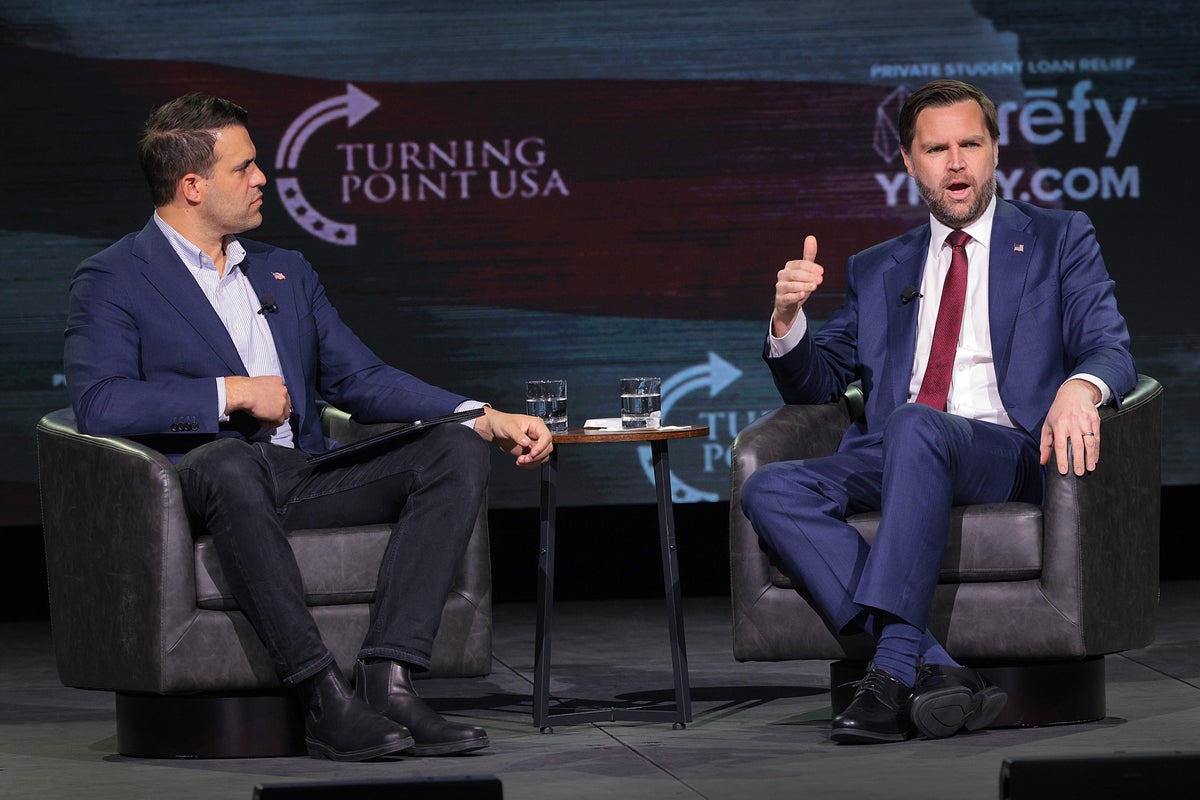
The tension between JD Vance and the Catholic hierarchy represents a fundamental shift in how political actors engage with religious institutions: the transition from deferential alignment to theological competition. When a political figure advises the Pope to "be careful" regarding theological pronouncements, they are not merely making a gaffe or courting controversy. They are asserting that the political platform—specifically a nationalistic, populist framework—serves as a more authentic interpreter of the faith than the clerical institution itself. This dynamic creates a structural conflict between two distinct power centers, each claiming moral and philosophical high ground over the same constituency.
The Mechanics of Institutional Dissent
To understand the friction at the Turning Point USA event, one must categorize the dissent through a framework of Institutional vs. Grassroots Legitimacy. Vance’s rhetoric suggests that the Vatican’s current trajectory, particularly regarding social justice and environmental stewardship, creates an "orthodoxy gap" for conservative believers.
This gap is defined by three primary friction points:
- Jurisdictional Overreach: The argument that the papacy has strayed from core dogma into the "cost functions" of global politics and climate science, areas where political leaders claim superior expertise or mandate.
- Constituency Realignment: The pivot of a specific religious demographic from institutional loyalty to ideological loyalty. In this model, the "brand" of Catholicism is separated from the "management" of the Vatican.
- The Heckler’s Veto as a Metric: The presence of hecklers at a low-turnout event serves as a leading indicator of internal fragmentation. While the media focuses on the noise, the analytical takeaway is the breakdown of the "Big Tent" conservative-religious alliance.
The Cost of Low-Turnout Engagement
The attendance figures at the TPUSA event provide a quantitative look at the limits of high-intensity, niche-messaging strategies. When a movement relies on a "Vanguard Model"—prioritizing the most fervent supporters over a broad base—it inevitably faces diminishing returns in physical turnout. Low attendance is not a failure of marketing; it is a signal of saturation.
In political strategy, a "saturated" audience has already been converted. Therefore, the marginal utility of a speech is zero. To expand, the speaker must pivot toward more moderate or diverse demographics, but doing so risks alienating the core. Vance’s decision to double down on theological critique indicates a strategic choice to prioritize Vertical Intensity (deepening the commitment of existing followers) over Horizontal Expansion (gaining new ones).
The Theology of National Interest
The specific critique leveled at the Pope—warning him to stay within a narrow definition of theology—relies on a Subsidiarity Framework. This Catholic social principle suggests that matters should be handled by the smallest, least centralized competent authority. Vance is effectively weaponizing a Church principle against the Church’s leader, arguing that the nation-state (and the family) should take precedence over globalist ecclesiastical directives.
This creates a logic loop:
- The Vatican issues a directive on global migration based on universal human dignity.
- The Populist Actor rejects this, citing the "higher" practical duty of the state to protect its own borders.
- The Result is a fragmented moral authority where the individual believer is forced to choose between the "Eternal City" and the "National Interest."
The risk for the politician is the Alienation Multiplier. While a specific subset of traditionalist Catholics might cheer a rebuke of the Pope, the broader "Cultural Catholic" demographic—a critical swing block in the Rust Belt—often retains a vestigial respect for the office of the papacy. Attacking the figurehead can trigger a defensive reflex that overrides political agreement.
Strategic Bottlenecks in the Populist-Religious Merger
The alliance between populist politics and religious traditionalism faces a significant structural bottleneck: The Problem of Infallibility. In a secular political environment, every platform is negotiable. In a theological environment, certain positions are framed as absolute. When JD Vance attempts to boundary-set for the Pope, he is engaging in a "Zero-Sum Sovereignty" game.
If the Pope is "wrong" on theology, the entire structure of Catholic authority is undermined. If the Pope is "right," then Vance’s political stance on issues like immigration or climate becomes morally untenable for a faithful adherent. There is no middle ground in this equation. The strategy currently employed is to narrow the definition of "theology" so significantly that the Pope is left with almost no room to speak on contemporary human affairs without being labeled "political."
This boundary-setting is a defensive maneuver designed to protect the political flank from moral critique. By preemptively labeling papal speech as "non-theological," the politician creates a psychological shield for the voter, allowing them to ignore the Vatican while maintaining their religious identity.
The Fragmentation of Conservative Media Ecosystems
The reaction to the TPUSA event illustrates the diverging incentive structures between legacy conservative media and the "New Right" digital ecosystem. Legacy outlets often view a low-turnout event or a controversial religious take as a liability. Conversely, the New Right views these as High-Fidelity Signal Tests.
For a strategist, the goal of such a speech is not to win the news cycle but to identify and solidify the "Core 10%." This 10% provides the volunteer hours, the small-dollar donations, and the social media amplification required to sustain a campaign. The "heckles" reported by the media are, in this context, an expected byproduct of a high-friction message. Friction generates heat, and heat indicates that the message is penetrating the target audience’s consciousness, even if it provokes a negative reaction from the non-target audience.
Quantitative Indicators of Influence
To measure the actual impact of this rhetorical shift, one must look beyond the room's attendance. The true metrics are:
- Digital Shareability: Did the "Be Careful" clip out-perform standard policy clips?
- Theological Search Trends: Is there an uptick in "Catholicism vs. Populism" or similar queries following the event?
- Donation Velocity: Does a "stand-off" with a major institution like the Vatican trigger a spike in contributions from the traditionalist base?
Historical data suggests that when a populist leader creates an "enemy" out of a global institution—whether it is the UN, the WHO, or the Vatican—it results in a short-term boost in internal cohesion at the expense of long-term diplomatic flexibility.
The Risk of the Theological Pivot
The most significant risk in Vance’s strategy is Orthodox Backfire. By inviting a debate on theology, a politician enters a domain where they lack institutional credentials. While a political leader can claim a mandate from the people, they cannot claim a mandate from a divine source without risking the charge of heresy or hubris.
The mechanism of failure here is the Clerical Rebound. If a significant number of bishops or influential clergy publicly refute the politician’s interpretation of theology, the "Orthodoxy Gap" closes, and the politician is left on the outside. This creates a strategic vulnerability where the opponent can frame the politician not just as a partisan, but as a dissident from their own claimed faith.
The Forecast: Institutional Decentralization
The long-term trajectory of this conflict suggests a permanent decentralization of religious influence in American politics. We are moving away from the era where a "priestly endorsement" carried weight. Instead, we are entering an era of Personalized Dogma, where political actors and their supporters assemble a "bespoke" faith that aligns with their nationalist or economic goals.
Vance’s warning to the Pope is the opening salvo in a campaign to redefine the Catholic voter as a "Political Nationalist first, Institutional Catholic second." This requires the systematic dismantling of the Vatican’s moral weight in the eyes of the American electorate.
The strategic play for any political actor in this space is to avoid direct theological debate and instead focus on the Institutional Incompetence narrative. Rather than telling a religious leader to "be careful with theology," a more effective maneuver is to highlight the gap between the institution's stated goals and its practical outcomes. However, by choosing the theological route, Vance has opted for a high-risk, high-reward strategy of ideological dominance.
The next tactical move for the Vance camp should be to anchor these critiques in specific, localized policy outcomes rather than broad theological warnings. To sustain this momentum, the campaign must transition from "warning" the institution to "replacing" the institution's role as the primary moral filter for its base. This involves creating parallel structures of community and "moral clarity" that do not rely on the traditional hierarchy. Failure to do so will leave the movement vulnerable to a traditionalist resurgence that views political populism as a shallow substitute for genuine faith.