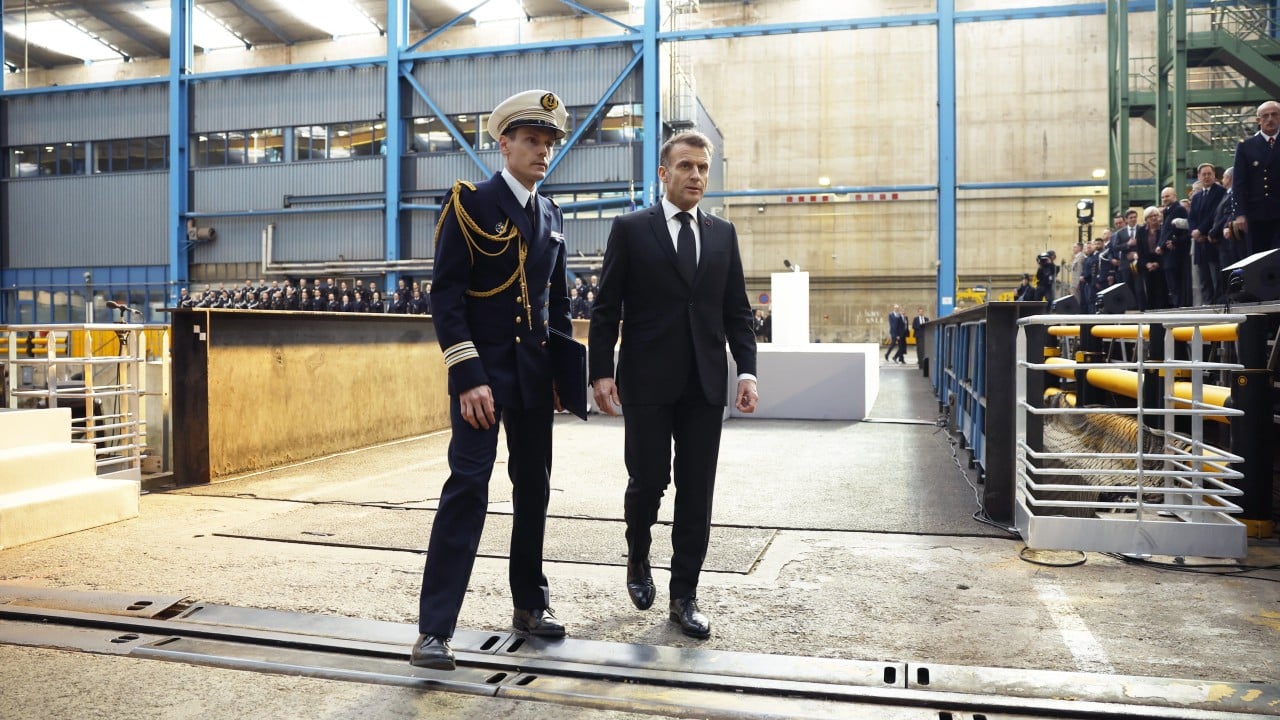
Emmanuel Macron just tossed a live hand grenade into the quiet halls of European diplomacy, and the smoke hasn't cleared. By suggesting that France is ready to open its nuclear umbrella to the rest of the European Union, the French President isn't just offering protection. He is effectively proposing a divorce from the American-led security order that has defined the continent since 1945. This isn't about mere military logistics; it is a fundamental play for the soul of European sovereignty that leaves Berlin shivering and Washington watching with a cold, narrowed eye.
The timing is far from accidental. With the American political machine grinding toward an election that could see a return to isolationism, Macron is betting that Europe is finally scared enough to listen. France remains the only EU power with its own atomic arsenal after Brexit. That gives Paris a unique, and some would say dangerous, leverage. For decades, the "Force de Frappe" was a strictly national affair, designed to protect French soil and nothing else. Now, Macron wants to turn that Gallic pride into a collective shield.
The Math of Deterrence
To understand why this is causing such a panic, you have to look at the cold numbers of the "Force de Frappe." France maintains a sea-based and air-based triad, currently consisting of roughly 290 nuclear warheads. It is a lean, mean machine compared to the thousands held by Russia or the United States, but it operates under a doctrine of "strict sufficiency." This means having just enough firepower to make any aggressor realize that the cost of an attack outweighs any possible gain.
The technical backbone of this strategy is the M51 submarine-launched ballistic missile. These are massive, multi-stage rockets launched from Triomphant-class submarines. Each missile can carry multiple independently targetable reentry vehicles (MIRVs), meaning one launch can strike several cities at once. Unlike the American warheads stationed in Germany or Italy, which require a "dual-key" system where the U.S. holds the final say, the French nukes are entirely under French control. There is no Washington veto.
Why Berlin is Terrified
The German reaction has been a mix of polite coughing and frantic behind-the-scenes signaling. For Germany, the American nuclear guarantee is the bedrock of their entire national identity. Trading a superpower’s protection for a mid-sized neighbor’s promise feels like a bad deal. There is also the "who pushes the button" problem. If a Russian tank rolls into Poland, would a French President really risk the total incineration of Paris to save Warsaw or Berlin?
Critics in the Bundestag argue that Macron’s offer is a trap. If Europe accepts a French nuclear lead, it must also accept French political leadership. It is a package deal. The French have always viewed European defense through the lens of strategic autonomy—a fancy way of saying "Europe for the Europeans, led by the French."
The Ghost in the Room
Russia is watching this play with intense interest. The Kremlin has long sought to drive a wedge between the U.S. and its European allies. By pushing for a European-only nuclear deterrent, Macron might be doing Moscow’s work for him. However, the counter-argument is that a multi-polar West is harder to bully. If Putin knows he has to deal with two separate, independent nuclear decision-makers—one in D.C. and one in Paris—the math of an invasion becomes infinitely more complex.
We have to consider the air-launched component as well. The ASMPA missile, carried by Rafale fighter jets, provides a "pre-strategic" warning shot. It is a terrifying concept. The idea is to detonate a low-yield nuclear device to signal to an enemy that they have crossed a red line and that full-scale city-leveling strikes are next. By offering to share this doctrine with allies, Macron is essentially asking them to join a suicide pact.
The Credibility Gap
Nuclear deterrence is entirely psychological. It only works if your enemy believes you will actually use the weapons. This is where the French offer hits a wall. The U.S. has spent 80 years proving its commitment to Europe through troop deployments, joint bases, and shared command structures. France has none of that infrastructure in place across the continent.
To make this offer credible, France would need to:
- Station nuclear-capable Rafale squadrons in Eastern Europe.
- Integrate allied officers into the French Strategic Air Forces command.
- Allow for a "Europeanized" planning process that currently only exists in Paris.
None of these things are currently on the table. Macron wants to provide the umbrella, but he wants to keep his hand firmly on the handle. This creates a paradox. For the offer to be effective, it must be shared; if it is shared, France loses the absolute sovereignty it cherishes above all else.
The Cost of Independence
Maintaining an independent nuclear force is an eye-watering expense. France spends billions every year modernizing its warheads and building the next generation of ballistic submarines (the SNLE 3G program). By bringing the rest of the EU under its wing, Paris might be looking for a way to socialize these costs. If Germany or the Netherlands start contributing to the "common defense," some of that money will inevitably flow into the French defense industry.
It is a brilliant bit of industrial policy disguised as high-level diplomacy. If Europe buys into the French nuclear dream, they aren't just buying protection; they are buying French tech, French missiles, and French submarines for the next fifty years.
A Continent Divided
The reaction across the rest of the continent has been split. The Baltic states and Poland, who live in the shadow of the Russian border, are the most skeptical. They don't want a "European" solution; they want more American boots on the ground. They view Macron’s talk as a dangerous distraction that might give the U.S. an excuse to leave.
Meanwhile, in Southern and Western Europe, there is more sympathy for the "strategic autonomy" argument. They see a world where the U.S. is increasingly focused on the Pacific and China, leaving Europe as a secondary theater. To them, Macron isn't a warmonger; he's a realist.
The Atomic Taboo
There is also the domestic political fallout to consider. In many European countries, particularly Germany and the Nordic states, "nuclear" is a dirty word. Proposing a massive expansion of nuclear cooperation is a political third rail. Macron is essentially asking European leaders to go to their voters and say, "We need to get more involved in planning for the end of the world." That is a tough sell in a climate dominated by inflation and green energy transitions.
The technology of these weapons is also evolving in ways that make "shared" deterrence harder. Hypersonic missiles and advanced missile defense systems mean that the window for decision-making is shrinking. In a world where a missile can reach a capital city in six minutes, there is no time for a committee meeting in Brussels to decide on a counter-strike.
The Shift in Strategy
What Macron is really doing is testing the fences. He knows that a fully integrated EU nuclear force is a decade—or more—away. But by making the offer now, he changes the conversation. He is moving the goalposts of what is considered "possible" in European defense.
This isn't just about bombs. It is about whether Europe can ever be a true power on the world stage without its own independent "big stick." Historically, no empire or superpower has ever outsourced its ultimate security to a distant ally and remained a top-tier player. Macron is betting that the era of the American protectorate is ending, whether Europe likes it or not.
The move forces every European capital to answer a brutal question: who do you trust more with your life—a distracted friend across the Atlantic, or a difficult neighbor across the Rhine?
If you want to see where the real power lies in this negotiation, watch the upcoming defense budget votes in Berlin. If the Germans start diverting funds toward "European" defense projects instead of American F-35s, Macron will have won his gamble. If they double down on U.S. hardware, the French nuclear offer will go down in history as just another piece of Parisian grandstanding that the world chose to ignore.
The board is set, the pieces are moving, and for the first time in generations, the nuclear question is wide open.