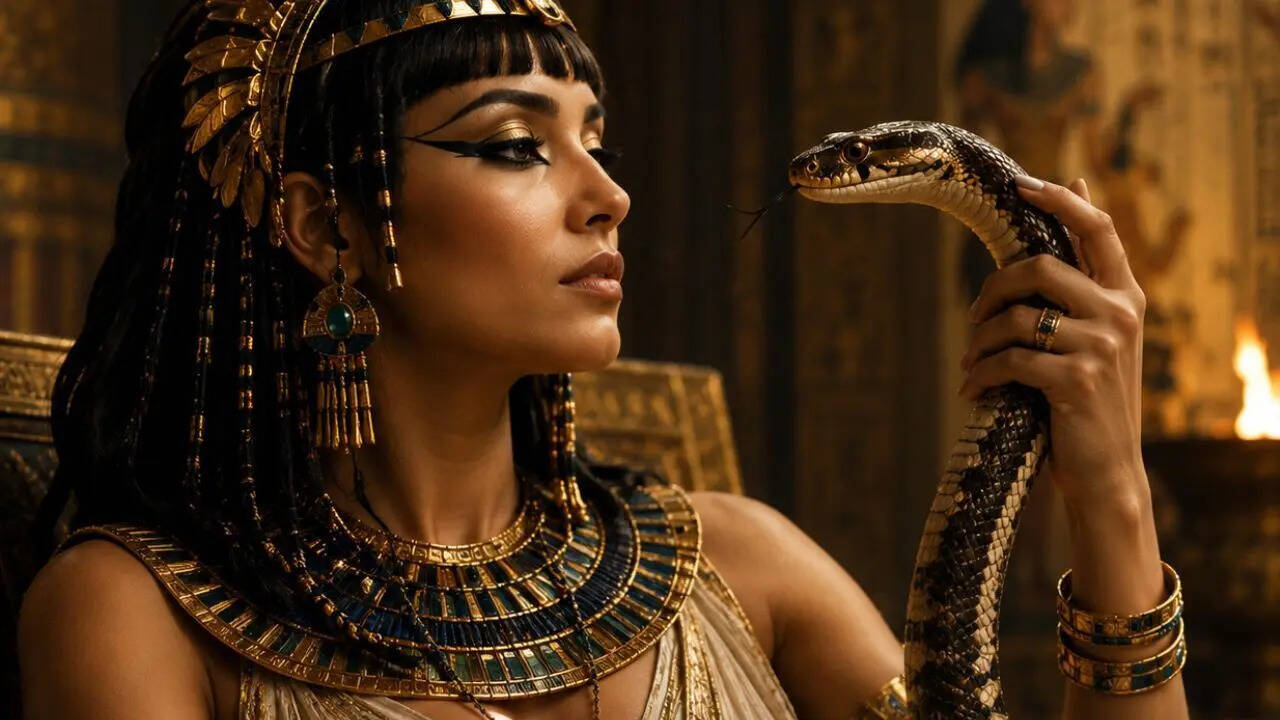
The collapse of the Ptolemaic dynasty in 30 BCE was not a romantic tragedy but a failed geopolitical gambit characterized by a catastrophic breakdown in diplomatic leverage and military logistics. While popular narratives focus on the sensationalism of an Egyptian cobra (Naja haje), a cold-logic audit of the historical and biological data suggests a high probability of systemic disinformation designed to consolidate Octavian’s narrative control over the Roman Empire. The death of Cleopatra VII represents the final liquidation of a sovereign state’s assets, and the "suicide by snake" account serves as a convenient mythological wrapper for a political execution or a calculated pharmacological exit.
The Logistics of the Asp Theory
The traditional account requires three variables to align perfectly: the successful smuggling of a venomous reptile into a high-security enclosure, the specific physiological reaction of the venom on the human nervous system, and the simultaneous death of two handmaidens, Iras and Charmion. When these variables are stress-tested against biological and situational constraints, the narrative begins to fragment.
The Biological Bottleneck
An Egyptian cobra typically measures between 1.5 and 2.5 meters. Concealing such an apex predator in a small basket of figs—as the legend claims—presents a significant physical constraint.
- Venom Efficiency: Cobra venom is a potent neurotoxin that disrupts the synaptic transmission of acetylcholine. However, a "dry bite," where the snake strikes without injecting venom, occurs in roughly 50% of defensive encounters. To guarantee the death of three adult humans within minutes would require the snake to deliver three consecutive, high-yield envenomations.
- The Latency Period: Neurotoxic death is rarely instantaneous. It involves progressive paralysis, respiratory distress, and a prolonged struggle for air. The Roman guards, stationed outside the mausoleum, reported finding Cleopatra in a state of "comatose elegance." This description contradicts the violent physiological reality of untreated cobra envenomation.
- The Multi-Target Problem: The assertion that one snake killed three people in rapid succession is statistically improbable. Snakes are not efficient serial killers; after one or two strikes, their venom glands are depleted, and their defensive behavior shifts toward escape rather than further combat.
The Pharmacological Alternative
If we discard the reptile as a logistical impossibility, the focus shifts to a sophisticated chemical solution. Cleopatra was a documented practitioner of early toxicology, having inherited the extensive libraries of the Musaeum of Alexandria. Her proximity to state-of-the-art chemical synthesis makes a concentrated toxic cocktail—likely a blend of hemlock, wolfsbane (aconite), and opium—the most probable mechanism of death.
The Synergistic Effect of a "Hollow Needle"
Contemporary historians, including Strabo, hinted at a "hollow comb" or a needle used to deliver a lethal dose directly into the bloodstream. This method bypasses the unpredictability of a snake bite and aligns with the following strategic requirements:
- Predictability: A pre-measured chemical dose ensures 100% lethality within a controlled timeframe.
- Aesthetics: Unlike the bruising and swelling associated with snake bites, certain plant-based toxins leave the skin relatively unmarked, preserving the Queen's image for her final public presentation.
- Efficiency: A needle allows for the rapid succession of deaths observed in Cleopatra and her attendants, something a single cobra could not achieve.
Geopolitical Motivations for the "Suicide" Narrative
To understand why the snake bite story persisted, one must analyze the incentive structure of Octavian (the future Emperor Augustus). He faced a delicate public relations crisis: he needed Cleopatra dead to eliminate her as a symbol of resistance, but he could not afford the optics of executing a female sovereign and mother of Caesar’s son.
The Triumph Constraint
In Roman political culture, a general’s "Triumph" reached its apex when the defeated monarch was paraded in chains. If Octavian had ordered her execution, he risked turning her into a martyr and alienating his eastern subjects. If she committed suicide via a traditional Roman method (like falling on a sword), she would have been seen as having achieved a soldier's honor.
The snake bite provided a perfect synthesis for Roman propaganda:
- Orientalism: The snake associated Cleopatra with "exotic" and "primitive" Egyptian mysticism, reinforcing the Roman narrative of her as an alien seductress rather than a legitimate political actor.
- Divinity: For the Egyptian populace, the cobra (Uraeus) was a symbol of royalty and the goddess Wadjet. By claiming death by snake, Cleopatra—or those writing her history—ensured her deification in the eyes of the locals, preventing a post-conquest uprising.
- The Clean Hands Doctrine: Octavian could claim he tried to keep her alive for his triumph, but she outsmarted him. This "regretful" stance allowed him to seize her kingdom while maintaining the moral high ground.
The Liquidation of the Ptolemaic Estate
Cleopatra’s death was the final act in a series of failed debt-leveraging maneuvers. The Ptolemaic Kingdom had been a client state of Rome for generations, largely through the "Rome as a Creditor" model. Cleopatra attempted to pivot this relationship from subordination to partnership by aligning herself first with Julius Caesar and then Mark Antony.
The Failure of the Antony-Cleopatra Joint Venture
The Battle of Actium (31 BCE) was the decisive market correction. Antony’s inability to coordinate his naval forces with Cleopatra’s logistical support led to a total loss of naval superiority. Following the retreat to Alexandria, the "Antony-Cleopatra" entity was essentially insolvent.
The primary strategic error was the reliance on a "dual-monarchy" system that lacked a unified command structure. Roman soldiers under Antony were culturally averse to taking orders from an Egyptian queen, creating internal friction that Octavian exploited through a highly effective psychological warfare campaign.
The Forensic Evidence Gap
The lack of a physical body prevents modern DNA or toxicological verification. Cleopatra and Antony were purportedly buried together in a tomb that has since been lost to the rising Mediterranean tides and seismic activity in the Alexandria harbor. Without the remains, historians are forced to rely on the "Octavian-controlled" literary record.
The Disappearance of Caesarion
The most critical evidence of Octavian’s ruthlessness is not the death of Cleopatra, but the systematic elimination of Caesarion (Ptolemy XV). As the biological son of Julius Caesar, Caesarion represented a direct threat to Octavian’s claim as Caesar’s sole heir. The mantra "Two Caesars are one too many" drove Octavian’s policy. While Cleopatra’s death was allowed to be portrayed as a mystic suicide, Caesarion’s death was a cold, calculated state execution.
The Strategic Reality of the Final Days
Cleopatra spent her final weeks conducting "stress tests" on various poisons using condemned prisoners. This fact, recorded by Plutarch, suggests her approach was entirely empirical. She was not looking for a "meaningful" death; she was looking for a "painless" one.
The choice of the mausoleum as the site of her final stand was a move of financial leverage. By sequestering herself with the vast Ptolemaic treasury and threatening to burn it all, she attempted to negotiate terms with Octavian. Once Octavian secured the gold, Cleopatra lost her only remaining bargaining chip. Her death followed almost immediately after the treasury was seized.
The snake bite narrative is a masterpiece of spin, transforming a failed asset liquidation and a probable pharmacological suicide into an eternal myth.
For the modern analyst, the lesson is clear: when a historical event perfectly serves the PR needs of the victor while defying biological probability, the narrative is a manufactured product. The "Asp" was not a snake; it was a political tool used to bury the complexity of the Ptolemaic collapse under a layer of digestible, exotic symbolism.
The only viable move in this geopolitical endgame was the erasure of the Ptolemaic line to clear the path for the Roman Principate. Any investigation into the Queen's death must treat the snake as a metaphorical variable rather than a biological fact. To understand the fall of Egypt, follow the gold and the lineage, not the scales.


