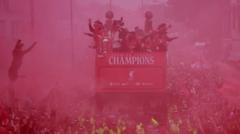
Public safety in high-density urban environments is not a matter of luck but a function of throughput capacity versus real-time demand. The 2022 Liverpool Football Club (LFC) victory parade, which resulted in 147 reported injuries prior to the subsequent "Doyle incident," serves as a critical case study in the breakdown of crowd management dynamics. While media narratives often focus on the emotional intensity of such events, a structural analysis reveals that the injuries were the predictable output of a system where the physical constraints of the city were overwhelmed by unmanaged human flow.
The Kinematics of Crowd Turbulence
Crowd injuries in a celebratory context are rarely the result of "stampedes"—a term that implies a conscious flight from danger. Instead, they are the result of crowd turbulence or "crazing." When crowd density exceeds four people per square meter, individual autonomy vanishes. At six people per square meter, the crowd begins to behave like a fluid.
The 147 injuries recorded at the LFC parade occurred within this fluid state. In this environment, a single trip or a localized push creates a "shockwave" that propagates through the mass. Because the density is so high, the force of these waves is additive. The mechanism of injury in these scenarios is typically compressive asphyxiation or blunt force trauma from being pressed against hard perimeters, such as security barriers or building facades.
The Three Pillars of Event Failure
To understand why the medical tents were overwhelmed before the primary security breach occurred, we must categorize the failure into three distinct operational domains:
- Topological Constraints: The physical geography of the parade route. Liverpool’s narrow Victorian-era corridors create natural "bottlenecks." When a moving attraction (the bus) passes through these points, it creates a vacuum effect behind it and a pressure front ahead of it.
- Information Asymmetry: The lag between real-time density spikes and the command center’s ability to redirect flow. If stewards on the ground cannot communicate the "feel" of the pressure before it becomes a medical emergency, the response is always reactive rather than preventative.
- The Persistence of Presence: Unlike a stadium event where fans depart after a whistle, a parade encourages "static accumulation." Fans arrive early to secure a spot and refuse to move, even when the density becomes dangerous, because the perceived value of their position outweighs their personal safety assessment.
Quantifying the Medical Burden
The 147 injuries are not merely a statistic; they represent a failure of the "Safe Capacity" calculation. Standard safety protocols, such as those outlined in the Green Guide (the Guide to Safety at Sports Grounds), utilize a formula to determine how many people a space can hold. However, these formulas often fail to account for the "Dynamic Load" of a moving parade.
The Cost Function of Crowd Management
The resource allocation for the parade was predicated on a static expectation of behavior. When the reality shifted—due to higher-than-anticipated turnout and the "Doyle incident" which exacerbated existing tensions—the cost function of the event shifted from "Maintenance" to "Crisis Intervention."
- Primary Care Inflation: Minor injuries (fainting, dehydration, small lacerations) occupy medical staff, reducing their ability to respond to "Category 1" life-threatening incidents.
- Access Point Blockage: High density doesn't just cause injuries; it prevents the extraction of the injured. In several instances during the LFC parade, emergency vehicles were physically unable to penetrate the crowd, forcing medical personnel to operate in "austere conditions" within the mass.
Structural Bottlenecks and the Doyle Incident Correlation
The report detailing the 147 injuries identifies a timeline where the system was already at a breaking point before the major security lapse involving the "Doyle incident." This suggests that the latter was not an isolated spark but a symptom of a system that had already lost its "Structural Integrity."
When a crowd is already under high physical stress, its psychological threshold for panic is significantly lowered. The "Doyle incident" acted as a force multiplier. Because the crowd was already at peak density, there was no "buffer zone" to absorb the shock of a security breach. This led to a cascade effect where the initial 147 injuries likely spiked as the crowd attempted to move away from a perceived threat in a space that had zero remaining capacity.
The Problem with Permeability
A major flaw in the strategy was the lack of "Pressure Relief Valves." In modern crowd science, large gatherings must have designated "empty zones" where people can be funneled if density reaches critical levels. The LFC parade route was largely impermeable. Fences and buildings acted as "Hard Boundaries."
- Hard Boundaries: Create "Reflection Waves." When a crowd moves toward a wall and cannot go through it, the energy reflects back into the incoming crowd, doubling the pressure.
- Soft Boundaries: Such as open parkland or wide plazas, allow for "Dissipation." The injury count suggests the route relied too heavily on Hard Boundaries.
Implementing Predictive Modeling for Future Triumphs
To prevent a recurrence, the logic of parade planning must shift from "Volume Management" to "Flow Dynamics." The reliance on historical attendance data is a fallacy because it does not account for the "Sentiment Intensity" of a specific win or the social media-driven "Flash Mob" effect that can swell numbers in minutes.
The Buffer Zone Strategy
Future events of this scale must incorporate "Staged Entry" and "Active Diversion." By using digital signage and real-time mobile alerts, organizers can shift the "Load Balance" of the city. If Section A is at 90% capacity, the system must automatically redirect incoming flows to Section B, even if Section B offers a less "optimal" view of the bus.
The limitation of this strategy is the "Human Factor." Fans are not rational actors in a moment of sporting euphoria. They are driven by "Proximity Bias." Therefore, physical barriers must be designed to be "frangible"—they should hold under normal pressure but collapse safely if a crowd crush begins, preventing the compressive asphyxiation that occurs against rigid steel.
The medical data from the LFC parade serves as a definitive warning. The 147 injuries were the "Leading Indicators" of a systemic collapse. If the density had been managed through algorithmic flow control rather than static stewarding, the Doyle incident would have remained a localized security issue rather than a catalyst for a near-catastrophe.
The immediate tactical requirement for municipal authorities is the implementation of "LIDAR-based Density Monitoring" at all major transit nodes leading to the parade route. By measuring the rate of arrival at the train stations and comparing it to the "Exit Capacity" of the parade viewing areas, organizers can trigger "Gate-Capping" protocols two hours before the crowd reaches critical mass. Safety is a calculation of space over time; if the time to clear a section exceeds the rate of arrival, the event must be halted or diverted immediately to preserve the life-safety of the participants.


.png)