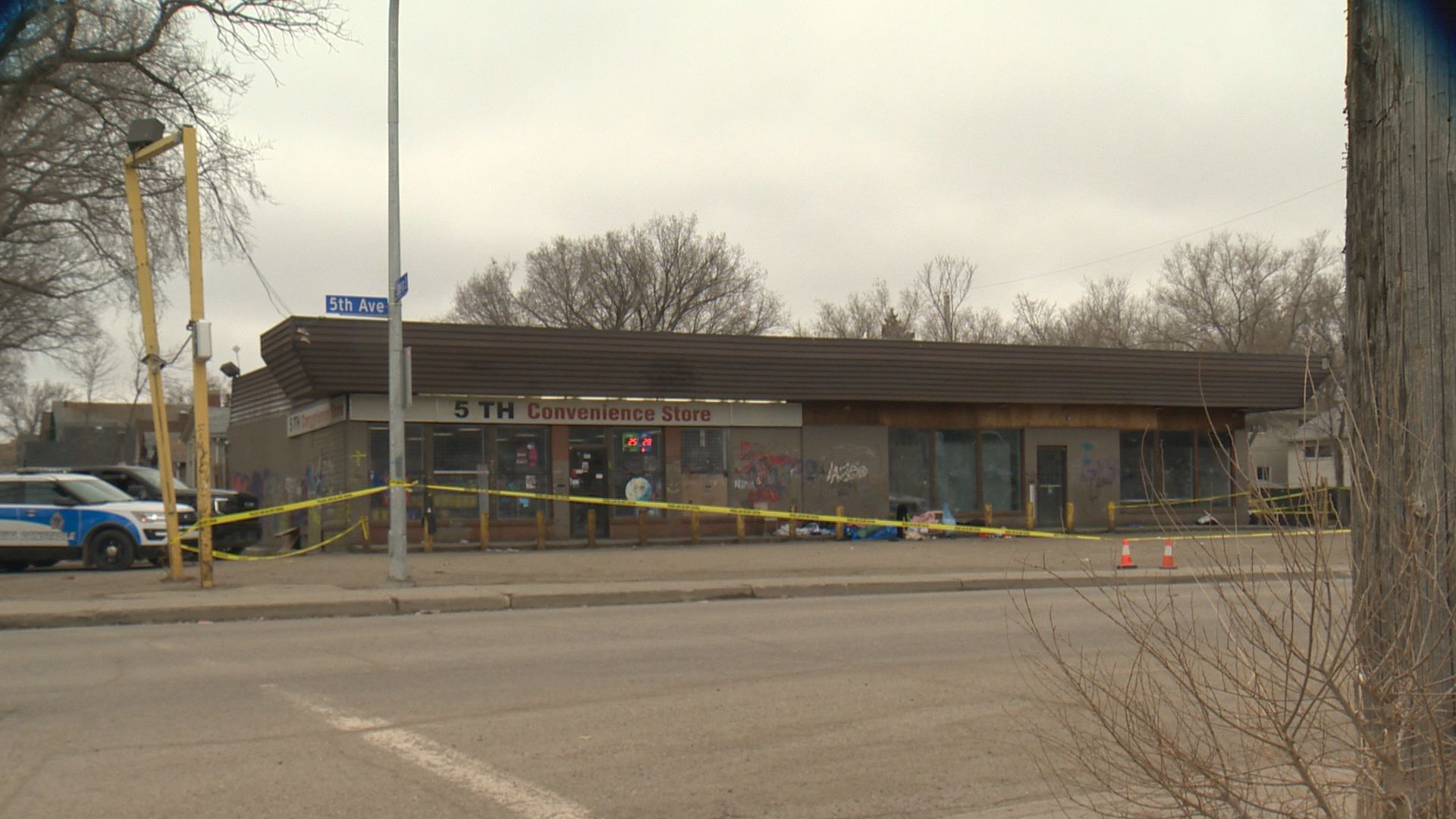
The concrete in downtown Regina doesn’t hold onto much. It’s a city built on the flat, wide expanse of the prairies, a place where the wind usually sweeps away the echoes of a Friday night before the sun even touches the horizon. But on a specific stretch near the 1800 block of Scarth Street, the silence that followed the early hours of a recent Saturday was different. It wasn’t the quiet of a sleeping city. It was the heavy, suffocating stillness that follows a sudden, violent rupture in the social fabric.
Crime reports are usually written in the cold ink of police shorthand. They tell us about "the accused," "the victim," and the "geographic coordinates." They strip away the humidity of the air, the smell of street-level exhaust, and the frantic heartbeat of a witness calling 911. What they miss is the human gravity of a life ending on a sidewalk and the long, agonizing shadow that follows.
The Midnight Boundary
Imagine the scene at 1:50 a.m. The bars are beginning to exhale their crowds. Most people are thinking about nothing more than the cold walk to their car or where to find a late-night slice of pizza. Then, a confrontation. It doesn’t take much. A misunderstood look, a bumped shoulder, or a word spoken in the wrong tone. In this instance, the Regina Police Service arrived to find a 21-year-old man, his life leaking out onto the pavement.
The officers performed CPR. They fought the inevitable with their hands and their training. But there is a point where the physical body simply gives up. He was pronounced dead at the hospital, leaving behind a hole in a family and a community that no press release can adequately measure.
Blood washes off the street eventually. The yellow tape is rolled up and tucked into the trunk of a cruiser. But for the people who live and work in the downtown core, the map of their city has been permanently altered. That corner is no longer just a corner. It is a landmark of loss.
The Weight of the Charge
By Monday, the legal machinery had begun its slow, deliberate grind. Police announced they had arrested a 25-year-old man. The charge is second-degree murder.
To the casual observer, the distinction between first and second degree might feel like a legal technicality, a nuance for the courtroom. It isn't. It is the difference between a calculated, premeditated act and an intentional killing that lacks that cold-blooded planning. It suggests a moment where a situation spiraled out of control, where a choice was made in the heat of a second that can never be unmade.
Twenty-five years old.
That is the age of the man now facing a life sentence. It is an age of starting careers, of making mistakes you can usually fix, of navigating the transition into true adulthood. Now, his life is defined by a single night on Scarth Street. When we talk about the statistics of violent crime in Saskatchewan, we often forget that these numbers are made of people who were, just hours before, someone’s son, someone’s friend, someone’s neighbor.
The Invisible Stakes
Why does a killing in a downtown core feel so different from a tragedy in a private home?
It’s because it violates the unspoken contract we have with our city. We agree to share these spaces—the parks, the sidewalks, the storefronts—under the assumption of mutual safety. When that safety is shattered, it creates a ripple effect of communal trauma. The office worker who walks that route every morning now feels a tightening in their chest. The restaurant owner nearby looks out the window and wonders if the foot traffic will return.
Public safety isn't just about the absence of crime. It’s about the presence of trust.
The investigation into this death involved more than just patrol officers. It required the Major Crimes Unit, the Forensic Identification Unit, and the Coroner’s Office. These are the people who sift through the debris of a tragedy to find a narrative that a judge can understand. They look at blood spatter, security footage, and witness statements, trying to reconstruct a minute of chaos into a coherent timeline.
While they work, the rest of the city moves on, but the questions linger. We find ourselves asking what led two young men to that specific point in time. Was it a systemic failure? A lack of mental health support? A culture that increasingly defaults to violence as a solution? Or was it simply the darkest confluence of bad luck and worse decisions?
The Courtroom and the Ghost
The accused made his first appearance in Provincial Court. These proceedings are often brief, almost mundane. There is a reading of charges, a discussion of legal counsel, and a setting of future dates. The atmosphere is sterile, smells of floor wax, and is dictated by rigid protocol.
It is the polar opposite of the chaotic, visceral reality of Scarth Street at 2:00 a.m.
In that courtroom, the 21-year-old victim is a name on a file. But back on the streets, he is a ghost. He is the reason a mother is currently staring at a bedroom that will never be occupied again. He is the reason a group of friends is gathered in a living room, speaking in hushed tones, trying to make sense of a world that suddenly feels much smaller and more dangerous.
We often look for a "why" that will satisfy us. We want a motive that makes sense so we can tell ourselves it couldn't happen to us. If it was a robbery, we can be more careful with our wallets. If it was a long-standing feud, we can take comfort in our own peaceful relationships. But when the details are murky and the violence feels sudden, the fear is harder to contain.
The Cost of a Moment
The legal process for a second-degree murder charge is a marathon, not a sprint. There will be preliminary hearings, evidence disclosures, and eventually, a trial. The 25-year-old accused will sit in a box, and his life will be dissected by lawyers. Every choice he made leading up to that night will be scrutinized.
But no matter the verdict, the outcome for the city is already settled.
Regina is a city that prides itself on being a "big small town." It’s a place where you expect to run into someone you know at the grocery store. That intimacy is a double-edged sword. When a tragedy like this happens, the degrees of separation are paper-thin. Someone knew the victim. Someone went to high school with the accused. The pain is localized, but it is intense.
The sirens that tore through the downtown air on Saturday morning have long since faded. The police have moved on to the next call, the next file, the next crisis. Yet, the echo remains for those who are paying attention. It’s an echo that reminds us that beneath the surface of our daily routines, there is a fragility we rarely acknowledge.
We walk the same sidewalks. We breathe the same prairie air. And sometimes, in the darkest part of the night, the thin line between a normal evening and a life-shattering tragedy simply disappears.
The street is open again. People are walking past the 1800 block of Scarth Street, their eyes fixed on their phones or the horizon. They step over the invisible mark where a life ended, unaware that the ground beneath them still carries the weight of a story that ended far too soon.