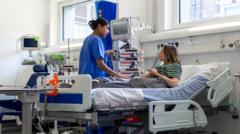
The plastic clock on the wall of the waiting room doesn't tick. It hums. It is a low, persistent vibration that seems to sync with the anxiety of the twenty people staring at a muted television screen. Among them is a man we will call Owen. He is sixty-four, a former steelworker from Port Talbot, and he has been waiting for a new hip for seven hundred days.
Owen isn't just a statistic in a government briefing. He is a person whose world has shrunk to the distance between his armchair and the kettle. Every morning, he checks the mail, hoping for the letter that will tell him his life can begin again. Every morning, the letter doesn’t arrive.
This is the reality of the Welsh NHS as it hurtles toward a defining election. The spreadsheets in Cardiff Bay tell a story of missed targets and budgetary constraints. But Owen’s life tells the story of the human cost of a system that is running out of time.
The Math of Human Misery
The numbers coming out of the Welsh Government are staggering, yet they often feel strangely hollow when stripped of context. Currently, the list of people waiting for non-urgent treatment in Wales has swelled to nearly 800,000. To put that in perspective, that is roughly one in every four people in the country.
The Welsh Government set a bold ambition: to eliminate two-year waits for most treatments by the spring. It was a line in the sand. A promise made to the public to prove that the post-pandemic recovery was finally gaining traction. But as the election draws near, that line is being washed away by a tide of reality.
Behind these targets lies a brutal logistical puzzle. You cannot simply "clear" a backlog when the front door of the hospital is jammed. When social care is underfunded, elderly patients who are medically fit to leave cannot go home because there is no one to help them wash or eat. They stay in hospital beds—"bed blocking" is the cold term—which means Owen’s surgical bed isn't free. The gears of the machine are grinding against one another until they smoke.
The Invisible Stakes of the Ballot Box
Politics usually feels like something that happens to other people. It is a series of debates on a screen, a flurry of leaflets through the door, and a collection of slogans that rarely survive the first frost. This time, the stakes are different. This election isn't about ideology in the abstract; it is about the physical survival of a national institution.
The Welsh NHS has become the central battlefield. Opposition parties point to the fact that waiting times in Wales are significantly longer than those in England. They argue that the Labour-led government has managed the budget poorly. The government counters by pointing to the "crumbling" infrastructure and a decade of Westminster-imposed austerity that has left them trying to build a skyscraper with a handful of rusted nails.
But for the voter standing in the booth, the question isn't who is to blame. The question is who can make the humming clock in the waiting room move again.
Consider the "hidden wait." This is the time between realizing something is wrong and actually getting onto the official waiting list. It is the weeks spent trying to get a GP appointment, the months spent waiting for a diagnostic scan, and the further months spent waiting for the consultant to sign the paperwork. By the time a patient like Owen is "officially" waiting, he has already been suffering for a year.
A System Breathing Through a Straw
To understand why the targets are slipping, you have to look at the people holding the system together.
Imagine a nurse named Sian. She works a twelve-hour shift in a hospital in the Rhondda. She hasn't had a full lunch break in three weeks. Sian is the one who has to look Owen in the eye and tell him his surgery has been cancelled for the third time because an emergency trauma case took the last available theater slot.
The staff are exhausted. They are leaving the profession in numbers that should terrify anyone who plans on getting old. When a nurse leaves, the remaining staff have to work harder, leading to more burnout, which leads to more resignations. It is a feedback loop of fatigue.
The government’s failure to meet its targets isn't just a failure of policy. It is a failure of capacity. You can't perform more surgeries if you don't have enough scrub nurses. You can't reduce outpatient waits if your consultants are retiring early to avoid pension tax traps.
The Welsh NHS is trying to run a marathon while breathing through a straw.
The Cost of the Wait
We often talk about waiting lists as if they are static things, like a queue at a supermarket. But health isn't static. While Owen waits for his hip, his other leg begins to fail because it is overcompensating. His mental health deteriorates because he can no longer walk his dog or see his grandchildren. He becomes depressed. He gains weight. He develops high blood pressure.
By the time the state finally gets around to fixing his hip, Owen is a much sicker man than he was two years ago. The surgery becomes more risky. The recovery takes longer. The cost to the taxpayer actually increases.
This is the Great Irony of the backlog. By delaying care to save money in the short term, the system ensures that it will spend far more in the long term. It is a form of debt—a biological deficit that must eventually be paid.
The Ghost of Aneurin Bevan
In Wales, the NHS is more than a public service. It is a matter of national identity. It was born here, the brainchild of Aneurin Bevan, the son of a Tredegar miner. There is a deep, cultural pride in the idea that care should be free at the point of need.
But pride doesn't perform cataracts surgeries.
The upcoming election will force a conversation that many in Wales have been avoiding: is the current model sustainable? Can a nation with an aging population and a struggling economy continue to provide everything for everyone, everywhere, all at once?
The political rhetoric will be fierce. There will be promises of "record investment" and "transformative reform." There will be claims that the "targets will be met by next year." But for those on the front lines, these words feel increasingly like echoes in an empty hall.
The reality is that there is no magic wand. Fixing the Welsh NHS requires a generational shift in how we think about health. It requires shifting the focus from treating the sick to keeping people well. It requires a social care system that is integrated so tightly with the medical system that they function as a single organism.
The Silent Majority
While the politicians argue and the journalists analyze the latest data drops, the silent majority continues to wait.
They are the young mothers waiting for mental health assessments. They are the teenagers waiting for scoliosis surgery. They are the pensioners like Owen, sitting in their armchairs, watching the mail slot.
The failure to meet waiting list targets isn't just a political embarrassment. It is a breach of the social contract. We pay our taxes with the understanding that when we fall, the state will be there to catch us. When that safety net develops holes large enough for thousands of people to fall through, the very foundation of society begins to tremble.
Owen doesn't care about the election. He doesn't care about the ministerial briefings or the bar charts on the news. He just wants to walk to the end of his street without crying.
He looks at the calendar on his fridge. It is marked with dates that have come and gone. Consultations that were rescheduled. Pre-op assessments that led to nothing. It is a calendar of broken promises.
The sun sets over the Welsh valleys, casting long shadows across the rows of terraced houses. In thousands of those houses, people are preparing for another night of pain, another night of wondering if their turn will ever come. The humming clock continues its steady, indifferent vibration. The election is coming, but for those trapped in the amber of the waiting list, time has already stopped.