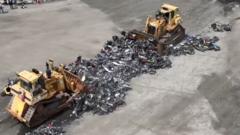
The sound of twisting metal and shattering plastic under a bulldozer’s treads provides the perfect soundtrack for a political press conference. In New York City, the recurring spectacle of hundreds of illegal motorbikes, mopeds, and ATVs being ground into scrap metal is presented as a definitive victory for public safety. It is a loud, visual promise of order restored to chaotic streets. But beneath the optics of the heavy machinery, the city is struggling with a much deeper problem that a bulldozer cannot solve. The sheer volume of these seizures—thousands per year—points to a massive, unregulated shadow economy that thrives on the friction between rapid delivery demands and outdated urban infrastructure.
New York’s crackdown targets a specific class of vehicle. These are the unregistered dirt bikes, quads, and "ghost" mopeds that lack license plates and insurance. For the NYPD, these machines are tools of criminality, used for everything from reckless stunts on the FDR Drive to quick-escape getaway vehicles for phone snatchings and drive-by shootings. For the public, they are a constant, high-decibel nuisance. Yet, the supply of these vehicles is virtually bottomless. As soon as five hundred bikes are crushed in a Queens impound lot, five hundred more appear on the streets of Upper Manhattan and the Bronx within a week.
The Economics of the Ghost Moped
The city is currently flooded with cheap, uncertified electric and gas-powered bikes that exist in a legal gray zone. They are often imported as "toys" or "parts" to bypass Department of Transportation safety standards. Once they hit the pavement, they become the primary tools for the city’s massive delivery workforce.
Most delivery apps do not provide vehicles to their contractors. This creates a desperate market for the cheapest possible transportation. A gas-powered moped that can be bought for $600 cash in a basement shop in Flushing is an irresistible proposition for a worker earning sub-minimum wage after expenses. These bikes aren't registered because, in many cases, they cannot be registered; they lack the necessary VINs or safety certifications required by the DMV.
When the police seize these bikes, they aren't just taking a vehicle; they are disrupting a fragile economic chain. However, because the bikes are so inexpensive, they are essentially disposable. The "crush" is a tax on the poor and the reckless, but it isn't a deterrent to the importers or the platforms that profit from the speed these bikes provide.
Why the Bulldozer is a Blunt Instrument
Publicly destroying property is an ancient tactic of governance. It is designed to humiliate the offender and reassure the observer. But as an enforcement strategy, it ignores the mechanical reality of how these vehicles enter the city.
The NYPD focuses on the end-user. Officers conduct "precision sweeps," often netting dozens of bikes in a single afternoon. While this removes immediate threats from the road, it does nothing to stem the tide of sales. If the city were serious about ending the "ghost bike" era, the focus would shift from the asphalt to the storefronts and the shipping containers.
The Regulatory Gap
There is a glaring lack of oversight regarding who can sell these vehicles and to whom. In New York, you can walk into a storefront and buy a bike that is clearly intended for road use, even if it lacks the hardware to be street-legal. The burden of legality is placed entirely on the rider the moment they pull out of the shop.
- Retailers operate with near-impunity, selling uncertified lithium-ion batteries and non-compliant frames.
- Import loopholes allow crates of "off-road" vehicles to enter ports, knowing full well they will be used on city sidewalks.
- Platform accountability is non-existent; delivery apps do not verify if the moped a worker uses is insured or registered.
By the time the bulldozer arrives, the city has already lost the battle. The money has been made, the illegal transit has occurred, and the replacement bike is already on its way from a warehouse in New Jersey or a shipping hub in Long Island City.
The Safety Risk of the Scrap Heap
There is a technical danger to these mass-crushing events that rarely makes the highlight reel. Many of the bikes seized are electric, powered by volatile lithium-ion batteries. These batteries have been responsible for hundreds of fires in New York apartments, causing dozens of deaths.
When the city bulldozes these bikes, they must first ensure the batteries are removed. If they aren't, the crushing process could trigger massive chemical fires. This adds a layer of expensive, dangerous labor to the process of "destroying" the problem. It turns a simple photo-op into a hazardous waste management project.
The city is essentially running a massive, taxpayer-funded recycling program for illegal imports. We pay the police to seize them, pay workers to strip the batteries, pay for the heavy equipment to crush them, and then sell the scrap metal for a fraction of the cost of the operation. It is a circular economy of waste.
Moving Beyond the Spectacle
If New York wants to actually clear the streets, it has to stop treating the symptoms. A hard-hitting approach would involve a multi-agency task force that targets the distribution networks.
Instead of waiting for a moped to blow a red light, the city could implement a strict licensing requirement for retailers. Any shop caught selling a non-compliant vehicle for road use should face immediate closure and heavy fines. Furthermore, the delivery giants—the companies actually driving the demand for these bikes—should be held liable. If a delivery is made on an unregistered, uninsured "ghost" moped, the platform should be fined, not just the rider.
The current system is a theater of frustration. The public is frustrated by the noise and danger. The police are frustrated by the endless supply of offenders. The riders are frustrated by the loss of their livelihoods.
The Real Cost of Order
We are currently spending millions of dollars on a recurring ritual that has no measurable impact on the total number of illegal bikes in circulation. It is a performance of power in an era where power is increasingly decentralized. The "wild west" of New York's streets isn't being tamed; it’s just being rearranged.
The bulldozer is a relic of 20th-century policing. It treats a complex, tech-driven logistical problem as a simple matter of debris removal. Until the city addresses the economic incentives that make these bikes a necessity for thousands of workers and a goldmine for unregulated importers, the metal will keep piling up.
The next time you see a pile of bikes being flattened on the news, look past the sparks and the shattered plastic. You aren't watching a solution. You are watching the city spend its own resources to destroy the evidence of a failed regulatory system.
Stop focusing on the bikes. Start focusing on the bills of lading.